Periodicity of Discount time Signal Problem 06
TL;DR
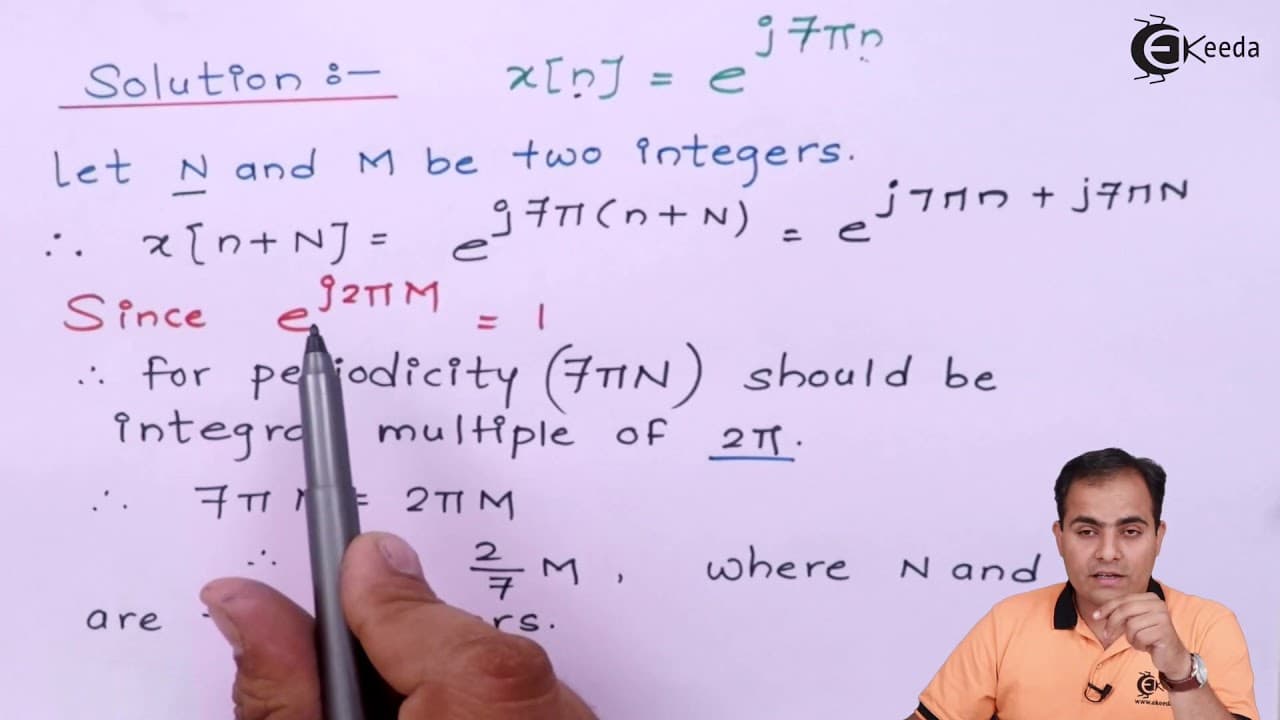
This video explains how to determine if an exponential function is periodic and find its fundamental period.
Transcript
click the bell icon to get latest videos from Ikeda hello friends and this is the last numerical to find out the periodicity of discrete-time signal as I told you this numerical is little bit different compared to previous one in previous cases we have used or we have selected a cause functions or sine functions but now in this case the function is... Read More
Key Insights
- ✊ Exponential functions can be periodic if the power of the exponential is an integer multiple of 2pi.
- ❓ By comparing the exponential function to a multiple of 2pi, the periodicity can be determined.
- 🤶 The formula for finding the fundamental period of an exponential function is n = 2/7 * M, where M is an integer.
- 🪜 The delay added to the function helps in analyzing the behavior and periodicity.
- 🌎 The derived formula shows that the value of n increases by 2 for M values of 7, 14, 21, etc.
- 🎮 The video provides an alternative method to find the periodicity of exponential functions.
- ❓ The periodicity of an exponential function can be represented by its fundamental period.
Install to Summarize YouTube Videos and Get Transcripts
Explore YouTube Video Summarizer or Get YouTube Transcript Extractor
Questions & Answers
Q: How can we determine if an exponential function is periodic?
To check for periodicity, we add a delay to the function and compare it to a multiple of 2pi. If the power of the exponential is an integer multiple of 2pi, then the function is periodic.
Q: What is the formula for finding the fundamental period of an exponential function?
The formula is n = 2/7 * M, where M is an integer. By substituting different values of M, we can find the corresponding values of n and determine the fundamental period.
Q: Can you explain how the delay is added to the exponential function?
The delay is added by introducing a variable n in the function, making it X(n+n). This delay shifts the function and helps in determining its periodicity.
Q: Is there a specific range for M values in the derived formula?
No, there is no specific range for M. Any integer value of M can be substituted in the formula to find the corresponding value of n and determine the fundamental period.
Summary & Key Takeaways
-
The video discusses how to check if a given exponential function is periodic and how to find its fundamental period.
-
By adding a delay to the function and comparing it to a multiple of 2pi, it can be determined if the function is periodic.
-
The formula for finding the fundamental period is derived as n = 2/7 * M, where M is an integer.
Read in Other Languages (beta)
Share This Summary 📚
Summarize YouTube Videos and Get Video Transcripts with 1-Click
Try YouTube Summary with ChatGPT & Claude or YouTube Transcript Generator
Explore More Summaries from Ekeeda 📚




Summarize YouTube Videos and Get Video Transcripts with 1-Click
Try YouTube Summary with ChatGPT & Claude or YouTube Transcript Generator