Review of revenue and cost graphs for a monopoly | Microeconomics | Khan Academy
TL;DR
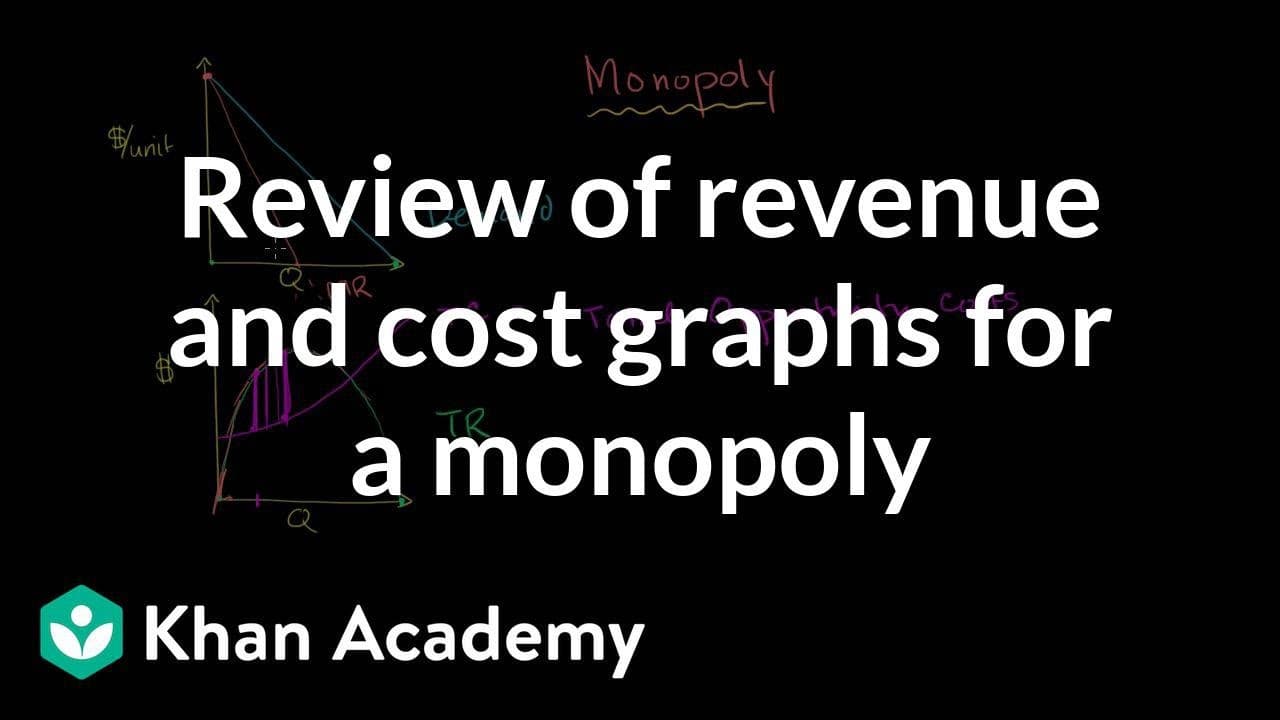
This video explains how monopolies can maximize profit by determining the point at which marginal revenue equals marginal cost, and visualizes economic profit using graphs and curves.
Transcript
- [Instructor] What I want to do in this video is review a little bit of what we've learned about monopolies and, in the process, get a better understanding for some of the graphical representations, which we have talked about in the past, but I wanna put it all together in this video here. So let's say that the industry that we are in, the demand ... Read More
Key Insights
- 😫 Monopolies have the power to control prices and maximize profit by setting the quantity at which marginal revenue equals marginal cost.
- 🇨🇷 Total revenue and total cost curves can be used to visually represent the revenue and cost aspects of a monopoly's operation.
- 🇨🇷 The concept of opportunity cost is important in understanding total cost in a monopoly.
- 🇨🇷 Graphical analysis, including marginal revenue, marginal cost, and average total cost curves, can help identify the optimal quantity for profit maximization.
- 🇨🇷 Economic profit in a monopoly is determined by the difference between total revenue and total cost.
- 🪚 Sustainable economic profits can be maintained in a monopoly due to barriers to entry that prevent competition.
- 🇦🇪 The height of the rectangle between the average total cost and demand curve represents economic profit on a per unit basis.
Install to Summarize YouTube Videos and Get Transcripts
Explore YouTube Video Summarizer or Get YouTube Transcript Extractor
Questions & Answers
Q: What is the relationship between quantity, total revenue, and economic profit in a monopoly?
In a monopoly, as quantity increases, total revenue initially increases, reaches a maximum point, and then starts to decrease. Economic profit is the difference between total revenue and total cost, and it maximizes at the quantity where marginal revenue equals marginal cost.
Q: How can the concept of opportunity cost be represented in a monopoly's total cost curve?
The total cost curve in a monopoly represents the total opportunity cost, which includes both explicit costs (expenses) and implicit costs (foregone alternatives). It shows how costs increase as quantity increases, indicating the resources used for production.
Q: How can marginal revenue and marginal cost curves help in maximizing profit for a monopoly?
Marginal revenue and marginal cost curves can help a monopoly determine the quantity at which they should produce to maximize profit. By finding the point where marginal revenue equals marginal cost, the monopoly can avoid producing units that would lead to lower profit due to higher costs.
Q: Why does the distance between the total revenue and total cost curves affect economic profit?
The distance between the total revenue and total cost curves represents the gap between revenue and cost per unit. A larger gap indicates a higher economic profit, while a shrinking gap indicates decreasing profit. Maximizing profit requires finding the point where the gap is the largest.
Summary & Key Takeaways
-
Monopolies have the ability to control the market and set prices.
-
To maximize profit, monopolies need to find the quantity at which marginal revenue equals marginal cost.
-
Economic profit can be visualized using graphs and curves, such as the total revenue curve, total cost curve, and average total cost curve.
Read in Other Languages (beta)
Share This Summary 📚
Summarize YouTube Videos and Get Video Transcripts with 1-Click
Try YouTube Summary with ChatGPT & Claude or YouTube Transcript Generator
Explore More Summaries from Khan Academy 📚



Summarize YouTube Videos and Get Video Transcripts with 1-Click
Try YouTube Summary with ChatGPT & Claude or YouTube Transcript Generator