RC step response 2 of 3 solve
TL;DR
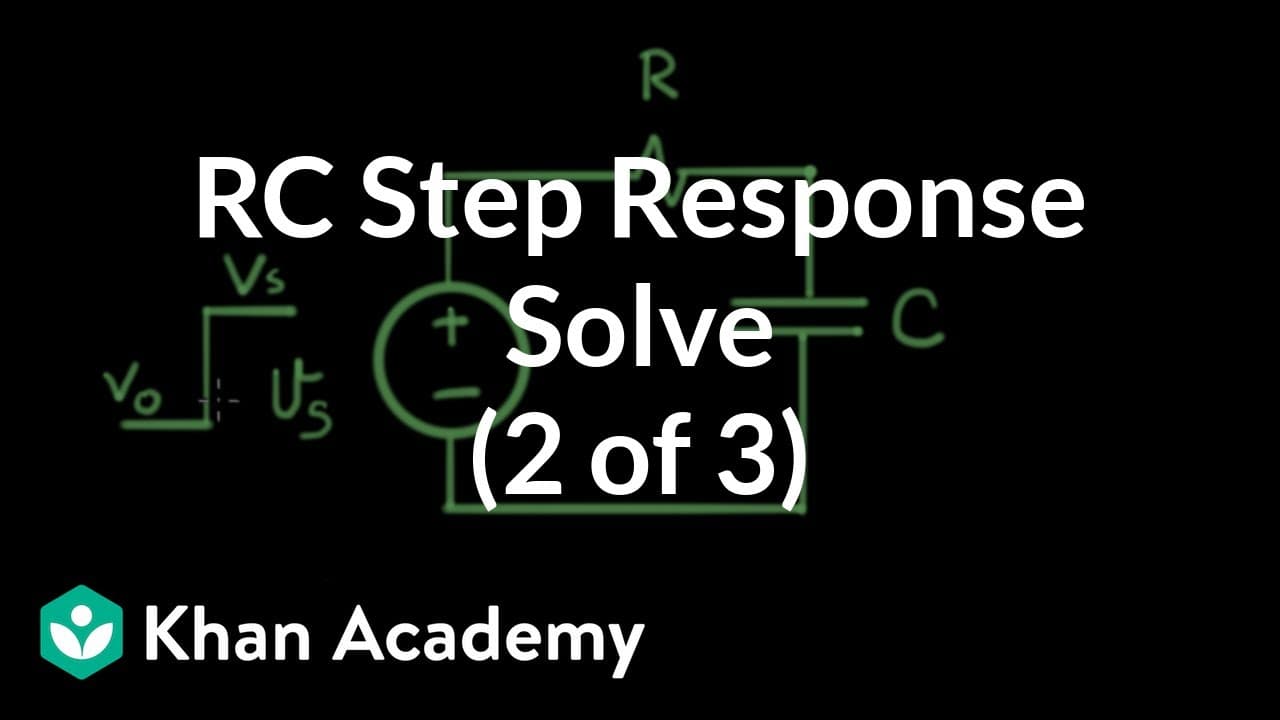
This video explains how to solve an RC circuit's natural and forced responses by setting initial conditions and manipulating the circuit.
Transcript
- [Voiceover] In the last video on step response, we set up the differential equation that describes our circuit, and we found that it was a non-homogeneous equation, and now we're gonna follow through on the strategy of solving it with a forced response plus a natural response. So here's two copies of our circuit, and we're gonna, on the top one h... Read More
Key Insights
- 😫 The natural response of an RC circuit is obtained by setting initial conditions and removing the input voltage source.
- 🔠 The forced response of an RC circuit is found by assuming a guess for the forced response function, similar to the input, and solving the resulting differential equation.
- 🪜 The total response of an RC circuit is obtained by adding the natural and forced responses together using the principle of superposition.
Install to Summarize YouTube Videos and Get Transcripts
Explore YouTube Video Summarizer or Get YouTube Transcript Extractor
Questions & Answers
Q: How is the natural response of an RC circuit solved?
The natural response is solved by setting the initial conditions, which involve the charge on the capacitor and suppressing the input voltage source. The natural response equation is k times e to the power of (-t / RC).
Q: What is the approach for solving the forced response of an RC circuit?
The forced response is solved by assuming a guess for the forced response function, which is typically similar to the input voltage source. This guess is then plugged into the differential equation, simplified, and solved for the constant term, resulting in the forced response being equal to the input voltage.
Q: How is the total response of an RC circuit obtained?
The total response is obtained by adding the natural response and the forced response together. This is achieved by using the principle of superposition, where the constants for each response are determined separately and then combined.
Q: How can the value of the constant for the natural response be determined?
The value of the constant for the natural response can be determined by setting the total voltage at a specific time, usually t=0, equal to the initial voltage on the capacitor. The constant is then solved for using this equation.
Summary & Key Takeaways
-
The video discusses solving the natural response of an RC circuit by setting initial conditions and removing the input voltage source.
-
It explores solving the forced response of the circuit by assuming a guess based on the input and plugging it into the differential equation.
-
The video then demonstrates combining the natural and forced responses to obtain the total response of the circuit.
Read in Other Languages (beta)
Share This Summary 📚
Summarize YouTube Videos and Get Video Transcripts with 1-Click
Try YouTube Summary with ChatGPT & Claude or YouTube Transcript Generator
Explore More Summaries from Khan Academy 📚



Summarize YouTube Videos and Get Video Transcripts with 1-Click
Try YouTube Summary with ChatGPT & Claude or YouTube Transcript Generator