Recognizing linear functions | Linear equations and functions | 8th grade | Khan Academy
TL;DR
Linear functions have a constant change in y for every change in x, while non-linear functions do not.
Transcript
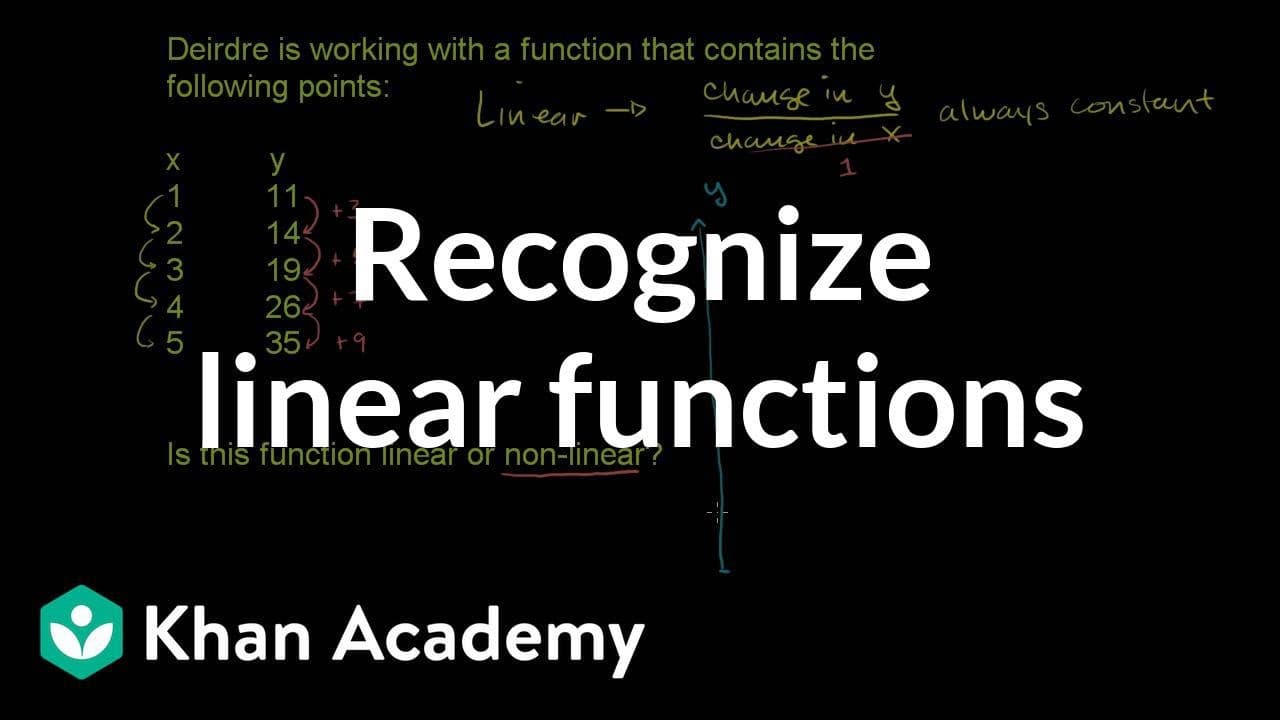
Deirdre is working with a function that contains the following points. These are the x values, these are y values. They ask us, is this function linear or non-linear? So linear functions, the way to tell them is for any given change in x, is the change in y always going to be the same value. For example, for any one-step change in x, is the change ... Read More
Key Insights
- 💱 Linear functions have a constant rate of change in y for every change in x.
- 💱 Non-linear functions have varying rates of change in y for different changes in x.
- 💱 Dividing the change in y by the change in x helps identify linear or non-linear functions.
- 📈 Graphing the function can provide a visual representation of its linearity.
- 💱 The given function is non-linear because the change in y increases with each change in x.
- 🫥 Linear functions have points that form a straight line on a graph.
- 🫥 Non-linear functions may have points that do not form a straight line on a graph.
Install to Summarize YouTube Videos and Get Transcripts
Explore YouTube Video Summarizer or Get YouTube Transcript Extractor
Questions & Answers
Q: How can you determine if a function is linear or non-linear?
By checking if the change in y for each change in x is always the same. If it is constant, the function is linear. If it varies, the function is non-linear.
Q: What is the significance of the change in y divided by the change in x?
Dividing the change in y by the change in x helps determine if the function has a constant rate of change. If the quotient is always the same, the function is linear.
Q: Can you give an example of a linear function?
Yes, a linear function could be y = 2x + 3, where for every increase of 1 in x, y increases by 2.
Q: How does graphing the function help determine linearity?
Plotting the points on a graph helps visualize the relationship between x and y. If the points form a straight line, the function is linear. If they do not, the function is non-linear.
Summary & Key Takeaways
-
Linear functions have a consistent change in y for every change in x, while non-linear functions do not.
-
To determine if a function is linear, divide the change in y by the change in x and check if it is a constant value.
-
In the given example, the function is non-linear because the change in y increases with each change in x.
Read in Other Languages (beta)
Share This Summary 📚
Summarize YouTube Videos and Get Video Transcripts with 1-Click
Try YouTube Summary with ChatGPT & Claude or YouTube Transcript Generator
Explore More Summaries from Khan Academy 📚



Summarize YouTube Videos and Get Video Transcripts with 1-Click
Try YouTube Summary with ChatGPT & Claude or YouTube Transcript Generator