Bringing a Collaborative Math Strategy Online
TL;DR
A teacher and student share a strategy called "Try It, Talk It, Color It, Check It" to enhance student engagement, collaboration, and learning in virtual classrooms.
Transcript
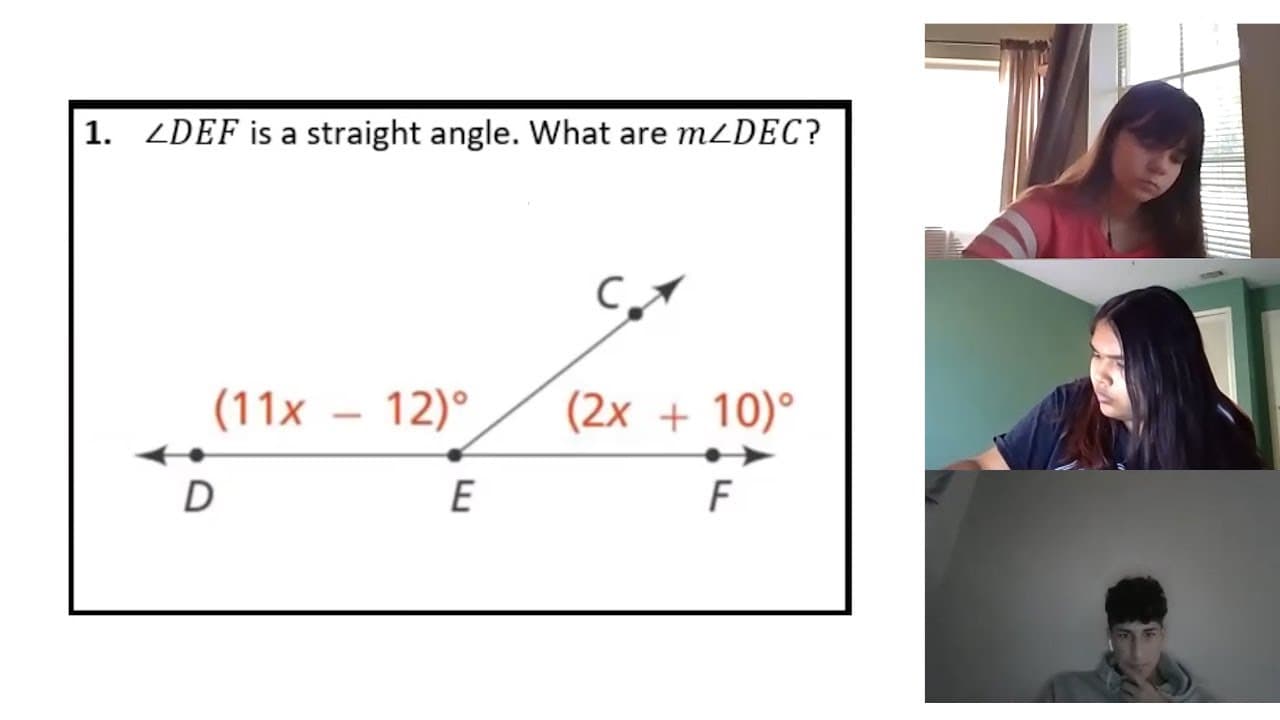
Teacher: Terry, could you explain to me why you set it equal to 90? Student: In the bottom, you can see it has the square right there showing that it's a right angle. Teacher: Great job. I love that you noticed that because... Ashley: One of the challenges in virtual learning was student voice. It took a whole new level of courage for a stude... Read More
Key Insights
- 🧑🎓 Virtual learning presents challenges for student engagement and teacher-student interaction.
- 🤳 The "Try It, Talk It, Color It, Check It" strategy encourages independent problem-solving, math discussions, self-assessment, and peer sharing.
- 🧑🎓 The inclusion of conversation prompts in virtual breakout rooms enhances math discussions among students.
- 😒 The use of sticky notes in the "Color It" step allows for quick, formative assessment of student understanding.
- 🧑🎓 The "Check It" phase provides an opportunity for students to explain their strategies and for teachers to evaluate student confidence levels.
- ❓ The strategy not only focuses on finding the correct answer but also emphasizes the process and collaborative learning.
- 🤔 By implementing this strategy, teachers can gain deeper insights into students' mathematical thinking and foster a supportive virtual learning environment.
Install to Summarize YouTube Videos and Get Transcripts
Explore YouTube Video Summarizer or Get YouTube Transcript Extractor
Questions & Answers
Q: What is the "Try It, Talk It, Color It, Check It" strategy?
This strategy involves four steps aimed at increasing student engagement and collaboration. It starts with students trying to solve problems independently, followed by math discussions in breakout rooms, using sticky notes to indicate confidence levels, and concluding with explaining strategies and verifying answers.
Q: How does the "Talk It" step address challenges in virtual learning?
The "Talk It" step provides a platform for students to discuss math even in a virtual setting. Conversation prompts help students get to know each other and engage in meaningful discussions about their problem-solving approaches.
Q: How does the "Color It" step aid in assessment?
By using sticky notes with different colors to indicate confidence levels, teachers can quickly assess students' understanding and identify areas where additional support may be needed. The colors serve as a snapshot of student learning during this step.
Q: What is the purpose of the "Check It" phase?
During the "Check It" phase, students explain their strategies and answers to their peers. This phase allows teachers to assess students' confidence levels and provides an opportunity for students to learn from one another's problem-solving approaches.
Summary & Key Takeaways
-
The "Try It" step allows students to work on problems independently and develop questions.
-
The "Talk It" step takes place in virtual breakout rooms with conversation prompts to facilitate math discussions.
-
In the "Color It" step, students use sticky notes to indicate their confidence level, providing a quick assessment. The "Check It" step allows students to explain their strategies and verify their answers.
Read in Other Languages (beta)
Share This Summary 📚
Summarize YouTube Videos and Get Video Transcripts with 1-Click
Try YouTube Summary with ChatGPT & Claude or YouTube Transcript Generator
Explore More Summaries from Edutopia 📚





Summarize YouTube Videos and Get Video Transcripts with 1-Click
Try YouTube Summary with ChatGPT & Claude or YouTube Transcript Generator