Just a chat about SQL and NoSQL and DynamoDB
TL;DR
Comparing SQL and NoSQL highlights the pros and cons of each database type.
Transcript
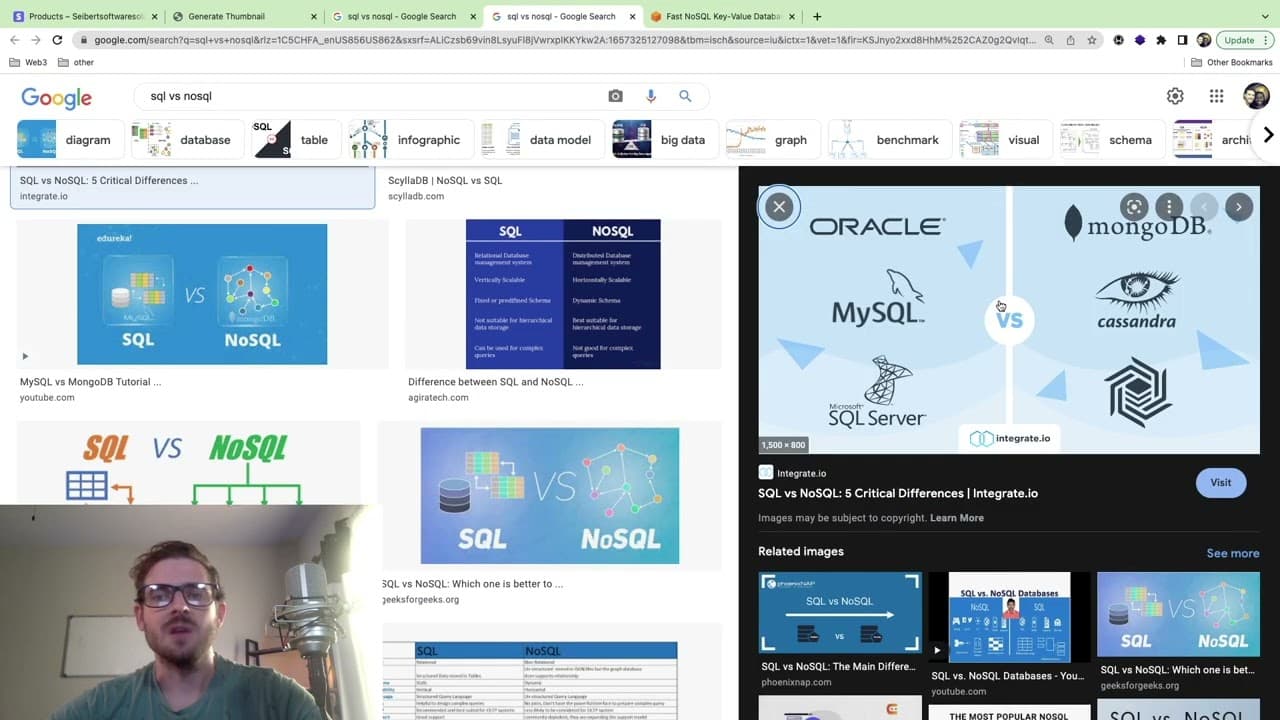
all right so i want to have a little talk about sql versus nosql databases and i want to just i just want to say like i'm not an expert at a database or back end i'm a jack-of-all-trades person i'm a full-stack engineer so take with take what i say like with a grain of salt is that the saying i've worked with sql databases a little bit but for most... Read More
Key Insights
- 💄 SQL databases, being relational, naturally support complex queries and data integrity, making them a stable choice for many applications.
- 🤝 NoSQL databases like DynamoDB provide performance benefits when dealing with schema-less and rapidly changing data structures, but come with trade-offs in data consistency.
- 🚥 Scalability is a significant concern; SQL typically scales vertically, while NoSQL offers more flexible horizontal scaling options.
- 💦 Beginners may find SQL easier to work with due to its structured query language, fostering better understanding of data relationships.
- 🥺 Issues with relational data handling in NoSQL can lead to operational challenges, especially in applications with interrelated data elements.
- 🎨 Denormalization in NoSQL can enhance performance but complicates data updates, requiring careful design and planning.
- 🔨 Tools like Prisma can help simplify SQL database management for developers, streamlining the migration and querying processes.
Install to Summarize YouTube Videos and Get Transcripts
Explore YouTube Video Summarizer or Get YouTube Transcript Extractor
Questions & Answers
Q: What are the primary benefits of using SQL databases?
SQL databases offer a structured approach to data storage, utilizing relational models that are easy to understand and query through standard SQL statements. They provide built-in support for transactions and data integrity. Furthermore, SQL databases can efficiently handle complex queries with JOINs, making them ideal for applications requiring relational data navigation, thus ensuring data consistency across tables.
Q: Why might a developer choose NoSQL over SQL?
Developers may choose NoSQL for its flexibility with unstructured or semi-structured data formats. NoSQL databases like DynamoDB are designed for high scalability, allowing easy adjustments to accommodate growing amounts of data and fluctuations in traffic. This makes NoSQL particularly suitable for applications requiring quick iterations and frequent schema changes, such as modern web apps using JSON.
Q: What challenges arise when using NoSQL databases?
Challenges with NoSQL databases include managing denormalized data, which can lead to redundant entries and increased complexity in updates. Unlike SQL, where data normalization is emphasized to minimize duplication, NoSQL often requires duplicating data for performance. Querying relational data can be cumbersome, requiring additional indexes and potentially leading to greater development overhead and inefficiencies in data retrieval.
Q: How can beginners benefit from learning SQL first?
Learning SQL provides beginners with fundamental concepts of how databases operate, including data modeling, querying, and data relationships. Mastering SQL offers a solid foundation that enhances problem-solving skills relevant to data management, as it teaches data normalization and efficient data handling, making it easier to transition to understanding NoSQL concepts later.
Q: What is the significance of database scalability in SQL and NoSQL?
Scalability plays a critical role in database selection. SQL databases typically scale vertically, meaning you enhance a single server's resources, which has limits. NoSQL databases, on the other hand, are often designed for horizontal scaling, allowing multiple servers to handle increased traffic and data loads, accommodating vast, distributed applications without hitting resource ceilings quickly.
Q: What does denormalization mean in the context of NoSQL databases?
Denormalization involves duplicating data across various collections in NoSQL databases to optimize read performance, as this avoids complex JOIN operations typical in SQL. However, it can introduce complications when updates are needed, as changes must be propagated to all copies of the data, which can become unmanageable as the dataset grows.
Summary & Key Takeaways
-
The speaker discusses their experience mainly with NoSQL databases like DynamoDB, despite having some experience with SQL databases. The pros and cons of both types are highlighted.
-
SQL databases are vertically scalable but have limits on how much traffic one server can handle. In contrast, NoSQL databases offer flexibility but lack robust support for relational data.
-
The speaker advises beginners to start with SQL due to its widespread use and straightforward operations, while emphasizing the complications that can arise with NoSQL databases like denormalization.
Read in Other Languages (beta)
Share This Summary 📚
Summarize YouTube Videos and Get Video Transcripts with 1-Click
Try YouTube Summary with ChatGPT & Claude or YouTube Transcript Generator
Explore More Summaries from Web Dev Cody 📚





Summarize YouTube Videos and Get Video Transcripts with 1-Click
Try YouTube Summary with ChatGPT & Claude or YouTube Transcript Generator