World War I Eastern front | The 20th century | World history | Khan Academy
TL;DR
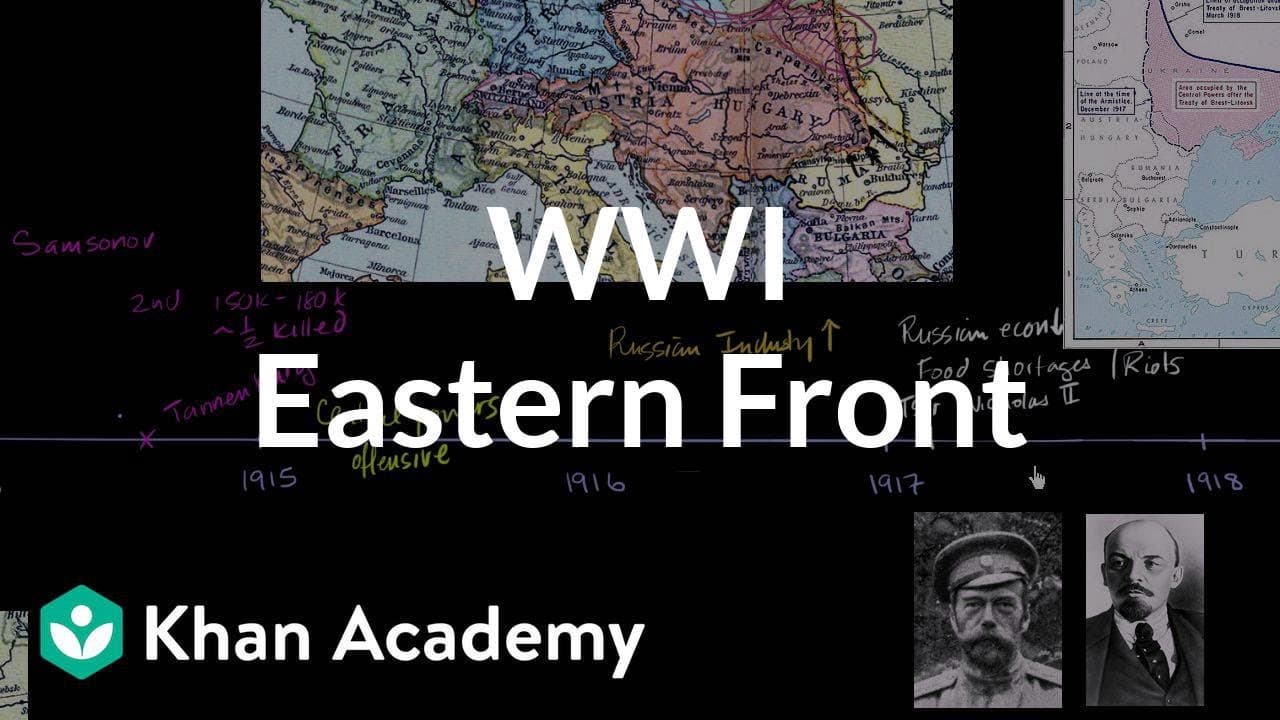
Germany's declaration of war on Russia leads to a series of defeats for the Russians on the Eastern Front, culminating in the signing of the Treaty of Brest-Litovsk in 1918.
Transcript
In early August 1914, we know that Germany declares war on Russia, just as Russia's mobilizing troops to get into a war with the Austro-Hungarian Empire. Because the Austro-Hungarians have declared war on Serbia. And the Russians apparently, or ostensibly, or used protection of Serbia as a pretext for getting into war with the Austrians. The German... Read More
Key Insights
- 🥺 Germany's alliance with Austria-Hungary and Russia's alliance with France led to the escalation of the war on the Eastern Front.
- ❓ The Russians suffered major defeats, such as at the Battle of Tannenberg, due to poor coordination and leadership.
- 😮 Economic and political turmoil in Russia, including the February Revolution and the rise of the Bolsheviks, had significant impacts on the course of the war.
- 👻 The signing of the Treaty of Brest-Litovsk marked the end of the Eastern Front and allowed Germany to focus on the Western Front.
Install to Summarize YouTube Videos and Get Transcripts
Explore YouTube Video Summarizer or Get YouTube Transcript Extractor
Questions & Answers
Q: Why did Germany declare war on Russia?
Germany had an alliance with Austria-Hungary, which led them to fight against Russia when Russia declared war on Austria-Hungary in support of Serbia.
Q: What was the outcome of the Battle of Tannenberg for the Russians?
The Russians suffered a major defeat, with the Russian Second Army being decimated and its leader, General Samsonov, committing suicide.
Q: How did the Russian economy and morale of the troops deteriorate?
The Russian economy struggled to supply munitions and arms to its troops, leading to food shortages and riots. The morale of the troops also suffered, contributing to the rise of the Bolsheviks.
Q: What were the consequences of the Treaty of Brest-Litovsk for Russia?
Russia lost a significant amount of territory to the Central Powers, effectively ending their involvement in World War I and allowing the Germans to focus on the Western Front.
Summary & Key Takeaways
-
In the early stages of World War I, Germany declares war on Russia due to their alliance with Austria-Hungary.
-
The Russians suffer a major defeat at the Battle of Tannenberg, leading to the suicide of General Samsonov.
-
The Russians regain momentum in 1916 but face economic and political turmoil, including the overthrow of the Tsar and the rise of the Bolsheviks.
-
Russia signs the Treaty of Brest-Litovsk, losing significant territory and effectively ending their involvement in World War I.
Read in Other Languages (beta)
Share This Summary 📚
Summarize YouTube Videos and Get Video Transcripts with 1-Click
Try YouTube Summary with ChatGPT & Claude or YouTube Transcript Generator
Explore More Summaries from Khan Academy 📚



Summarize YouTube Videos and Get Video Transcripts with 1-Click
Try YouTube Summary with ChatGPT & Claude or YouTube Transcript Generator