42 is the new 33 - Numberphile
TL;DR
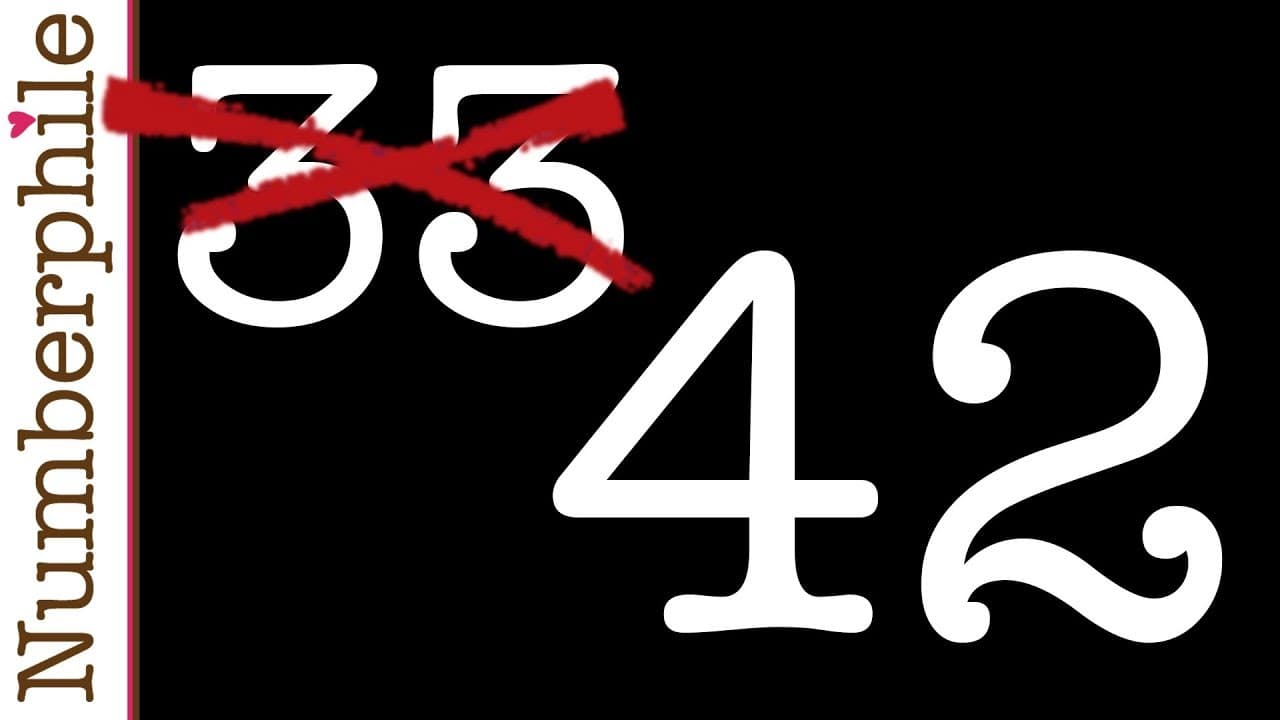
Mathematician Andrew Booker discovers a solution to the equation x^3 + y^3 + z^3 = 33, providing new insights into the study of cubes and paving the way for further research.
Transcript
(Brady: I know you've made a discovery.) (Have you memorised the three numbers?)
- I haven't.
- (You don't know them?)
- I don't know them, sorry. [Laughs] In fact I didn't even notice, I learned from somebody else's posting that one of the numbers is prime. So [laughs] hadn't notice that. We found three integers whose cubes sum to 33. This number... Read More
Key Insights
- 💁 Dividing a number by 9 and observing the remainder provides valuable information about the solvability of the cube sum problem.
- 🖱️ The use of computer computation has revolutionized the search for cube sum solutions, allowing mathematicians to explore a vast range of possibilities.
- 🍹 Booker's method of transforming the equation and using algebraic techniques provides another approach to tackling the cube sum problem.
Install to Summarize YouTube Videos and Get Transcripts
Explore YouTube Video Summarizer or Get YouTube Transcript Extractor
Questions & Answers
Q: How did Andrew Booker come up with the idea to solve the problem of finding three integers whose cubes sum to 33?
Booker was inspired by a video made by mathematician Tim Browning and decided to explore the problem further. He used algebraic manipulation to transform the equation and devised a method to check all possible values of the variables.
Q: What role did computer computation play in Booker's discovery?
Booker utilized powerful computers to crunch the massive number of calculations required to search for solutions. This significantly reduced the search space and ultimately led to the discovery of the solution quickly.
Q: Are there any restrictions on the numbers that can be used in the equation?
If a number divided by 9 has a remainder of 4 or 5, it is impossible to find three integers whose cubes sum to that number. This restriction helped narrow down the search range and eliminate certain potential solutions.
Q: What implications do Booker's findings have for further research in this area?
Booker's discovery provides evidence supporting the conjecture that every number not divisible by 9 and not having a remainder of 4 or 5 will have infinitely many solutions for the cube sum problem. This opens up avenues for further investigation and potentially the development of rigorous proofs.
Summary & Key Takeaways
-
Mathematician Andrew Booker finds three integers whose cubes sum to 33, solving a problem that has intrigued mathematicians for decades.
-
The search for these cube solutions was aided by dividing the number by 9 and observing remainders, leading to the exclusion of certain numbers.
-
Booker's method involved using algebraic techniques and computer computation, resulting in the unexpected discovery of the solution.
Read in Other Languages (beta)
Share This Summary 📚
Summarize YouTube Videos and Get Video Transcripts with 1-Click
Try YouTube Summary with ChatGPT & Claude or YouTube Transcript Generator
Explore More Summaries from Numberphile 📚





Summarize YouTube Videos and Get Video Transcripts with 1-Click
Try YouTube Summary with ChatGPT & Claude or YouTube Transcript Generator