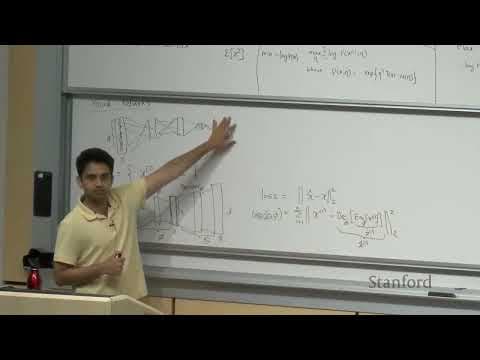
Stanford CS330: Deep Multi-task & Meta Learning | 2020 | Lecture 6: Non-Parametric Few-Shot Learning
TL;DR
This content discusses non-parametric few-shot learning techniques and their applications in meta-learning, including medical image diagnosis, imitation learning, drug discovery, motion prediction, and language generation.
Transcript
okay let's get started let's uh get started on the topic for today so today we're going to be talking about non-parametric few shot learning this will also be part of your second homework assignment we'll talk about a few different methods for this and what even what non-parametric future learning even is and then we'll also go over a case study of... Read More
Key Insights
- 😘 Non-parametric few-shot learning methods are effective in low-data regimes and can be used for a variety of meta-learning applications.
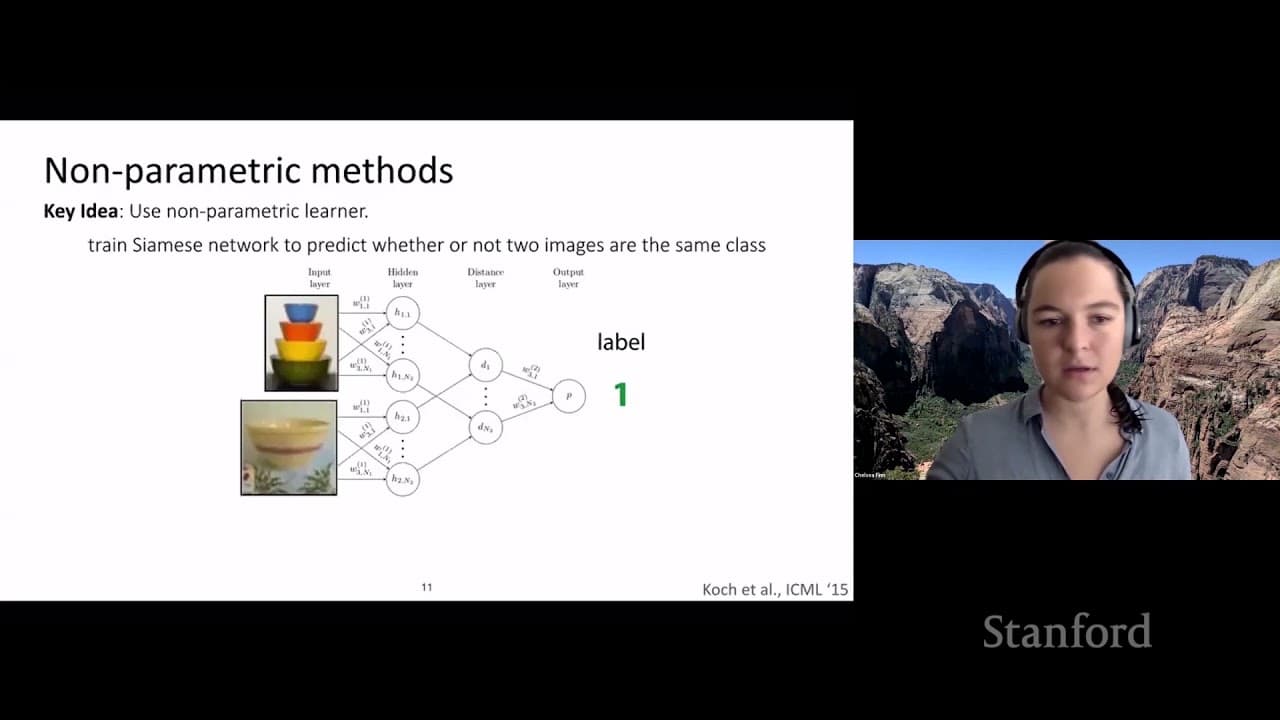
- 🚱 Prototypical networks and siamese networks are two common approaches to non-parametric few-shot learning.
- 🍵 Non-parametric methods can handle interclass variability through multiple prototypes or prototype mixtures.
- 🤘 Meta-learning algorithms should be expressive, consistent, and uncertainty-aware to improve performance and generalize well to new tasks.
- 😫 Non-parametric methods are computationally efficient but may not scale well to large data sets or regression tasks.
Install to Summarize YouTube Videos and Get Transcripts
Explore YouTube Video Summarizer or Get YouTube Transcript Extractor
Questions & Answers
Q: What is the difference between parametric and non-parametric learners?
Parametric learners involve learning a model with fixed parameters, while non-parametric learners, such as nearest neighbors, use the training data points as parameters and do not require a fixed model structure.
Q: How do non-parametric few-shot learning methods handle interclass variability?
Non-parametric methods can handle interclass variability by using multiple prototypes per class or by using a mixture of prototypes for each class, allowing them to capture different variations within a single class.
Q: Can non-parametric methods be used for regression tasks?
While non-parametric methods are mostly used for classification tasks, they can be adapted for regression by changing the loss function and treating each task as a single function to regress on rather than multiple classes.
Q: Which meta-learning approach is suitable for large-scale classification problems?
Non-parametric methods, such as prototypical networks, are suitable for large-scale classification problems as they can handle a high number of classes without requiring retraining for each new class.
Summary & Key Takeaways
-
The content introduces non-parametric few-shot learning and compares it to black box and optimization-based meta-learning methods.
-
It explores different approaches to non-parametric few-shot learning, such as siamese networks and prototypical networks, highlighting their benefits and limitations.
-
The content provides a case study on applying non-parametric few-shot learning to dermatological image classification, demonstrating improved accuracy compared to baseline methods.
-
It discusses the properties of meta-learning algorithms, such as expressiveness, consistency, and uncertainty awareness.
-
The content concludes by highlighting a range of applications for non-parametric few-shot learning, including imitation learning, drug discovery, motion prediction, and language generation.
Read in Other Languages (beta)
Share This Summary 📚
Summarize YouTube Videos and Get Video Transcripts with 1-Click
Try YouTube Summary with ChatGPT & Claude or YouTube Transcript Generator
Explore More Summaries from Stanford Online 📚

Summarize YouTube Videos and Get Video Transcripts with 1-Click
Try YouTube Summary with ChatGPT & Claude or YouTube Transcript Generator