Products
Features
YouTube Video Summarizer
Summarize YouTube videos
Web & PDF Highlighter
Highlight web pages & PDFs
Chat with PDF
Ask any PDF questions with AI
Ask AI Clone
Chat with your highlights & memories
Audio Transcriber
Transcribe audio files to text
Glasp Reader
Read and highlight articles
Kindle Highlight Export
Export your Kindle highlights
Idea Hatch
Hatch ideas from your highlights
Integrations
Obsidian Plugin
Notion Integration
Pocket Integration
Instapaper Integration
Medium Integration
Readwise Integration
Snipd Integration
Hypothesis Integration
Apps & Extensions
Chrome Extension
Safari Extension
Edge Add-ons
Firefox Add-ons
iOS App
Android App
Discover
Discover
Ideas
Discover new ideas and insights
Articles
Curated articles and insights
Books
Book recommendations by great minds
Posts
Essays and notes from readers
Quotes
Inspiring quotes collection
Videos
Curated videos and summaries
Explore Glasp
Glasp Newsletter
Weekly insights and updates
Glasp Talk
Interview series with great minds
Glasp Blog
Latest news and articles
Glasp Use Cases
Learn how others use Glasp
Build & Support
Glasp API
Access Glasp's API for developers
MCP Connector
Connect Glasp to Claude & ChatGPT
Community
Glasp Reddit Community
Students
Student discount and benefits
FAQs
Frequently Asked Questions
AboutPricing
DashboardLog inSign up

Numerical of G.I. Method - Design of Highway Pavements - Transportation Engineering - I
1.2K views
•
April 6, 2022
by
Ekeeda
YouTube video player
Numerical of G.I. Method - Design of Highway Pavements - Transportation Engineering - I

TL;DR

Calculating the thickness of a pavement using the group index method, based on soil data such as % passing 75 micrometer sieve, liquid weight, and plastic limit.

Transcript

hello students today we are going to solve numerical of group index method question is given as a soil subgrade has following data soil portion passing 75 micrometer sieve is equal to 60 percent liquid weight is equals to 45 percent and plastic limit is equals to 20 percent find out the thickness of pavement required for above soils upgrade if thic... Read More

Key Insights

  • 🫰 The group index method is commonly used in pavement design to assess the suitability of soil and determine pavement thickness.
  • â›” Soil properties like particle size distribution, liquid limit, and plastic limit are considered in the group index calculation.
  • 🧡 The group index value falls within a range in a table, which corresponds to a specific thickness value for the pavement layer.

Install to Summarize YouTube Videos and Get Transcripts

Explore YouTube Video Summarizer or Get YouTube Transcript Extractor

Questions & Answers

Q: What is the purpose of determining the group index value in pavement design?

The group index value is used to classify the soil and estimate its relative strength, which is crucial for designing the thickness of the pavement layer.

Q: How is the group index value calculated?

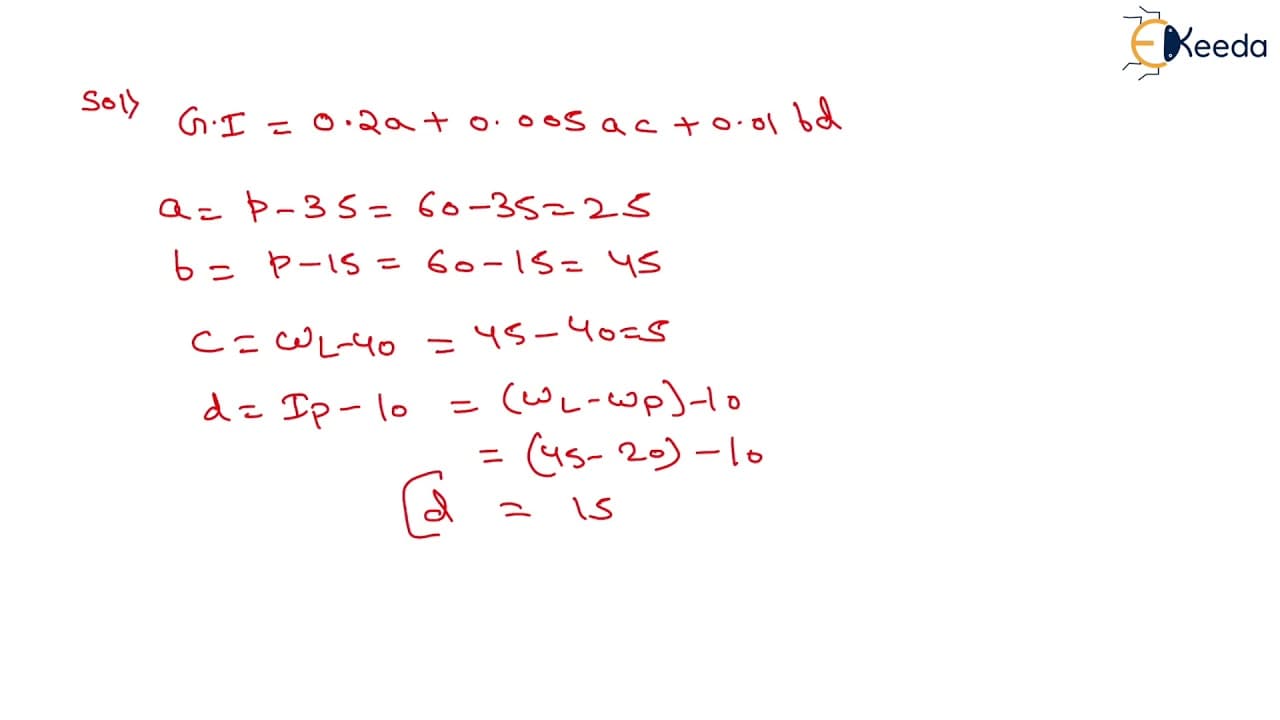
The group index value is calculated using the formula: group index = 0.2a + 0.005ac + 0.01bd, where a, b, c, d are determined based on the given soil data.

Q: What is the significance of the abcd values in the group index formula?

The abcd values represent various characteristics of the soil, such as its particle size distribution, liquid limit, plastic limit, and velocity index, which collectively determine the group index value.

Q: How is the thickness of the pavement calculated using the group index value?

The thickness can be determined by interpolating the given values in the table based on the group index value, using the formula provided in the content.

Summary & Key Takeaways

  • Soil subgrade data is provided, including % passing 75 micrometer sieve (60%), liquid weight (45%), and plastic limit (20%).

  • The group index formula is used to find the group index value, which is 11.625 in this case.

  • Based on the group index value and the values given in a table, the thickness of the pavement is estimated to be 67.2 cm.


Read in Other Languages (beta)

English

Share This Summary 📚

Summarize YouTube Videos and Get Video Transcripts with 1-Click

Download browser extensions on:

Try YouTube Summary with ChatGPT & Claude or YouTube Transcript Generator

Explore More Summaries from Ekeeda 📚

Characteristics of Good Stone thumbnail
Characteristics of Good Stone
Ekeeda
Darcy's Law and Duipits Theory -  Ground Water and Well Hydraulics - Water Resource Engineering 1 thumbnail
Darcy's Law and Duipits Theory - Ground Water and Well Hydraulics - Water Resource Engineering 1
Ekeeda
Software Testing and Quality Assurance - Agile Testing | 12 November | 6 PM thumbnail
Software Testing and Quality Assurance - Agile Testing | 12 November | 6 PM
Ekeeda
Transient Response and Steady State Error Problem 1 - Time Response Analysis - Control Systems thumbnail
Transient Response and Steady State Error Problem 1 - Time Response Analysis - Control Systems
Ekeeda
Numerical on concept of Capillary rise thumbnail
Numerical on concept of Capillary rise
Ekeeda
Non   Homogeneous Linear Equations with Constant Coefficients thumbnail
Non Homogeneous Linear Equations with Constant Coefficients
Ekeeda

Summarize YouTube Videos and Get Video Transcripts with 1-Click

Download browser extensions on:

Try YouTube Summary with ChatGPT & Claude or YouTube Transcript Generator

Apps & Extensions

  • Chrome Extension
  • Safari Extension
  • Edge Add-ons
  • Firefox Add-ons
  • iOS App
  • Android App

Key Features

  • YouTube Video Summarizer
  • Web & PDF Summarizer
  • Web & PDF Highlighter
  • Chat with PDF
  • Ask AI Clone
  • Audio Transcriber
  • Glasp Reader
  • Kindle Highlight Export
  • Idea Hatch

Integrations

  • Obsidian Plugin
  • Notion Integration
  • Pocket Integration
  • Instapaper Integration
  • Medium Integration
  • Readwise Integration
  • Snipd Integration
  • Hypothesis Integration

More Features

  • APIs
  • MCP Connector
  • Blog & Post
  • Embed Links
  • Image Highlight
  • Personality Test
  • Quote Shots

Company

  • About us
  • Blog
  • Community
  • FAQs
  • Job Board
  • Newsletter
  • Pricing
Terms

•

Privacy

•

Guidelines

© 2026 Glasp Inc. All rights reserved.




