Problem No 6 on Basic System Properties | Continuous and Discrete Time Systems | Signals and Systems
TL;DR
This video analyzes the properties of a discrete time system, including memory, causality, linearity, and time invariance.
Transcript
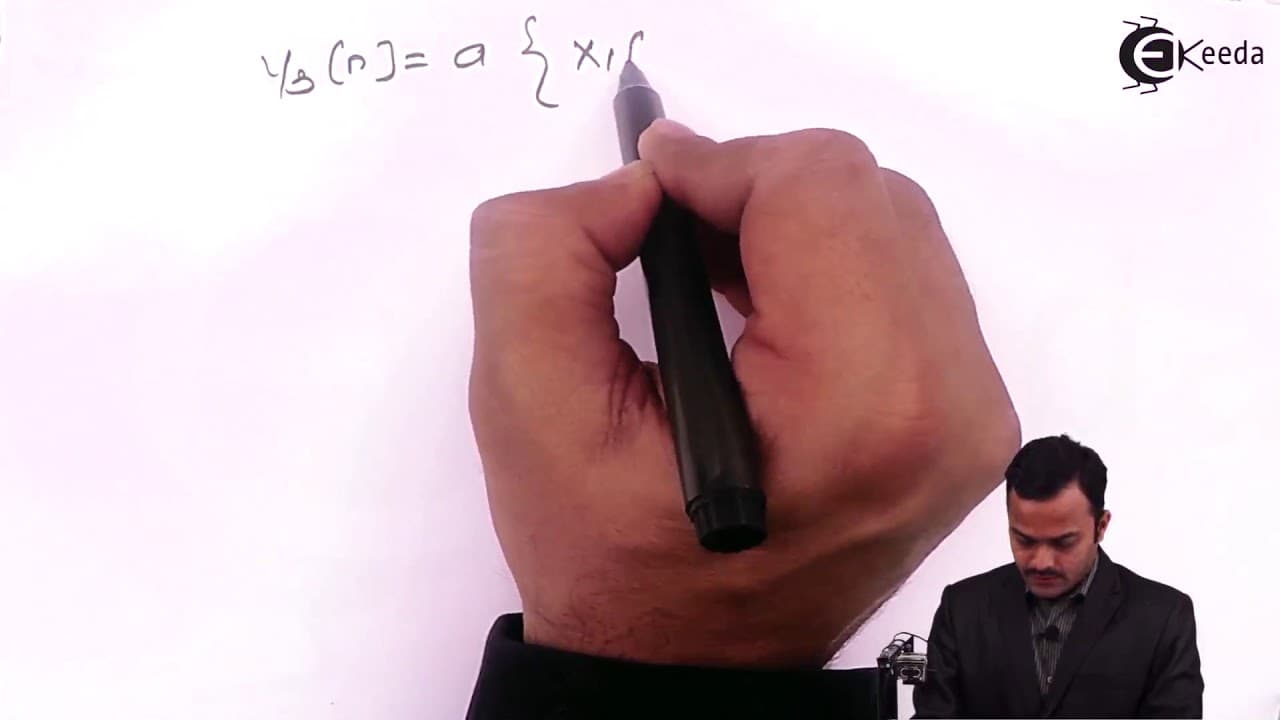
hi students in this video we are going to take a discrete time system and will check for the properties so the equation is given by y of n equals x of n plus n times x of n plus 1 so this is a system for which we need to check whether it requires memory or not that means whether it's a memory less or not that we have to check then we'll check for t... Read More
Key Insights
- ❓ The equation of the given system is y(n) = x(n) + n*x(n+1).
- 🎁 The system requires memory because the present output depends on present and future inputs.
- 🎁 The system is not causal as the present output depends on future inputs.
- ❓ The system is linear as it exhibits homogeneity and superposition.
Install to Summarize YouTube Videos and Get Transcripts
Explore YouTube Video Summarizer or Get YouTube Transcript Extractor
Questions & Answers
Q: What is the equation of the given system?
The equation of the system is y(n) = x(n) + n*x(n+1).
Q: Does the system require memory?
Yes, the system requires memory because the present output depends on both the present and future inputs.
Q: Is the system causal?
No, the system is not causal because the present output depends on future inputs.
Q: Is the system linear?
Yes, the system is linear because it exhibits the properties of homogeneity and superposition.
Q: What is homogeneity in relation to linearity?
Homogeneity means that if the input is multiplied by a constant, the output will also be multiplied by the same constant.
Q: What is superposition in relation to linearity?
Superposition means that if multiple inputs are applied to the system separately, the corresponding outputs can be added together.
Q: Is the system time invariant?
No, the system is not time invariant because shifting the input does not result in a corresponding shift at the output.
Q: Can you provide an example of a time-invariant system?
A time-invariant system would have the property that shifting the input would result in a corresponding shift at the output, ensuring the system's output remains unchanged.
Summary & Key Takeaways
-
The given system equation is y(n) = x(n) + n*x(n+1), and it needs to be checked for memory.
-
The system is found to require memory because the present output depends on the present and future inputs.
-
The system is not causal because the present output depends on future inputs.
-
The system is linear because it exhibits homogeneity and superposition.
-
The system is not time invariant because shifting the input does not result in a corresponding shift at the output.
Read in Other Languages (beta)
Share This Summary 📚
Summarize YouTube Videos and Get Video Transcripts with 1-Click
Try YouTube Summary with ChatGPT & Claude or YouTube Transcript Generator
Explore More Summaries from Ekeeda 📚

Summarize YouTube Videos and Get Video Transcripts with 1-Click
Try YouTube Summary with ChatGPT & Claude or YouTube Transcript Generator