Properties of Unilateral | Z-Transform | Signals and System
TL;DR
The video explains the concept of unilateral Z-transform and its properties for solving difference equations.
Transcript
hi friends in this video we are going to see unilateral z transform basically z transform has classification namely either it could be a bilateral z transform or it could be unilateral that transformed let's check the difference between them in bilateral z transform we are assuming signal could be both sided meaning in signal we could have term u o... Read More
Key Insights
- 🙃 The Z-transform can be either bilateral or unilateral, depending on the consideration of signals on both sides or only right-sided sequences.
- 🤪 Unilateral Z-transform is used in the solution of difference equations, which is analogous to solving differential equations in the time domain.
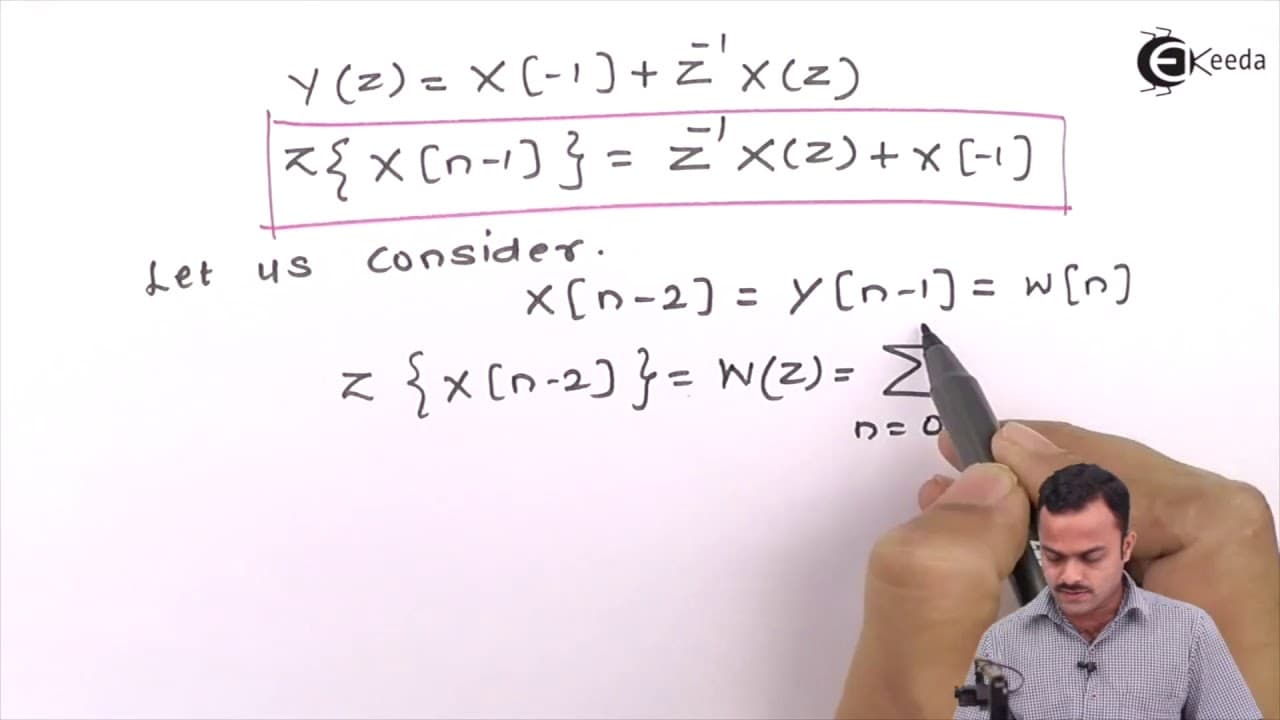
- 💤 The time delay property in unilateral Z-transform involves adding an initial condition term to the Z-transform.
- 🤪 The time advance property in unilateral Z-transform involves multiplying the Z-transform by powers of Z.
- 🤪 Unilateral Z-transform is a powerful tool in signal processing for analyzing and solving difference equations.
- 🤪 Unilateral Z-transform is a causal and right-sided sequence, while bilateral Z-transform considers both causal and non-causal sequences.
- 🤪 The properties of unilateral Z-transform allow for the transformation and analysis of signals in the Z domain.
Install to Summarize YouTube Videos and Get Transcripts
Explore YouTube Video Summarizer or Get YouTube Transcript Extractor
Questions & Answers
Q: What is the difference between bilateral and unilateral Z-transform?
Bilateral Z-transform considers signals on both sides, while unilateral Z-transform only considers right-sided signals.
Q: When is unilateral Z-transform used?
Unilateral Z-transform is used in solving difference equations, which is analogous to solving differential equations in the time domain.
Q: What are the properties of unilateral Z-transform?
The two properties discussed are time delay, where an initial condition is added to the Z-transform, and time advance, where the Z-transform is multiplied by powers of Z.
Q: How is unilateral Z-transform useful for solving difference equations?
Unilateral Z-transform helps in solving difference equations by transforming them into the Z domain, equivalent to solving differential equations in the time domain.
Summary & Key Takeaways
-
The Z-transform can be classified as either bilateral or unilateral. Bilateral Z-transform considers signals on both sides, while unilateral Z-transform only considers right-sided signals.
-
Unilateral Z-transform is useful for solving difference equations and is analogous to solving differential equations in the time domain.
-
The video explains the properties of time delay and time advance in unilateral Z-transform.
Read in Other Languages (beta)
Share This Summary 📚
Summarize YouTube Videos and Get Video Transcripts with 1-Click
Try YouTube Summary with ChatGPT & Claude or YouTube Transcript Generator
Explore More Summaries from Ekeeda 📚




Summarize YouTube Videos and Get Video Transcripts with 1-Click
Try YouTube Summary with ChatGPT & Claude or YouTube Transcript Generator