RC step response 3 of 3 example
TL;DR
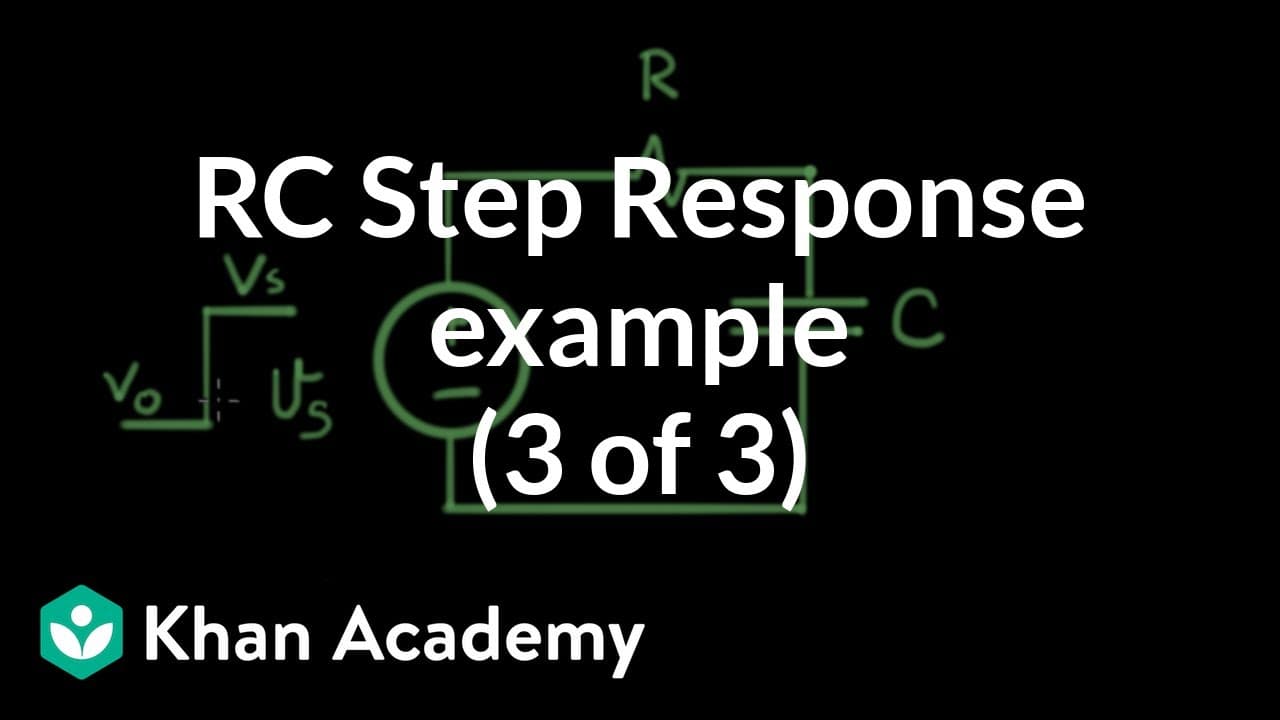
This content explains the step response of an RC circuit using a real-life example, demonstrating how the circuit reacts to a step input.
Transcript
- [Voiceover] In the last video, we worked out the step response of an RC circuit, and now we're gonna look at a real example. So, this is our answer, this is the step response, the total response to our circuit, to a step input. And what does this look like? Well, I'm gonna move down a little bit. We'll make up a circuit and we'll do a real exampl... Read More
Key Insights
- ⌛ The step response of an RC circuit demonstrates the time-dependent behavior of the circuit in response to sudden changes in input voltage.
- ⌛ Calculating the RC value is crucial in determining the time constant and understanding the circuit's response characteristics.
- ⚡ The output voltage of the RC circuit starts at the initial voltage, rises towards the step input voltage, and eventually settles at the steady-state value.
Install to Summarize YouTube Videos and Get Transcripts
Explore YouTube Video Summarizer or Get YouTube Transcript Extractor
Questions & Answers
Q: What is the purpose of analyzing the step response of an RC circuit?
Analyzing the step response of an RC circuit helps us understand how the circuit reacts to sudden changes in input voltage, which is important in various electronic applications.
Q: How is the step response calculated for an RC circuit?
The step response can be calculated by considering the initial voltage, the step voltage, the time constant (RC), and the exponential decay formula, which determines the change in voltage over time.
Q: What does the plotted step response graph represent?
The plotted step response graph illustrates how the output voltage of the RC circuit changes over time when a step input voltage is introduced. It shows the initial rise, steady-state value, and the exponential decay.
Q: How does the circuit demonstrated in the video react to the step input?
The circuit initially has an output voltage of 0.2V and rises exponentially towards the step input value of 1.2V. It then settles at the step input voltage and follows the smooth exponential decay when the step input is removed.
Summary & Key Takeaways
-
The video demonstrates the step response of an RC circuit using a specific circuit example with a step input voltage.
-
The circuit components used are a one K ohm resistor and a four microfarad capacitor.
-
By calculating the RC value and plugging in the values, the step response is determined and graphically plotted.
Read in Other Languages (beta)
Share This Summary 📚
Summarize YouTube Videos and Get Video Transcripts with 1-Click
Try YouTube Summary with ChatGPT & Claude or YouTube Transcript Generator
Explore More Summaries from Khan Academy 📚



Summarize YouTube Videos and Get Video Transcripts with 1-Click
Try YouTube Summary with ChatGPT & Claude or YouTube Transcript Generator