Graphical impact of cost changes on marginal and average costs
TL;DR
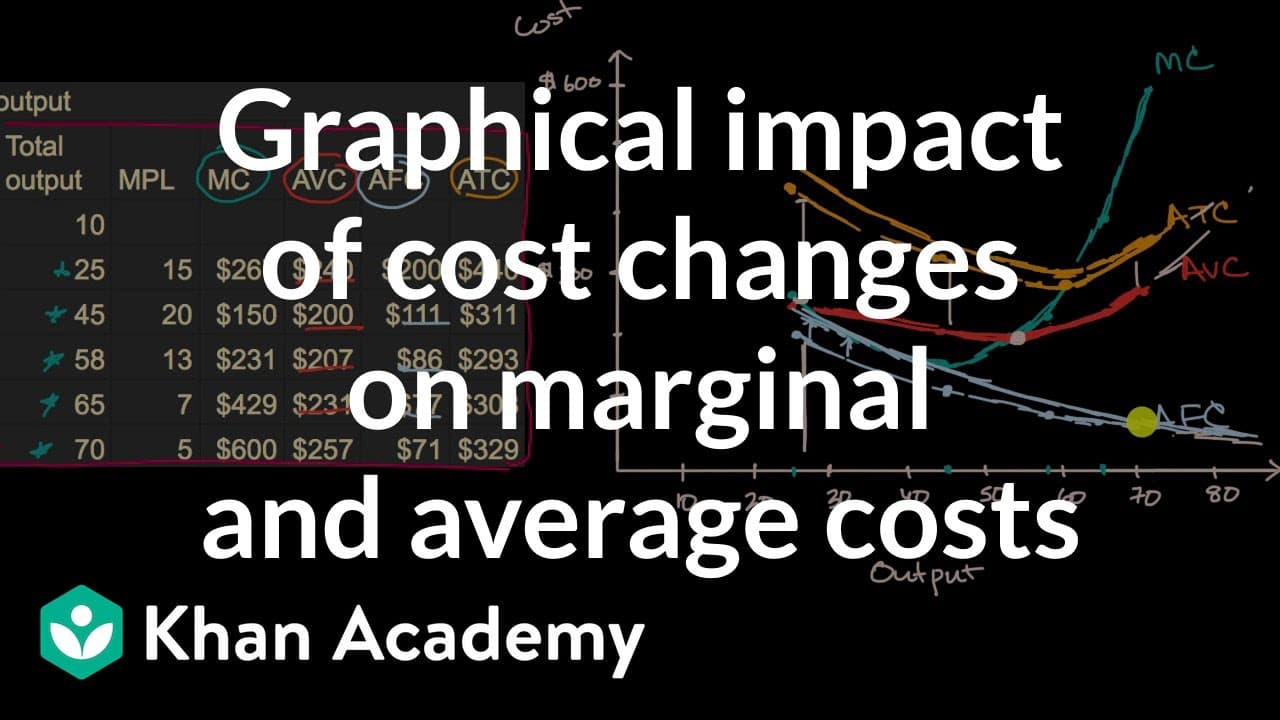
Changes in productivity and cost can impact average fixed cost, average total cost, and marginal cost, as illustrated through visualizations of cost curves.
Transcript
- [Instructor] In the last video, we numerically studied how changes in productivity or cost might affect your marginal cost, your average variable cost, your average fixed cost, or your average total cost. In this video, we're gonna think about it visually. So, we constructed these curves several videos ago to visualize how average fixed cost tren... Read More
Key Insights
- 🇨🇷 Average fixed cost asymptotes towards zero as more units are produced, leading to convergence with average total cost and average variable cost.
- 🇨🇷 A change in fixed costs affects average fixed cost and average total cost, but not average variable cost.
- 🇨🇷 Changes in variable costs impact both average total cost and marginal cost.
- 🇨🇷 Productivity changes can influence average variable cost, marginal cost, and average total cost.
- 🇨🇷 Visualizations through cost curves provide a clear understanding of how changes in productivity and cost impact cost structure.
- 🇨🇷 Fixed costs remain constant regardless of output levels, while variable costs increase with higher production.
- 🇨🇷 Marginal cost represents the additional cost incurred by producing one additional unit.
Install to Summarize YouTube Videos and Get Transcripts
Explore YouTube Video Summarizer or Get YouTube Transcript Extractor
Questions & Answers
Q: How does a change in fixed costs affect average total cost?
A change in fixed costs, such as an increase in rent, causes the average fixed cost curve to shift up, leading to an increase in average total cost for all quantities produced. The amount of the increase in fixed costs reflects directly in the average total cost curve.
Q: Why do changes in fixed costs not affect average variable costs?
Fixed costs are not included in average variable costs. Average variable costs only consider variable costs, such as labor and materials, which are not impacted by changes in fixed costs. Fixed costs and variable costs are separate components of total costs.
Q: How does a change in variable costs impact marginal costs?
An increase in variable costs, such as giving pay increases, causes the variable cost curve to shift up. As more output is produced, incremental costs increase, leading to an upward trend in marginal cost. Therefore, changes in variable costs directly affect marginal costs.
Q: How are changes in productivity reflected in cost curves?
Changes in productivity can affect average variable cost, marginal cost, and average total cost. An increase in productivity would result in a decrease in average variable cost and marginal cost. Conversely, a decrease in productivity would cause an increase in average variable cost and marginal cost.
Summary & Key Takeaways
-
Changes in fixed costs, such as an increase in rent, would cause the average fixed cost curve to shift up, leading to an increase in average total cost for all quantities produced.
-
Changes in variable costs, such as giving pay increases, would cause the variable cost curve to shift up, affecting both average total cost and marginal cost.
-
Productivity changes would impact average variable cost, marginal cost, and average total cost.
Read in Other Languages (beta)
Share This Summary 📚
Summarize YouTube Videos and Get Video Transcripts with 1-Click
Try YouTube Summary with ChatGPT & Claude or YouTube Transcript Generator
Explore More Summaries from Khan Academy 📚



Summarize YouTube Videos and Get Video Transcripts with 1-Click
Try YouTube Summary with ChatGPT & Claude or YouTube Transcript Generator