Marginal revenue and marginal cost in imperfect competition | APⓇ Microeconomics | Khan Academy
TL;DR
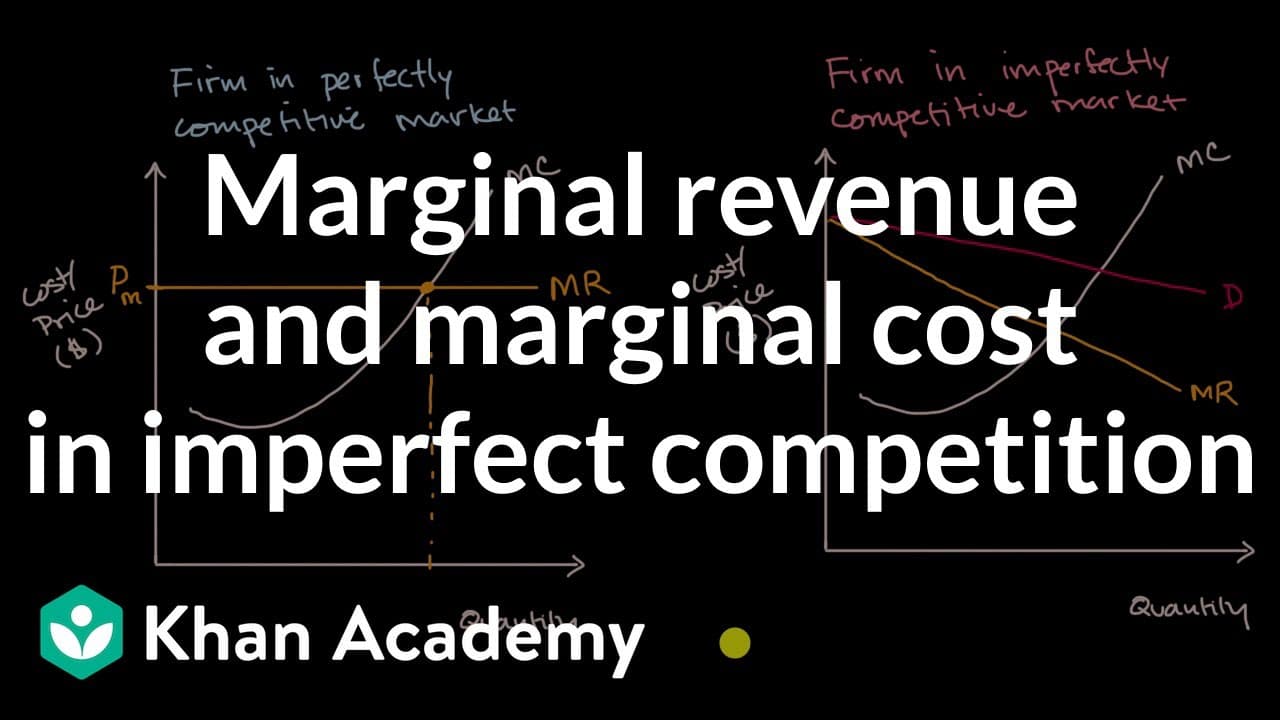
In imperfectly competitive markets, firms have their own demand curve, and the marginal revenue curve is even more downward-sloping. Producing at the quantity where marginal cost equals marginal revenue leads to inefficiency.
Transcript
- [Instructor] In this video, we're going to think about marginal revenue and marginal cost for a firm in an imperfectly competitive market. But before we do that, I just want to be able to review and compare to what we already know about a firm in a perfectly competitive market. So right over here, we're analyzing the firm's economics. This shows ... Read More
Key Insights
- 🚥 In a perfectly competitive market, firms are price-takers and have a horizontal marginal revenue curve.
- 📉 In imperfectly competitive markets, firms have their own demand curve, and the marginal revenue curve is more downward-sloping.
- 🥺 Producing at the quantity where marginal cost equals marginal revenue leads to inefficiency in imperfectly competitive markets.
- ✋ The price in an imperfectly competitive market can be higher than the marginal cost, creating a gap and inefficiency.
- 😀 Firms in imperfectly competitive markets face a trade-off between maximizing profit and considering inefficiency.
- ❓ The demand curve in imperfectly competitive markets determines the price a firm can get at different quantities.
- 📉 The marginal revenue curve in imperfectly competitive markets is more downward-sloping than the demand curve.
Install to Summarize YouTube Videos and Get Transcripts
Explore YouTube Video Summarizer or Get YouTube Transcript Extractor
Questions & Answers
Q: How is the behavior of firms different in a perfectly competitive market compared to an imperfectly competitive market?
In a perfectly competitive market, firms are price-takers and have a horizontal marginal revenue curve, while in an imperfectly competitive market, firms have their own demand curve, and the marginal revenue curve is more downward-sloping.
Q: What is the rational quantity for a firm to produce in an imperfectly competitive market?
The rational quantity for a firm to produce in an imperfectly competitive market is where the marginal cost equals the marginal revenue.
Q: Why is there an inefficiency in producing more than the rational quantity in an imperfectly competitive market?
Even though the price is higher than the marginal cost, producing more than the rational quantity in an imperfectly competitive market leads to lower marginal revenue compared to the marginal cost, resulting in inefficiency.
Q: What is the difference between the demand curve and the marginal revenue curve in an imperfectly competitive market?
The demand curve in an imperfectly competitive market represents the price a firm can get at any quantity, while the marginal revenue curve is even more downward-sloping than the demand curve.
Summary & Key Takeaways
-
In a perfectly competitive market, firms are price-takers and have a horizontal marginal revenue curve.
-
In imperfectly competitive markets, firms have their own demand curve, and the marginal revenue curve is more downward-sloping.
-
Producing at the quantity where marginal cost equals marginal revenue in imperfectly competitive markets leads to inefficiency, as the price is higher than the marginal cost.
Read in Other Languages (beta)
Share This Summary 📚
Summarize YouTube Videos and Get Video Transcripts with 1-Click
Try YouTube Summary with ChatGPT & Claude or YouTube Transcript Generator
Explore More Summaries from Khan Academy 📚



Summarize YouTube Videos and Get Video Transcripts with 1-Click
Try YouTube Summary with ChatGPT & Claude or YouTube Transcript Generator