Simple Harmonic Motion (11 of 16): Period of an Oscillating Mass?
TL;DR
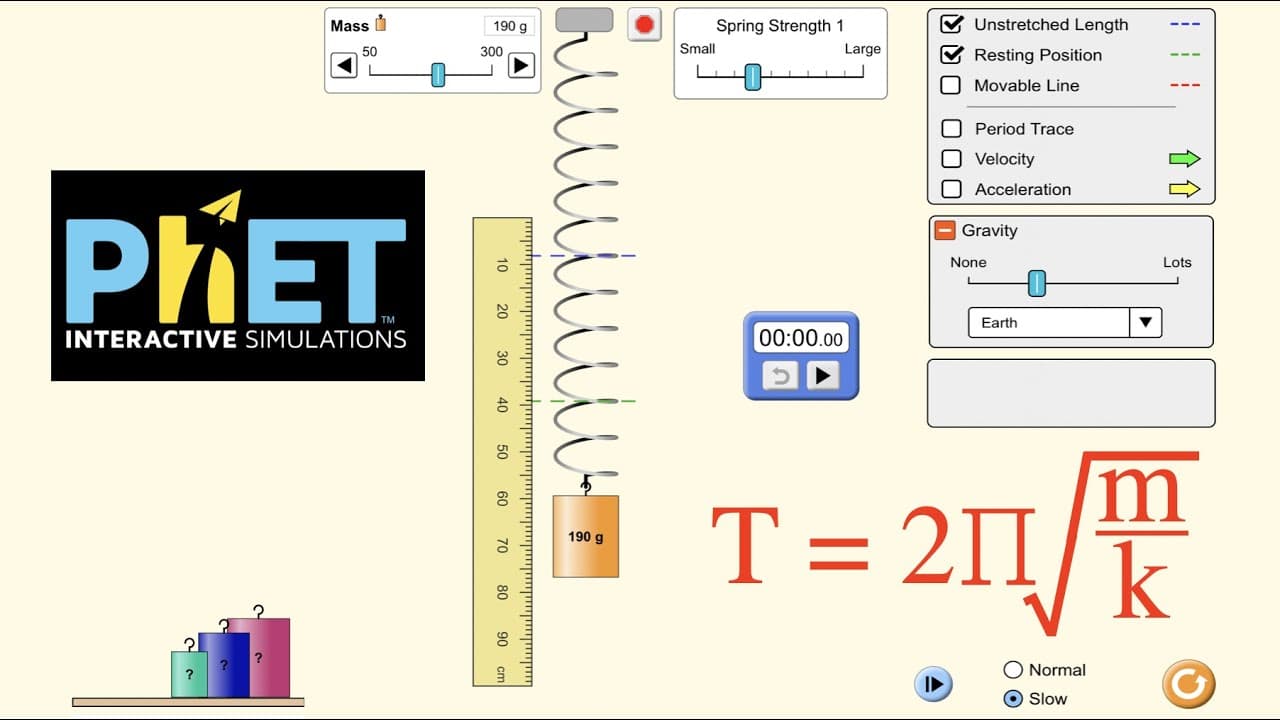
The video explores the factors that influence the period of a mass oscillating on a spring, including amplitude, mass, acceleration due to gravity, and spring constant.
Transcript
today's video is entitled mass on a spring and we're going to look at the factors that affect the period for a mass that is oscillating on a spring of course this also comes under the title of simple harmonic motion now before we get started please don't forget to subscribe to my channel step by step science get all my excellent physics chemistry a... Read More
Key Insights
- 💆 The amplitude does not affect the period of a mass oscillating on a spring.
- 💆 The mass and period are directly proportional to each other.
- 💆 The acceleration due to gravity does not impact the period of a mass-spring system.
- 🌸 The spring constant is inversely proportional to the period, meaning that increasing the spring constant decreases the period.
- 🇹🇲 The period can be calculated using the equation: T = 2π√(m/k), where T is the period, m is the mass, and k is the spring constant.
- 🏍️ The frequency is the inverse of the period and measures the number of cycles per second.
- 🎮 The PhET simulation used in the video provides a visual representation of the concepts discussed.
Install to Summarize YouTube Videos and Get Transcripts
Explore YouTube Video Summarizer or Get YouTube Transcript Extractor
Questions & Answers
Q: What is the period of a mass oscillating on a spring?
The period is the time it takes for the spring to complete one cycle, moving from its original position and returning. It is influenced by factors such as amplitude, mass, acceleration due to gravity, and spring constant.
Q: How does the amplitude affect the period?
Surprisingly, the amplitude does not have an effect on the period. Regardless of how far the spring is stretched or pulled back, the time it takes for one cycle remains the same.
Q: Is there a relationship between mass and period?
Yes, there is a direct relationship between mass and period. Increasing the mass of the object on the spring will also increase the period, making it take longer for one cycle to complete.
Q: How does the acceleration due to gravity affect the period?
The acceleration due to gravity has no effect on the period. Whether the gravity is high or low, the time it takes for one cycle remains constant.
Q: What is the relationship between spring constant and period?
The spring constant is inversely proportional to the period. Increasing the spring constant will decrease the period, making the cycles occur more quickly.
Summary & Key Takeaways
-
The video explains the terms related to simple harmonic motion, such as period, cycle, frequency, and amplitude.
-
The simulation from PhET Simulations is used to demonstrate how different factors affect the period of a spring.
-
The video examines how changing the amplitude, mass, acceleration due to gravity, and spring constant affect the period of the mass-spring system.
Read in Other Languages (beta)
Share This Summary 📚
Summarize YouTube Videos and Get Video Transcripts with 1-Click
Try YouTube Summary with ChatGPT & Claude or YouTube Transcript Generator
Explore More Summaries from Step by Step Science 📚
Summarize YouTube Videos and Get Video Transcripts with 1-Click
Try YouTube Summary with ChatGPT & Claude or YouTube Transcript Generator