Products
Features
YouTube Video Summarizer
Summarize YouTube videos
Web & PDF Highlighter
Highlight web pages & PDFs
Chat with PDF
Ask any PDF questions with AI
Ask AI Clone
Chat with your highlights & memories
Audio Transcriber
Transcribe audio files to text
Glasp Reader
Read and highlight articles
Kindle Highlight Export
Export your Kindle highlights
Idea Hatch
Hatch ideas from your highlights
Integrations
Obsidian Plugin
Notion Integration
Pocket Integration
Instapaper Integration
Medium Integration
Readwise Integration
Snipd Integration
Hypothesis Integration
Apps & Extensions
Chrome Extension
Safari Extension
Edge Add-ons
Firefox Add-ons
iOS App
Android App
Discover
Discover
Ideas
Discover new ideas and insights
Articles
Curated articles and insights
Books
Book recommendations by great minds
Posts
Essays and notes from readers
Quotes
Inspiring quotes collection
Videos
Curated videos and summaries
Explore Glasp
Glasp Newsletter
Weekly insights and updates
Glasp Talk
Interview series with great minds
Glasp Blog
Latest news and articles
Glasp Use Cases
Learn how others use Glasp
Build & Support
Glasp API
Access Glasp's API for developers
MCP Connector
Connect Glasp to Claude & ChatGPT
Community
Glasp Reddit Community
Students
Student discount and benefits
FAQs
Frequently Asked Questions
AboutPricing
DashboardLog inSign up

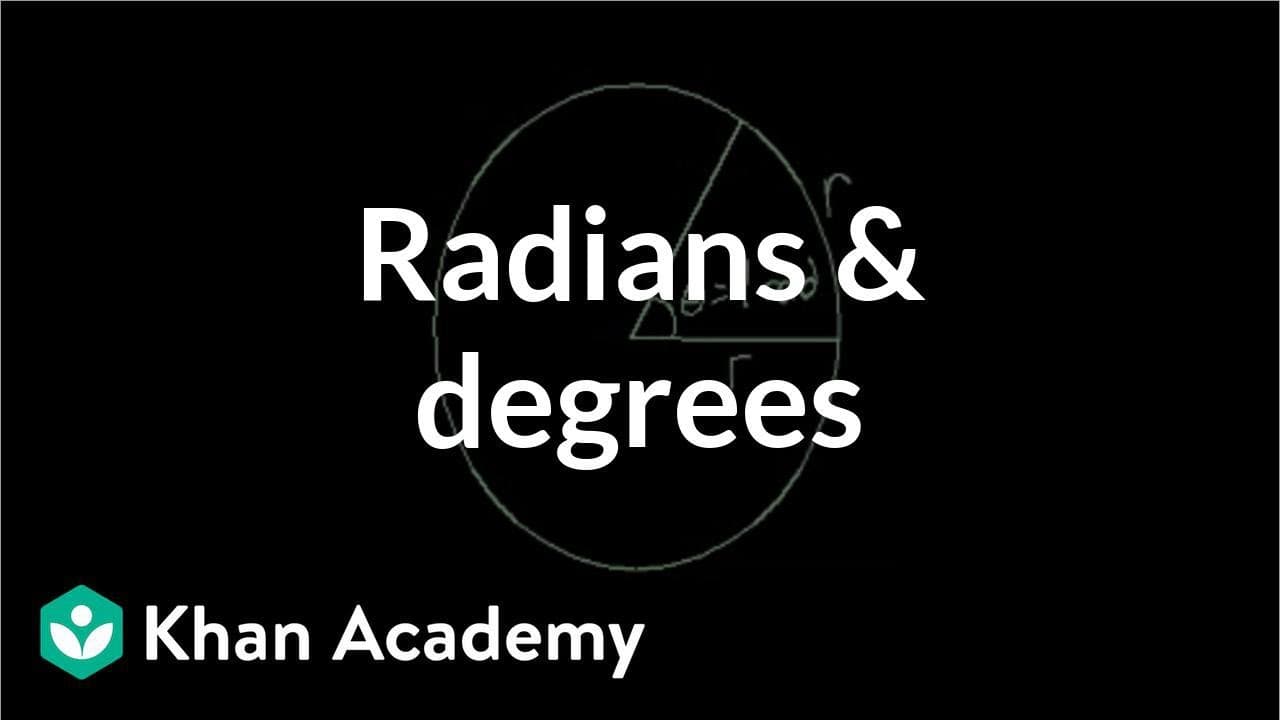
Radian and degree | Unit circle definition of trig functions | Trigonometry | Khan Academy
August 14, 2007
by
Khan Academy
YouTube video player
Radian and degree | Unit circle definition of trig functions | Trigonometry | Khan Academy

TL;DR

An explanation of radians and degrees, including their definitions and conversion formulas.

Transcript

Welcome to the presentation on radians and degrees. So you all are probably already reasonably familiar with the concept of degrees. I think in our angles models we actually drill you through a bunch of problems. You're probably familiar that a right angle is 90 degrees. Or half a right angle -- 45 degrees. And you're also probably familiar with th... Read More

Key Insights

  • âš¾ Radians measure angles based on the length of the arc they subtend, while degrees are based on a division of a circle into 360 parts.
  • â­• The conversion between radians and degrees can be derived from the relationships between the circumference of a circle and the length of the radius.
  • 🛟 Radians are the mathematical standard for measuring angles, while degrees are more commonly used in everyday life.
  • 💨 The conversion formulas provide a way to easily switch between radians and degrees in calculations.

Install to Summarize YouTube Videos and Get Transcripts

Explore YouTube Video Summarizer or Get YouTube Transcript Extractor

Questions & Answers

Q: What is a radian and how is it related to a circle?

A radian is the angle that subtends an arc with the same length as the radius of a circle. It is closely related to a circle because 2 pi radians form a complete circle.

Q: How many radians are there in a circle?

There are 2 pi radians in a circle. This can be derived from the fact that the circumference of a circle is 2 pi times the radius.

Q: What is the conversion formula between radians and degrees?

The conversion formula is 1 radian = 180/pi degrees. This can be obtained by setting up an equation between the number of radians in a circle (2 pi) and the number of degrees in a circle (360).

Q: How do you convert degrees to radians?

To convert degrees to radians, you can use the formula: radians = degrees * (pi/180). Multiply the given number of degrees by pi/180 to get the equivalent in radians.

Summary & Key Takeaways

  • Radians are a unit of measurement for angles, defined as the angle that subtends an arc with the same length as the radius.

  • There are 2 pi radians in a circle, which is equal to 360 degrees.

  • The conversion formulas are: 1 radian = 180/pi degrees and 1 degree = pi/180 radians.


Read in Other Languages (beta)

English

Share This Summary 📚

Summarize YouTube Videos and Get Video Transcripts with 1-Click

Download browser extensions on:

Try YouTube Summary with ChatGPT & Claude or YouTube Transcript Generator

Explore More Summaries from Khan Academy 📚

Classical Japan during the Heian Period | World History | Khan Academy thumbnail
Classical Japan during the Heian Period | World History | Khan Academy
Khan Academy
Breakthrough Junior Challenge Winner Reveal! Homeroom with Sal - Thursday, December 3 thumbnail
Breakthrough Junior Challenge Winner Reveal! Homeroom with Sal - Thursday, December 3
Khan Academy
Interview with Karina Murtagh thumbnail
Interview with Karina Murtagh
Khan Academy

Summarize YouTube Videos and Get Video Transcripts with 1-Click

Download browser extensions on:

Try YouTube Summary with ChatGPT & Claude or YouTube Transcript Generator

Apps & Extensions

  • Chrome Extension
  • Safari Extension
  • Edge Add-ons
  • Firefox Add-ons
  • iOS App
  • Android App

Key Features

  • YouTube Video Summarizer
  • Web & PDF Summarizer
  • Web & PDF Highlighter
  • Chat with PDF
  • Ask AI Clone
  • Audio Transcriber
  • Glasp Reader
  • Kindle Highlight Export
  • Idea Hatch

Integrations

  • Obsidian Plugin
  • Notion Integration
  • Pocket Integration
  • Instapaper Integration
  • Medium Integration
  • Readwise Integration
  • Snipd Integration
  • Hypothesis Integration

More Features

  • APIs
  • MCP Connector
  • Blog & Post
  • Embed Links
  • Image Highlight
  • Personality Test
  • Quote Shots

Company

  • About us
  • Blog
  • Community
  • FAQs
  • Job Board
  • Newsletter
  • Pricing
Terms

•

Privacy

•

Guidelines

© 2026 Glasp Inc. All rights reserved.

