What Is Cellular Respiration and How Does It Work?
TL;DR
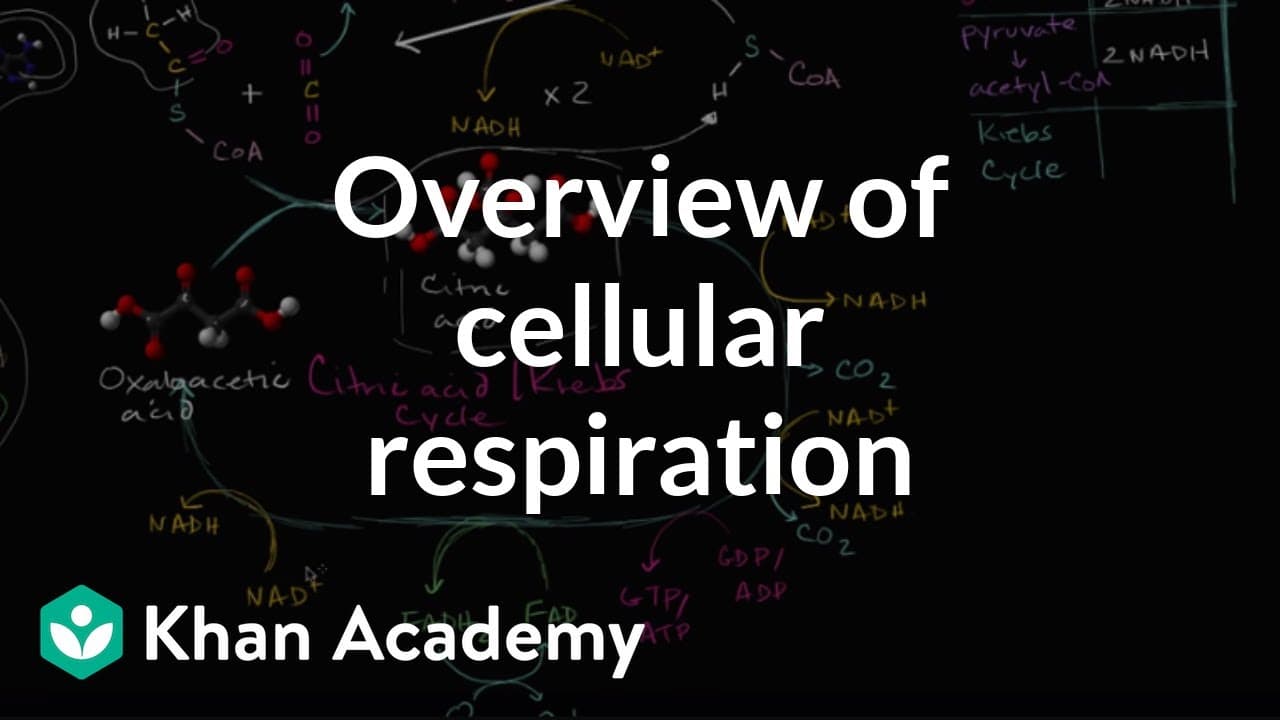
Cellular respiration is the process by which cells convert glucose into ATP through glycolysis, the Krebs cycle, and oxidative phosphorylation. Glycolysis splits glucose into pyruvate, producing ATP and NADH, while the Krebs cycle further breaks down pyruvate, releasing carbon dioxide and generating additional NADH and FADH2. If oxygen is absent, pyruvate can be redirected to fermentation instead of continuing to the Krebs cycle.
Transcript
- [Voiceover] So what I wanna do in this video is give ourselves an overview of cellular respiration. It can be a pretty involved process, and even the way I'm gonna do it, as messy as it looks, is going to be cleaner than actually what goes on inside of your cells, and other organs themselves, because I'm going to show clearly from going from gluc... Read More
Key Insights
- 🏍️ Cellular respiration involves multiple interconnected steps: glycolysis, the Krebs cycle, and oxidative phosphorylation.
- 🍳 Glycolysis produces ATP and NADH, while the Krebs cycle further breaks down molecules, releasing carbon dioxide and producing NADH and FADH2.
- 😒 The electron transport chain in oxidative phosphorylation uses NADH and FADH2 to create a proton gradient, which is used to produce ATP.
- 🎁 Fermentation is an alternative pathway if oxygen is not present or the organism does not want to continue with cellular respiration.
Install to Summarize YouTube Videos and Get Transcripts
Explore YouTube Video Summarizer or Get YouTube Transcript Extractor
Questions & Answers
Q: What is the purpose of glycolysis in cellular respiration?
Glycolysis aims to split glucose into two pyruvate molecules, producing two ATP and two NADH molecules. It is the first step in cellular respiration.
Q: What happens to pyruvate if there is no oxygen present?
Without oxygen, pyruvate can be used for fermentation, where it is used to oxidize NADH back into NAD. This allows the pyruvate to be reused again for glycolysis.
Q: Where does the Krebs cycle take place in the cell?
The Krebs cycle occurs in the matrix of the mitochondria. It involves the breakdown of acetyl-CoA to produce energy-rich molecules such as NADH and FADH2.
Q: How is ATP produced in oxidative phosphorylation?
ATP is produced in oxidative phosphorylation through the electron transport chain. NADH and FADH2 are oxidized, releasing energy that is used to create a proton gradient, which is then used to produce ATP.
Summary & Key Takeaways
-
Cellular respiration is a complex process that involves the breakdown of glucose through glycolysis, the Krebs cycle, and oxidative phosphorylation.
-
Glycolysis, which occurs in the cytosol, splits glucose into two pyruvate molecules and produces two ATP and two NADH molecules.
-
If oxygen is not present or the organism does not want to continue with cellular respiration, pyruvate can be used for fermentation. Otherwise, it proceeds to the Krebs cycle where further breakdown occurs.
Read in Other Languages (beta)
Share This Summary 📚
Summarize YouTube Videos and Get Video Transcripts with 1-Click
Try YouTube Summary with ChatGPT & Claude or YouTube Transcript Generator
Explore More Summaries from Khan Academy 📚



Summarize YouTube Videos and Get Video Transcripts with 1-Click
Try YouTube Summary with ChatGPT & Claude or YouTube Transcript Generator