How Does the Production Possibilities Curve Work?
TL;DR
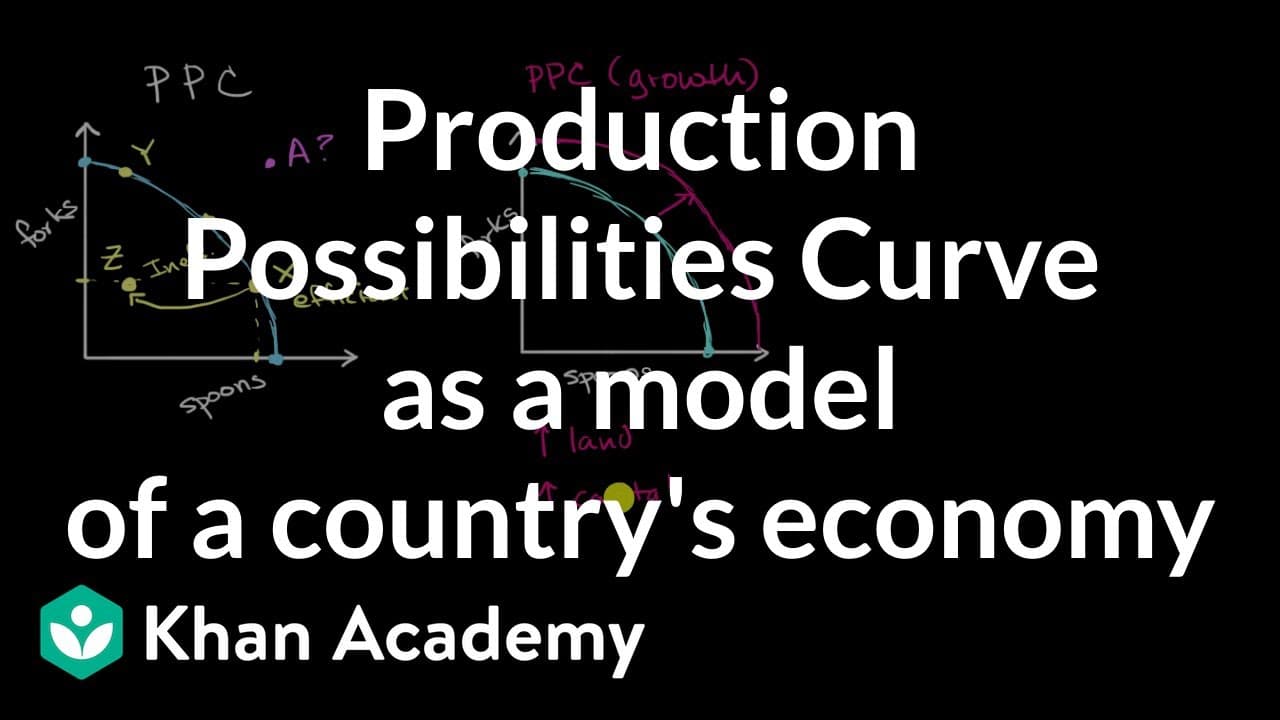
The production possibilities curve illustrates a nation's capacity to efficiently use resources for producing goods. Points on the curve indicate optimal production levels, while points inside signify inefficiency. Shifting the curve outward shows growth possibilities, whereas an inward shift reflects resource contraction.
Transcript
- [Instructor] Let's say that we have some country, let's call it Utenslandia, that can only produce one of two goods or some combination of them. So it can produces forks, or it could produce spoons. And so this axis is the quantity forks, this axis is the quantity of spoons and let's say that if it puts all of its energy into forks, well it would... Read More
Key Insights
- 🧑💼 The production possibilities curve highlights the limitations of resources and the trade-offs involved in production.
- ❓ Efficiency is achieved when a country operates on the curve, utilizing all available resources effectively.
- 🔠 Growth in production capacity can be achieved by increasing inputs such as land, capital, labor, or technology.
- 🥺 Contraction occurs when a country faces a decrease in resources, leading to a reduction in the production possibilities curve.
Install to Summarize YouTube Videos and Get Transcripts
Explore YouTube Video Summarizer or Get YouTube Transcript Extractor
Questions & Answers
Q: What does the production possibilities curve represent?
The production possibilities curve shows the maximum quantity of goods a country can efficiently produce, given its available resources.
Q: How does the curve illustrate efficiency?
Points on the curve demonstrate efficient production, where a country utilizes all its resources effectively to produce a combination of goods.
Q: Can a country produce beyond the production possibilities curve?
Without additional resources, points beyond the curve are unattainable. However, by increasing inputs such as land, capital, labor, or technology, a country can shift the curve outward.
Q: What happens during contraction in the production possibilities curve?
Contraction occurs when a country's resources decrease due to factors like war or destruction of capital. This leads to a shift inward in the production possibilities curve, indicating a reduction in production capacity.
Summary & Key Takeaways
-
The production possibilities curve demonstrates the quantity of goods a country can produce efficiently, based on its resources.
-
Points on the curve represent efficient production, while points inside the curve indicate inefficiency.
-
Shifting the curve outward indicates growth, while shifting it inward represents contraction.
Read in Other Languages (beta)
Share This Summary 📚
Summarize YouTube Videos and Get Video Transcripts with 1-Click
Try YouTube Summary with ChatGPT & Claude or YouTube Transcript Generator
Explore More Summaries from Khan Academy 📚



Summarize YouTube Videos and Get Video Transcripts with 1-Click
Try YouTube Summary with ChatGPT & Claude or YouTube Transcript Generator