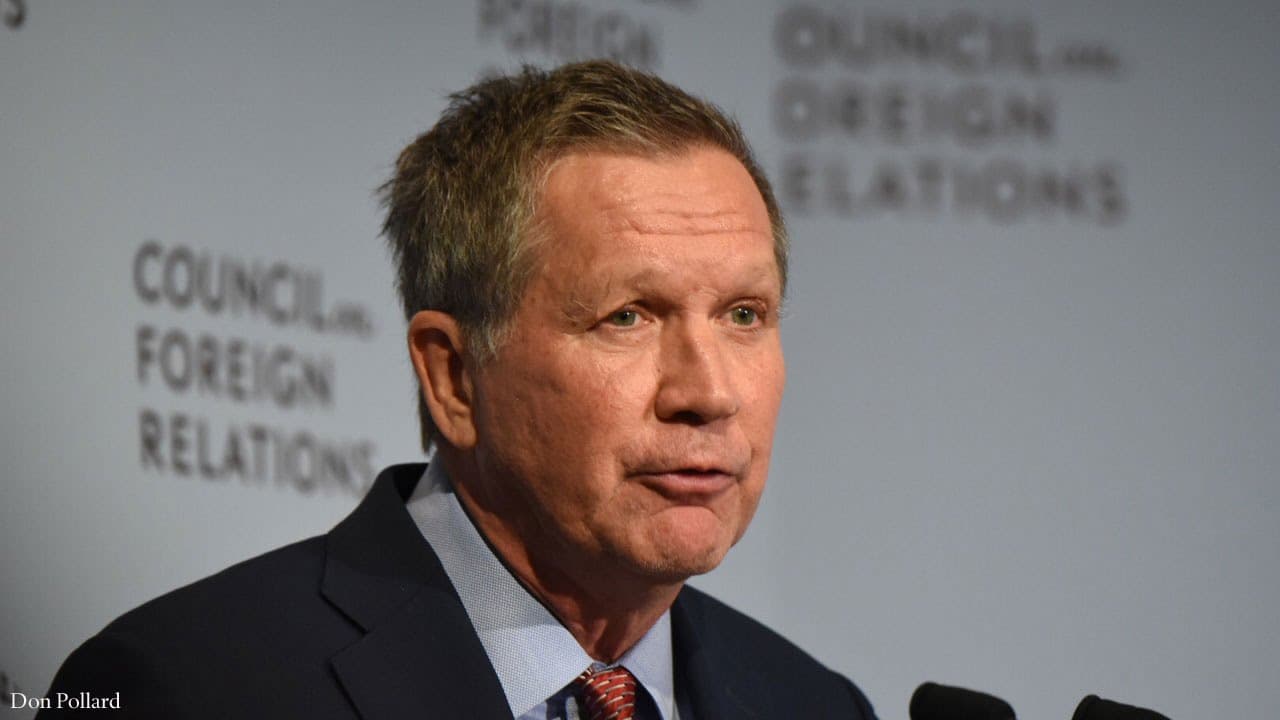
A Conversation With John Kasich
TL;DR
John Kasich outlines his foreign policy vision and critiques current strategies.
Transcript
(Applause.) HAASS: Well, good afternoon I�m Richard Haass, and I want to welcome everyone to the Council on Foreign Relations. For those of you either in the room or watching who may not know us, we�re an independent, nonpartisan membership organization, think tank, and publisher. We�re dedicated to being a resource for our nearly 5,000 members, fo... Read More
Key Insights
- Kasich emphasizes the need for strong bipartisan support to achieve national security objectives, drawing inspiration from past leaders like Ronald Reagan.
- He highlights the threat of global terrorism, particularly from groups like ISIS, and stresses the importance of a coordinated international response.
- Kasich criticizes current U.S. foreign policy, particularly the handling of ISIS and the Syrian crisis, and advocates for a more proactive military involvement.
- He calls for enhanced international intelligence cooperation and the need to support allies like the Kurds in the fight against ISIS.
- Kasich addresses the issue of encryption technology and its challenges for national security, advocating for collaboration between technology and intelligence communities.
- He underscores the importance of public diplomacy and winning the war of ideas to counter extremist ideologies.
- Kasich criticizes the current administration's approach to Russia and China, advocating for a firmer stance on territorial integrity and international norms.
- He proposes an economic revival plan to strengthen the U.S. economy, which he views as essential for maintaining military strength and global leadership.
Install to Summarize YouTube Videos and Get Transcripts
Explore YouTube Video Summarizer or Get YouTube Transcript Extractor
Questions & Answers
Q: What is John Kasich's stance on international terrorism?
John Kasich views international terrorism, particularly from groups like ISIS, as a significant threat that requires a coordinated and concerted international response. He emphasizes the need for strong military involvement and intelligence cooperation to effectively counter these threats and protect national security.
Q: How does Kasich propose to handle the Syrian crisis?
Kasich is critical of current diplomatic efforts in Syria, describing them as empty promises. He advocates for a coalition of NATO allies and regional partners to defeat ISIS on the ground, support rebel forces, and establish safe havens with no-fly zones to protect civilians and reduce the refugee crisis.
Q: What is Kasich's view on encryption technology and national security?
Kasich acknowledges the challenges posed by encryption technology for national security, particularly in preventing intelligence agencies from detecting terrorist communications. He advocates for collaboration between the technology community and intelligence agencies to find solutions that balance security needs with privacy concerns.
Q: How does Kasich view the role of public diplomacy?
Kasich stresses the importance of public diplomacy in countering extremist ideologies. He believes in consolidating and refocusing efforts to promote the values of the civilized world, such as human rights and equality, to win the war of ideas against groups like ISIS.
Q: What are Kasich's criticisms of the current administration's foreign policy?
Kasich criticizes the current administration for what he sees as weak responses to global threats, particularly in dealing with Russia's aggression and China's territorial claims. He argues for a clearer and more assertive U.S. stance on international norms and territorial integrity.
Q: What economic measures does Kasich propose to support U.S. foreign policy?
Kasich proposes an economic revival plan that includes tax reforms, reducing government spending, and increasing defense spending by $100 billion. He believes a strong economy is essential for maintaining military strength and global leadership, enabling the U.S. to effectively implement foreign policy objectives.
Q: How does Kasich propose to address the issue of NATO and European security?
Kasich calls for strengthening NATO's capabilities, supporting new member states on the frontlines with Russia, and enhancing military cooperation with allies. He emphasizes the need for clear responses to any Russian aggression and supports increased defense spending and military presence in Europe.
Q: What is Kasich's perspective on U.S.-China relations?
Kasich views China's territorial claims in the South China Sea as violations of international norms and calls for the U.S. to stand firm with its Pacific allies. He advocates for increased military presence and joint exercises in the region while seeking to engage China in constructive dialogue to respect the security interests of all Pacific nations.
Summary & Key Takeaways
-
John Kasich discusses his vision for U.S. foreign policy, emphasizing the need for bipartisan support and a strong military to address global threats like ISIS. He criticizes current strategies and calls for a more coordinated international effort.
-
Kasich highlights the importance of intelligence cooperation, supporting allies, and addressing challenges posed by encryption technology. He advocates for a proactive approach to countering terrorism and extremist ideologies.
-
Kasich criticizes the administration's handling of Russia and China, calling for a firmer stance on international norms. He outlines an economic plan to bolster U.S. military strength and leadership, emphasizing the importance of public diplomacy.
Read in Other Languages (beta)
Share This Summary 📚
Summarize YouTube Videos and Get Video Transcripts with 1-Click
Try YouTube Summary with ChatGPT & Claude or YouTube Transcript Generator
Explore More Summaries from Council on Foreign Relations 📚

Summarize YouTube Videos and Get Video Transcripts with 1-Click
Try YouTube Summary with ChatGPT & Claude or YouTube Transcript Generator