Problems On Deterministic Finite Automata Part 2
TL;DR
This video introduces the concept of Deterministic Finite Automata (DFA) and provides examples of constructing DFAs for different languages.
Transcript
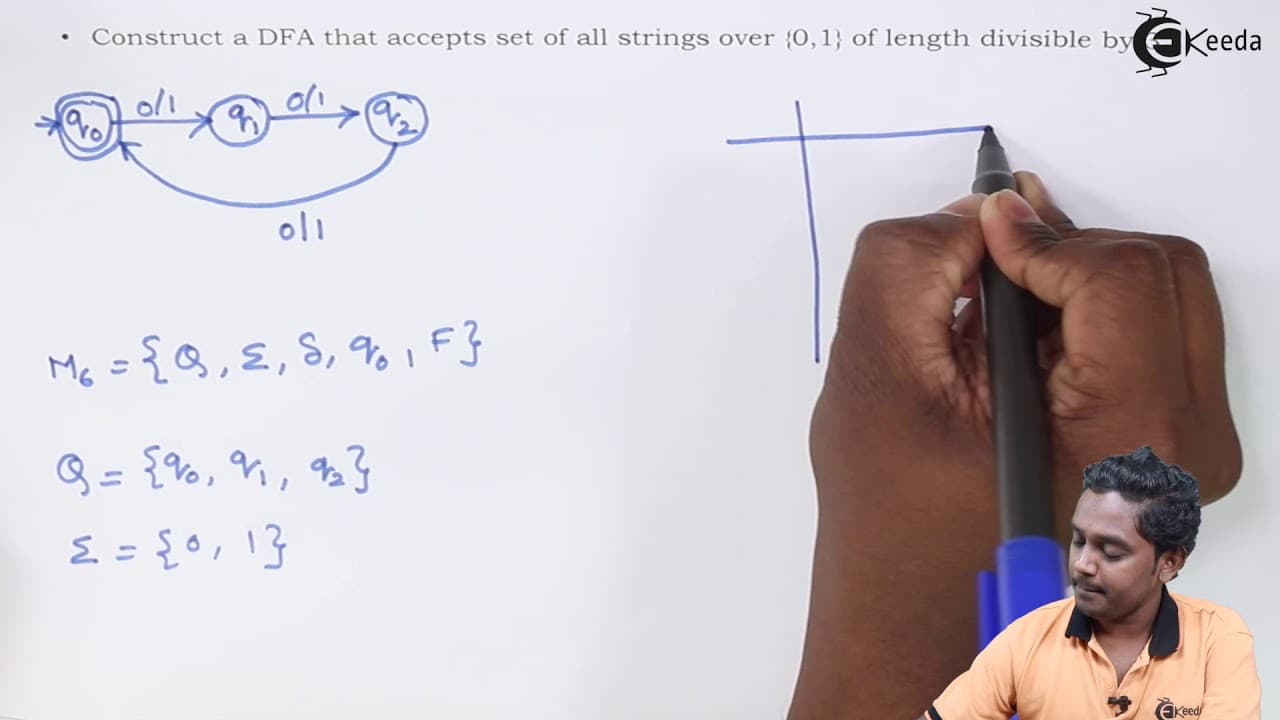
click the bell icon to get latest videos from equator hello friends in the last video we have seen a few question which were very easy to do since design as a TFA let's see few more questions on that the question over here is to construct a deterministic finite automata to accept the strings or even leant on a given input alphabet 0 & 1 let's see w... Read More
Key Insights
- 😫 DFAs are used to recognize languages or patterns based on a set of rules.
- 🔤 The construction of a DFA involves defining the set of states, input alphabet, transition function, initial state, and final state.
- 🎨 Final states determine the acceptance or rejection of input strings, making them crucial in DFA design.
- 🧡 DFAs have broad applications in computer science, ranging from programming languages to DNA analysis.
Install to Summarize YouTube Videos and Get Transcripts
Explore YouTube Video Summarizer or Get YouTube Transcript Extractor
Questions & Answers
Q: What is a Deterministic Finite Automata (DFA)?
A DFA is a theoretical model used in computer science and mathematics to recognize patterns or languages. It consists of a set of states, an input alphabet, a transition function, an initial state, and one or more final states.
Q: How do DFAs work?
DFAs start at the initial state and process each input symbol by transitioning to a new state based on the current state and the input symbol. Once all symbols are processed, the final state determines whether the input string is accepted or rejected.
Q: What is the significance of the final state in a DFA?
The final state represents the acceptance or rejection of an input string. If the DFA ends in a final state, the input string is accepted; otherwise, it is rejected. Choosing the correct final state is crucial in designing a DFA for specific languages.
Q: What are some applications of DFAs?
DFAs have various applications in areas such as programming languages, compilers, network protocols, DNA sequence analysis, and pattern recognition. They are used to detect specific patterns or validate inputs against predefined languages.
Summary & Key Takeaways
-
The video explains the concept of deterministic finite automata (DFA) and how they can be used to accept or reject strings based on certain conditions.
-
Two examples of constructing DFAs are provided: one for accepting even length strings and another for accepting strings with lengths divisible by three.
-
The video demonstrates the process of designing DFAs by defining the set of states, input alphabet, transition function, initial state, and final state.
-
The examples highlight the importance of choosing the correct final state based on the language being recognized by the DFA.
Read in Other Languages (beta)
Share This Summary 📚
Summarize YouTube Videos and Get Video Transcripts with 1-Click
Try YouTube Summary with ChatGPT & Claude or YouTube Transcript Generator
Explore More Summaries from Ekeeda 📚





Summarize YouTube Videos and Get Video Transcripts with 1-Click
Try YouTube Summary with ChatGPT & Claude or YouTube Transcript Generator