Problem on Derivatives of Inverse Trigonometric Function Using Substitution Part 4 - Diploma Maths 2
TL;DR
This video explains how to find derivatives of inverse trigonometric functions using substitution, with step-by-step examples.
Transcript
click the Bell icon to get latest videos from equator hello friends in this video we are going to continue on how to find a derivative of inverse trigonometric function using substitution let us start in problem number eight we have if Y is equal to tan inverse of under root 1 plus X square minus 1 upon X find dy by DX y is tan inverse under root 1... Read More
Key Insights
- 😑 Substitution can simplify the expression of inverse trigonometric functions, making it easier to find their derivatives.
- 😑 Conversion of expressions involving square roots and inverse trigonometric functions to basic trigonometric ratios is often helpful.
- 😑 Differentiation of inverse trigonometric functions involves applying the chain rule and simplifying the expressions step by step.
- 🔺 Trigonometric identities and formulas, such as half-angle formulas and complementary angle formulas, are used to simplify the expressions.
Install to Summarize YouTube Videos and Get Transcripts
Explore YouTube Video Summarizer or Get YouTube Transcript Extractor
Questions & Answers
Q: What is the purpose of substitution when finding the derivative of inverse trigonometric functions?
Substitution is used to simplify the expression and make it easier to find the derivative. By substituting x = tan(theta), the expression can be rewritten in terms of sine and cosine, which are easier to differentiate.
Q: How is the expression tan inverse(sqrt(1 + x^2) - 1/x) simplified?
The expression is simplified by using trigonometric identities and formulas. It is converted to tan inverse(1 - cos(theta))/sin(theta), and further simplified to tan inverse(2sin^2(theta/2)/cos(theta/2)).
Q: How do you differentiate the function Y = theta/2 with respect to x?
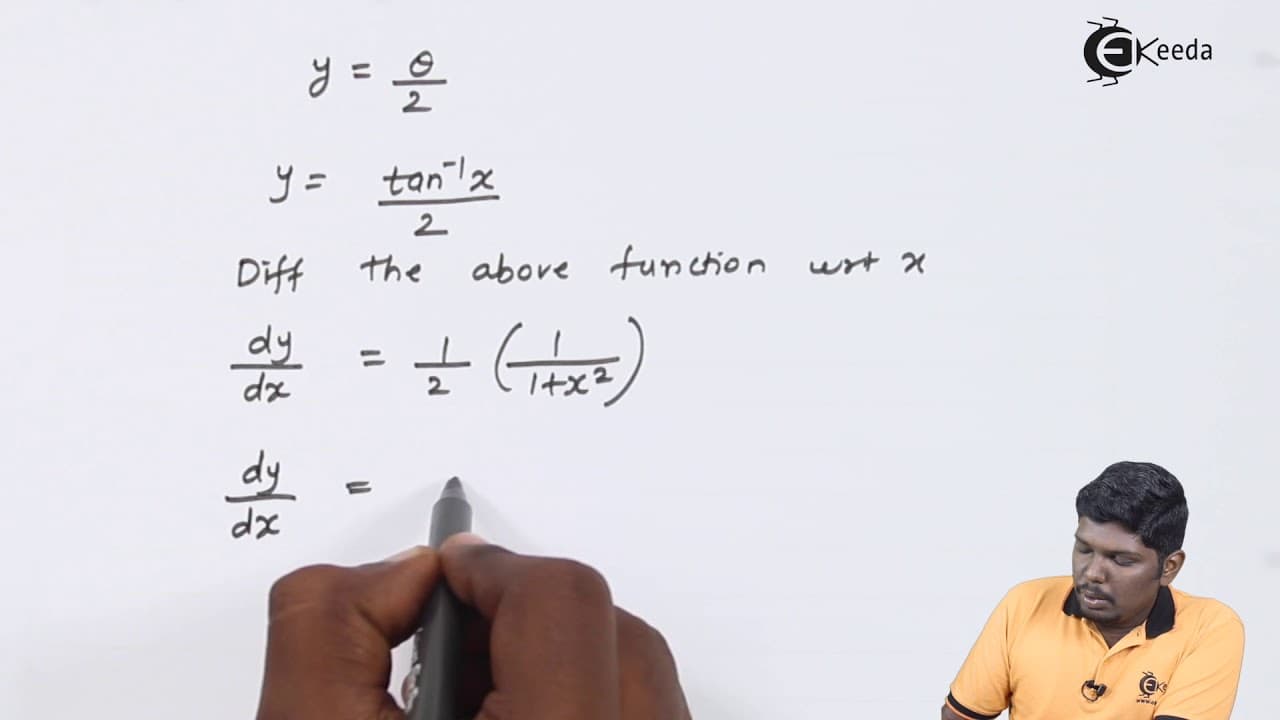
Since the expression is not in terms of x, the value of theta is substituted back in, which is tan inverse(x/2). Differentiating theta/2 with respect to x gives the derivative of Y as 1/(2(1 + x^2)).
Q: What is the derivative of Y = tan inverse(sqrt(1 + cos)/1 - cos)?
The expression can be simplified using trigonometric identities to tan inverse(cot(x/2)). By differentiating this expression with respect to x, the derivative of Y is found to be -1/2.
Summary & Key Takeaways
-
The video demonstrates how to find the derivative of the function Y = tan inverse(sqrt(1 + x^2) - 1/x) using the substitution method.
-
The process involves substituting x = tan(theta) and simplifying the expression to involve basic trigonometric ratios like sine and cosine.
-
By simplifying the expression further, the final derivative of Y with respect to x is found to be 1/(2(1 + x^2)).
Read in Other Languages (beta)
Share This Summary 📚
Summarize YouTube Videos and Get Video Transcripts with 1-Click
Try YouTube Summary with ChatGPT & Claude or YouTube Transcript Generator
Explore More Summaries from Ekeeda 📚






Summarize YouTube Videos and Get Video Transcripts with 1-Click
Try YouTube Summary with ChatGPT & Claude or YouTube Transcript Generator