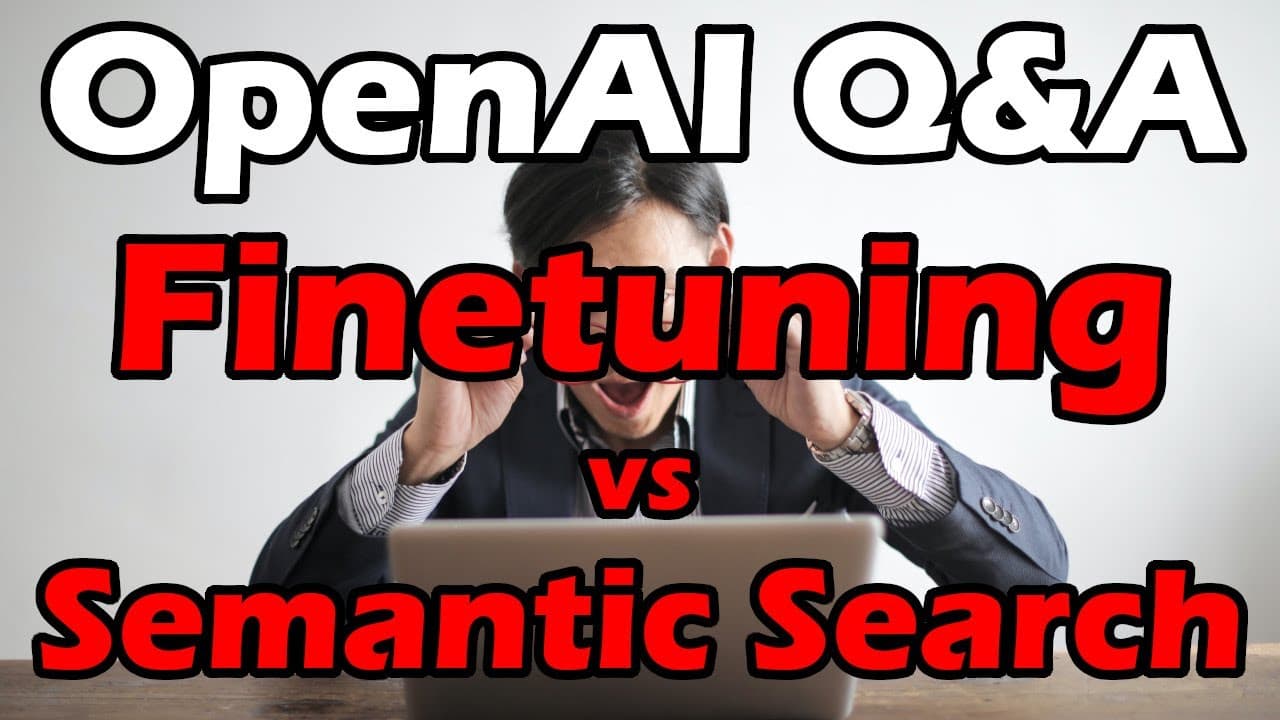
OpenAI Q&A: Finetuning GPT-3 vs Semantic Search - which to use, when, and why?
TL;DR
Fine-tuning is not an effective method for training models on new information for question-answering tasks, while semantic search provides faster, easier, and cheaper solutions.
Transcript
morning everybody David Shapiro here with another video so this is a question that I get a lot people ask how do I fine-tune uh gpt3 on my Corpus of data so that I can ask questions um so let's talk about fine tuning versus search uh when to use which and why so as I just mentioned I get a lot of questions about QA how do I how do I train my model ... Read More
Key Insights
- 👶 Fine-tuning is a transfer learning method for training models on new tasks, not new information.
- 👻 Semantic search allows for efficient and scalable searching based on semantic meaning.
- 🖤 Fine-tuning is slow, expensive, and lacks reliability as an information store.
- 💨 Semantic search is faster, cheaper, and can recall exact information.
- 👶 Fine-tuning requires constant retraining, while semantic search can easily add new information to databases.
- 🖤 Fine-tuning has limits in understanding knowledge and lacks a cognitive architecture.
- 👶 Fine-tuning is an entirely new discipline, and most people find it difficult to master.
Install to Summarize YouTube Videos and Get Transcripts
Explore YouTube Video Summarizer or Get YouTube Transcript Extractor
Questions & Answers
Q: Is fine-tuning effective for training models on new information for question-answering tasks?
No, fine-tuning is not reliable as an information store and requires constant retraining. It teaches models new tasks rather than new information.
Q: How does semantic search work?
Semantic search uses semantic embeddings, which represent the meaning of the text, to search databases based on context and topics discussed in the records. It is faster, cheaper, and can recall exact information.
Q: What are the drawbacks of fine-tuning for question-answering?
Fine-tuning is slow, difficult, and expensive. It does not overrule confabulation or hallucination and lacks a theory of knowledge. It is not a scalable solution and requires constant retraining.
Q: Can fine-tuned models be used in the QA process?
Fine-tuned models can be used as a component in the QA process, helping with answering specific questions from a given corpus. However, it is not necessary, especially with the latest aligned models.
Summary & Key Takeaways
-
Fine-tuning is a type of transfer learning used to teach models new tasks, while semantic search allows databases to search for information based on semantic meaning.
-
Fine-tuning is not reliable as an information store and requires constant retraining, while semantic search can efficiently scale and recall exact information.
-
Fine-tuning is slow, difficult, and expensive, while semantic search is fast, easy, and cost-effective.
Read in Other Languages (beta)
Share This Summary 📚
Summarize YouTube Videos and Get Video Transcripts with 1-Click
Try YouTube Summary with ChatGPT & Claude or YouTube Transcript Generator
Explore More Summaries from David Shapiro 📚


![Claude 3 Review - LLMs are finally good at fiction and prose! [Cyberpunk Fanfic] thumbnail](/_next/image?url=https%3A%2F%2Fi.ytimg.com%2Fvi%2F3anercD5sLA%2Fhqdefault.jpg&w=750&q=75)


Summarize YouTube Videos and Get Video Transcripts with 1-Click
Try YouTube Summary with ChatGPT & Claude or YouTube Transcript Generator