MONETARY POLICY - Expansive vs Restrictive - Explained for beginners!
TL;DR
Central Banks use monetary policies to stabilize economies.
Transcript
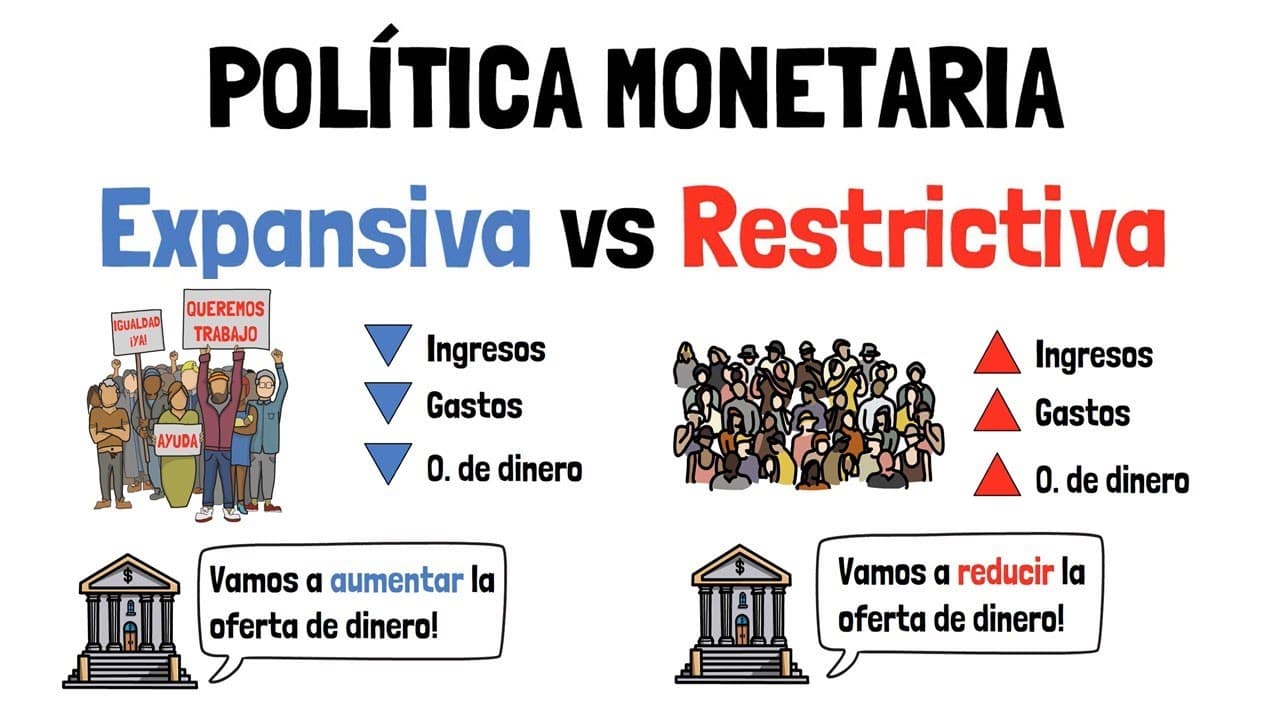
In all countries, there is a monetary authority called the Central Bank, which controls the amount of money in circulation or the money supply. When the economy is growing, people earn more and spend more, so the amount of money in circulation tends to rise, causing inflation. To tackle inflation, the Central Bank reduces the supply of money. On th... Read More
Key Insights
- Central Banks control money supply to maintain economic stability, using expansionary or restrictive policies depending on economic conditions.
- An expansionary monetary policy involves increasing the money supply to combat deflation and encourage spending during economic downturns.
- A restrictive monetary policy reduces the money supply to control inflation during periods of economic growth.
- The discount rate is a tool used by Central Banks to influence the cost of borrowing, affecting the money supply.
- Adjusting the bank legal reserve rate allows Central Banks to control the amount of money commercial banks can lend or invest.
- Open Market Operations involve buying or selling public debt securities to either inject or extract money from the economy.
- By lowering the discount rate and legal reserve rate or purchasing securities, Central Banks can increase the money supply.
- Conversely, raising the discount rate and legal reserve rate or selling securities helps to reduce the money supply.
Install to Summarize YouTube Videos and Get Transcripts
Explore YouTube Video Summarizer or Get YouTube Transcript Extractor
Questions & Answers
Q: What is the role of the Central Bank in monetary policy?
The Central Bank is responsible for controlling the money supply in an economy to maintain stability. It uses monetary policy to either increase or decrease the amount of money in circulation, depending on economic conditions, to manage inflation and deflation effectively.
Q: How does the Central Bank use the discount rate to influence the economy?
The discount rate is the interest rate charged by the Central Bank on loans to commercial banks. By raising the discount rate, the Central Bank makes borrowing more expensive, reducing the money supply. Conversely, lowering the rate makes borrowing cheaper, increasing the money supply and stimulating economic activity.
Q: What is the bank legal reserve rate, and how does it affect the money supply?
The bank legal reserve rate is the percentage of deposits that commercial banks must hold as reserves and not use for loans or investments. Lowering this rate allows banks to lend more, increasing the money supply. Raising the rate restricts lending, reducing the money supply to control inflation.
Q: Explain Open Market Operations and their role in monetary policy.
Open Market Operations involve the Central Bank buying or selling government securities to influence the money supply. By purchasing securities, the Central Bank injects money into the economy, increasing the supply. Selling securities extracts money, reducing the supply, which can help control inflation.
Q: What is the difference between expansionary and restrictive monetary policy?
Expansionary monetary policy aims to increase the money supply to combat deflation and stimulate economic activity during downturns. Restrictive monetary policy seeks to decrease the money supply to control inflation during periods of economic growth, ensuring stability by managing the flow of money.
Q: How does monetary policy impact inflation and deflation?
Monetary policy directly affects inflation and deflation by adjusting the money supply. Increasing the money supply can reduce deflation by encouraging spending, while decreasing it can control inflation by reducing spending. Central Banks use these adjustments to stabilize the economy and maintain balance.
Q: Why is understanding monetary policy important for economic stability?
Understanding monetary policy is crucial because it helps explain how Central Banks manage economic fluctuations. By regulating the money supply, they can address inflation and deflation, ensuring a stable economic environment that supports growth, investment, and consumer confidence.
Q: What are the main tools used by Central Banks in monetary policy?
Central Banks use three main tools in monetary policy: the discount rate, bank legal reserve rate, and Open Market Operations. These tools allow them to influence borrowing, lending, and the overall money supply, enabling them to manage economic conditions and maintain stability effectively.
Summary & Key Takeaways
-
Central Banks use monetary policy to regulate the economy's money supply, aiming to maintain stability. They apply expansionary policies to increase money supply during downturns and restrictive policies to decrease it during growth periods.
-
Monetary policy tools include the discount rate, bank legal reserve rate, and Open Market Operations, which Central Banks adjust to influence borrowing, lending, and money circulation.
-
Understanding these monetary policies is crucial for grasping how Central Banks stabilize economies by managing inflation and deflation through strategic adjustments of the money supply.
Read in Other Languages (beta)
Share This Summary 📚
Summarize YouTube Videos and Get Video Transcripts with 1-Click
Try YouTube Summary with ChatGPT & Claude or YouTube Transcript Generator
Explore More Summaries from Kotaro en Español 📚


Summarize YouTube Videos and Get Video Transcripts with 1-Click
Try YouTube Summary with ChatGPT & Claude or YouTube Transcript Generator