What Is Non-Deterministic Finite Automata (NFA)?
TL;DR
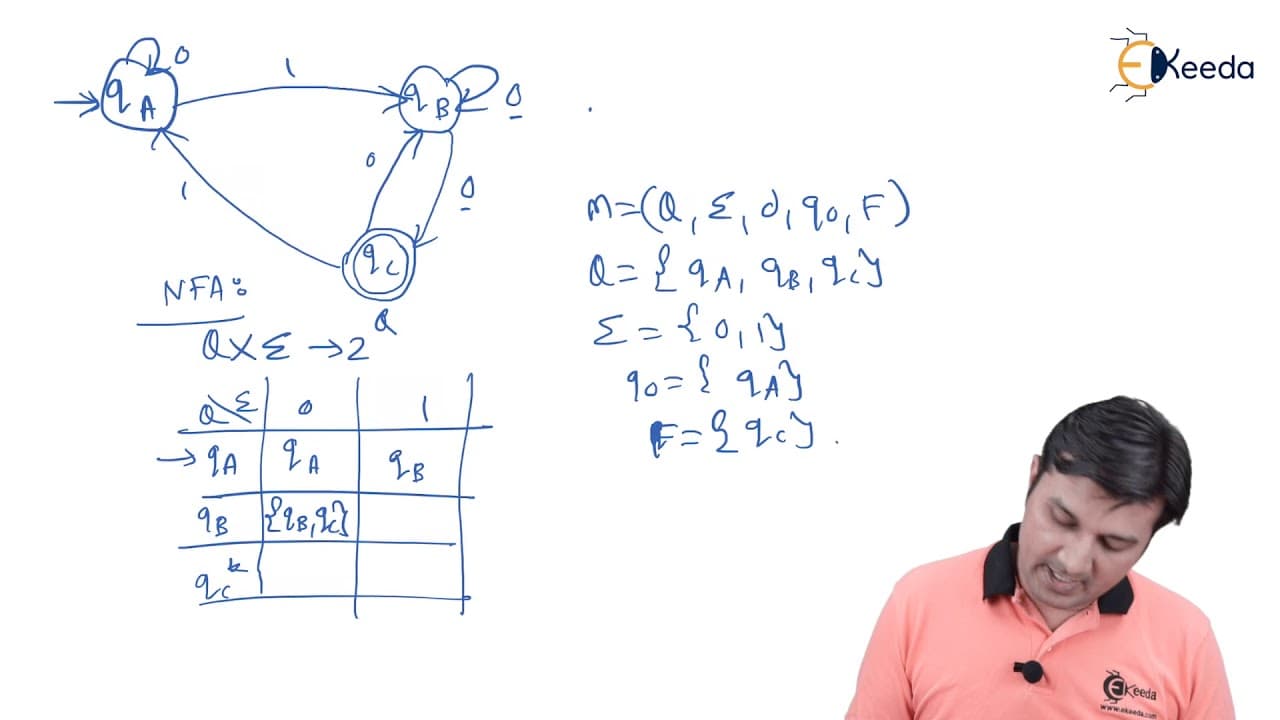
Non-Deterministic Finite Automata (NFA) allows for zero, one, or more transitions from each state on each input symbol, making it more flexible than Deterministic Finite Automata (DFA), which permits exactly one transition. The NFA shares a similar mathematical representation with DFA but differs in how transitions are expressed, enabling it to handle more complex patterns in computations.
Transcript
hello friends welcome to the next session here we are going to study what is non-deterministic finite automata let's get started now non-deterministic finite automata is something which is going to be very non deterministic in nature that is Street jumping onto the definition I see it consists of a finite set of states one state is called as the st... Read More
Key Insights
- 🔣 NFA allows for zero, one, or more transitions from each state on each input symbol, making it more unpredictable than DFA.
- 💨 The mathematical representation of NFA is similar to that of DFA, but with some differences in the way transitions are represented.
- 🚰 The transition table is an important component of NFA, helping to visualize the possible transitions from each state.
- 🍵 NFA can handle more complex patterns than DFA, but it can also be more time-consuming to design and analyze.
- 🖐️ NFA is a fundamental concept in computer science and plays a crucial role in areas such as formal languages and automata theory.
- 😑 NFA is often used in regular expression matching and can be converted to an equivalent DFA for efficient processing.
- 👶 The conversion of NFA to DFA involves creating a new DFA that simulates the behavior of the NFA.
Install to Summarize YouTube Videos and Get Transcripts
Explore YouTube Video Summarizer or Get YouTube Transcript Extractor
Questions & Answers
Q: How does NFA differ from DFA?
DFA allows for exactly one transition from each state on each input symbol, while NFA allows for zero, one, or more transitions.
Q: What is the mathematical representation of NFA?
The mathematical representation of NFA includes a finite set of states (Q), an input alphabet (Σ), a transition function (δ), a start state (q0), and a set of final states (F).
Q: How is the transition function represented in NFA?
In NFA, the transition function (δ) is represented as Q x Σ → 2^Q, where 2^Q represents the set of all possible subsets of Q.
Q: What is the purpose of the transition table in NFA?
The transition table represents the possible transitions from each state on each input symbol, providing a clear overview of the NFA behavior.
Summary & Key Takeaways
-
NFA consists of a finite set of states, a start state, and zero or more final states. It differs from Deterministic Finite Automata (DFA) in that it allows for multiple transitions from each state on each input symbol.
-
The mathematical representation of NFA is similar to that of DFA, with some differences in the way transitions are represented.
-
The transition table is an important component of NFA, representing the possible transitions from each state on each input symbol.
Read in Other Languages (beta)
Share This Summary 📚
Summarize YouTube Videos and Get Video Transcripts with 1-Click
Try YouTube Summary with ChatGPT & Claude or YouTube Transcript Generator
Explore More Summaries from Ekeeda 📚


Summarize YouTube Videos and Get Video Transcripts with 1-Click
Try YouTube Summary with ChatGPT & Claude or YouTube Transcript Generator