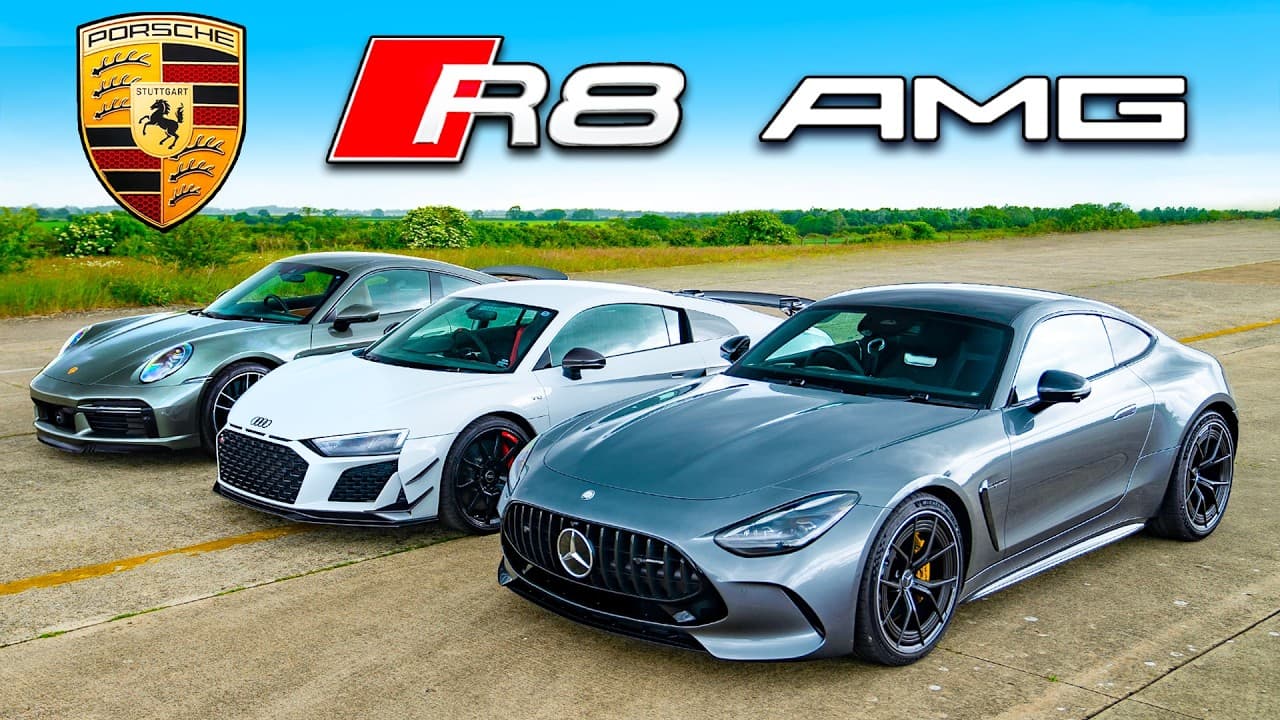
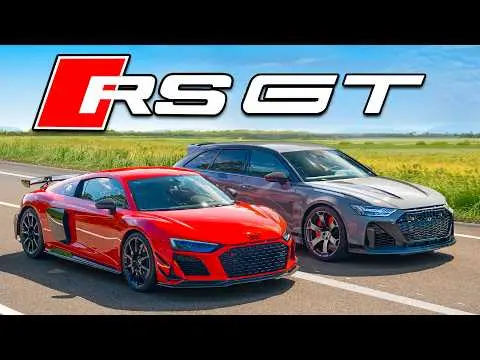
New AMG GT 63 v R8 GT v 911 Turbo: DRAG RACE
TL;DR
Porsche 911 Turbo S dominates AMG GT 63 and Audi R8 GT.
Transcript
well we'll win in a drag race between the new Mercedes AMG gt63 Coupe an Audi R8 V10 GT and a Porsche 911 Turbo S well we're going to have a drag race to compare them over the standing quarter mile I'm Matt Watson you're watching carwow so let me tell you about this new AMG GT coupe it has a 4 L twin turbo V8 and it puts out 585 horsepower 800 Newt... Read More
Key Insights
- The Mercedes-AMG GT 63 features a 4-liter twin-turbo V8 engine, producing 585 horsepower and 800 Nm of torque, with power distributed to all four wheels.
- The Audi R8 GT is equipped with a 5.2-liter naturally aspirated V10 engine, delivering 620 horsepower and 565 Nm of torque, but only to the rear wheels.
- The Porsche 911 Turbo S has a 3.8-liter twin-turbo flat-six engine, producing 650 horsepower and 800 Nm of torque, with all-wheel drive capability.
- Despite its power, the AMG GT 63 is the heaviest at 2,130 kg, which impacts its performance in drag races against lighter competitors.
- The Audi R8 GT, while the most expensive at £200,000, struggles with traction due to its rear-wheel drive setup, affecting its acceleration.
- The Porsche 911 Turbo S, costing £180,000, showcases superior launch capabilities and acceleration, winning the drag race convincingly.
- In rolling race scenarios, the Porsche continues to outperform, demonstrating its efficient power delivery and superior engineering.
- The brake test highlights the Porsche's impressive stopping power, further solidifying its status as the top performer among the three vehicles.
Install to Summarize YouTube Videos and Get Transcripts
Explore YouTube Video Summarizer or Get YouTube Transcript Extractor
Questions & Answers
Q: What are the engine specifications of the Mercedes-AMG GT 63?
The Mercedes-AMG GT 63 is powered by a 4-liter twin-turbo V8 engine that produces 585 horsepower and 800 Nm of torque. The power is delivered to all four wheels through a 9-speed automatic gearbox equipped with a multi-clutch system and launch control.
Q: How does the Audi R8 GT's drivetrain affect its performance?
The Audi R8 GT's performance is impacted by its rear-wheel drive setup, which, despite its 620 horsepower and 565 Nm of torque from a 5.2-liter V10 engine, results in traction issues. This limits its acceleration and makes it less competitive in drag races against all-wheel drive rivals.
Q: What makes the Porsche 911 Turbo S stand out in these races?
The Porsche 911 Turbo S stands out due to its powerful 3.8-liter twin-turbo flat-six engine, producing 650 horsepower and 800 Nm of torque. Its all-wheel drive system provides excellent traction, allowing for superior launch and acceleration, making it the top performer in both drag and rolling races.
Q: What was the main challenge for the Mercedes-AMG GT 63 in the race?
The main challenge for the Mercedes-AMG GT 63 was its weight, tipping the scales at 2,130 kg. This significantly impacted its acceleration and overall performance, making it less competitive against the lighter and more agile Porsche 911 Turbo S and Audi R8 GT.
Q: How did the Porsche perform in the brake test compared to its competitors?
In the brake test, the Porsche 911 Turbo S demonstrated superior stopping power, outperforming both the Mercedes-AMG GT 63 and the Audi R8 GT. Its advanced braking system allowed it to stop in the shortest distance, showcasing its engineering excellence.
Q: Why did the Audi R8 GT struggle in the drag races?
The Audi R8 GT struggled in the drag races primarily due to its rear-wheel drive configuration, which limited its traction and acceleration. Despite having a powerful V10 engine, the lack of all-wheel drive made it challenging to compete against the Porsche and Mercedes, both of which have better traction control systems.
Q: What were the results of the standing quarter-mile race?
In the standing quarter-mile race, the Porsche 911 Turbo S completed the distance in 10.4 seconds, securing first place. The Audi R8 GT finished in 11.1 seconds, and the Mercedes-AMG GT 63 came in last with a time of 11.2 seconds, highlighting the Porsche's superior performance.
Q: How did the vehicles perform in the rolling race?
In the rolling race, the Porsche 911 Turbo S again demonstrated its superior performance, quickly accelerating and leaving its competitors behind. The Audi R8 GT managed to keep up initially, but the Porsche's efficient power delivery allowed it to pull ahead, while the Mercedes-AMG GT 63 lagged further behind.
Summary & Key Takeaways
-
In a thrilling drag race, the Porsche 911 Turbo S outperformed its competitors, the Mercedes-AMG GT 63 and Audi R8 GT, thanks to its superior power and all-wheel drive system.
-
Despite the AMG GT 63's powerful engine, its heavy weight hindered its performance, while the Audi R8 GT struggled with traction due to its rear-wheel drive setup.
-
The Porsche's excellent launch and braking capabilities were key factors in its dominance, making it the standout performer in both drag and rolling races.
Read in Other Languages (beta)
Share This Summary 📚
Summarize YouTube Videos and Get Video Transcripts with 1-Click
Try YouTube Summary with ChatGPT & Claude or YouTube Transcript Generator
Explore More Summaries from carwow 📚


Summarize YouTube Videos and Get Video Transcripts with 1-Click
Try YouTube Summary with ChatGPT & Claude or YouTube Transcript Generator