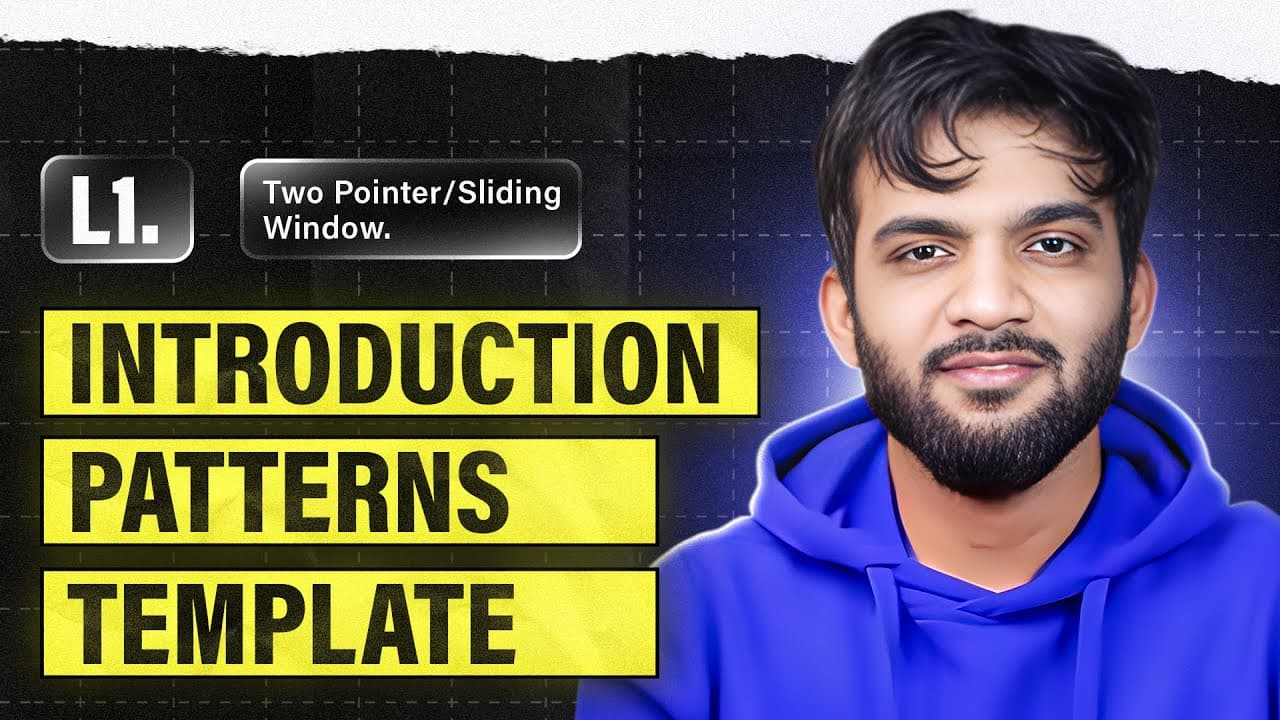
L1. Introduction to Sliding Window and 2 Pointers | Templates | Patterns
TL;DR
Introduction to sliding window and two-pointer techniques with problem-solving patterns.
Transcript
so with this video we will be starting off with the 2 pointer and the sliding window playlist from the sters A2Z DS course in case you haven't checked out our DSA course please make sure you check it out the link will be in the description but before starting off hey everyone welcome back to the channel I hope you guys are doing extremely w... Read More
Key Insights
- The video introduces the sliding window and two-pointer techniques, emphasizing their importance in problem-solving, especially in coding interviews.
- Sliding window and two-pointer methods are not typical algorithms to memorize but require understanding concepts and applying them to specific problems.
- Four common patterns in sliding window problems include constant window size, longest subarray with conditions, counting subarrays, and finding the shortest window.
- Constant window problems involve maintaining a fixed window size and shifting it across the array to find optimal solutions.
- Longest subarray problems require expanding the window until the condition is violated, then shrinking it to maintain validity, optimizing for the longest valid subarray.
- Counting subarrays with specific conditions often involves breaking down the problem into smaller subproblems and using subtraction to find the desired count.
- Shortest window problems involve finding a valid window and then shrinking it to find the smallest valid window that meets the condition.
- The video emphasizes the importance of understanding these patterns and practicing with various problems to become proficient in interviews and coding challenges.
Install to Summarize YouTube Videos and Get Transcripts
Explore YouTube Video Summarizer or Get YouTube Transcript Extractor
Questions & Answers
Q: What is the main focus of the video?
The video focuses on introducing the sliding window and two-pointer techniques, which are crucial for solving algorithmic problems, particularly in interviews. It explains the concepts, patterns, and templates for effectively applying these methods to various problems.
Q: How are constant window problems approached?
Constant window problems involve maintaining a fixed window size and shifting it across the array to optimize the solution. The technique uses two pointers to define the window's boundaries and adjusts the sum or condition based on the problem's requirements.
Q: What is the approach for longest subarray problems?
Longest subarray problems require expanding the window until the condition is violated, then shrinking it to maintain validity. The goal is to find the longest valid subarray while optimizing the process by strategically expanding and shrinking the window.
Q: How are counting subarray problems solved?
Counting subarray problems are often broken down into smaller subproblems. By finding the number of subarrays with conditions less than or equal to a certain value and subtracting from another condition, the desired count can be determined. This approach uses pattern two techniques.
Q: What is the strategy for finding the shortest window?
Finding the shortest window involves identifying a valid window and then shrinking it to find the smallest window that still meets the condition. This approach requires careful management of the window's boundaries to ensure the condition is maintained while minimizing the window size.
Q: Why are these techniques important for interviews?
Sliding window and two-pointer techniques are important for interviews because they provide efficient solutions to common algorithmic problems. Understanding these patterns and practicing with various problems can significantly enhance problem-solving skills and performance in coding interviews.
Q: How does the video suggest practicing these techniques?
The video suggests practicing these techniques by solving a variety of problems that follow the outlined patterns. By applying the templates and understanding the concepts, viewers can become proficient in using sliding window and two-pointer methods in different scenarios.
Q: What resources are recommended for further learning?
The video recommends checking out the A2Z DSA course for more detailed explanations and problem sets related to sliding window and two-pointer techniques. Additionally, viewers are encouraged to follow the entire playlist and other social media handles for continuous learning and updates.
Summary & Key Takeaways
-
The video is an introduction to sliding window and two-pointer techniques, essential for solving algorithmic problems, especially in interviews. It outlines four main patterns and provides templates for approaching these problems effectively.
-
Constant window problems involve maintaining a fixed window size, while longest subarray problems require expanding and shrinking the window based on validity conditions. These techniques help optimize problem-solving strategies.
-
Counting subarrays with conditions and finding the shortest window are advanced patterns that require breaking down problems into subproblems and using strategic shrinking and expanding techniques to find optimal solutions.
Read in Other Languages (beta)
Share This Summary 📚
Summarize YouTube Videos and Get Video Transcripts with 1-Click
Try YouTube Summary with ChatGPT & Claude or YouTube Transcript Generator
Explore More Summaries from take U forward 📚


Summarize YouTube Videos and Get Video Transcripts with 1-Click
Try YouTube Summary with ChatGPT & Claude or YouTube Transcript Generator