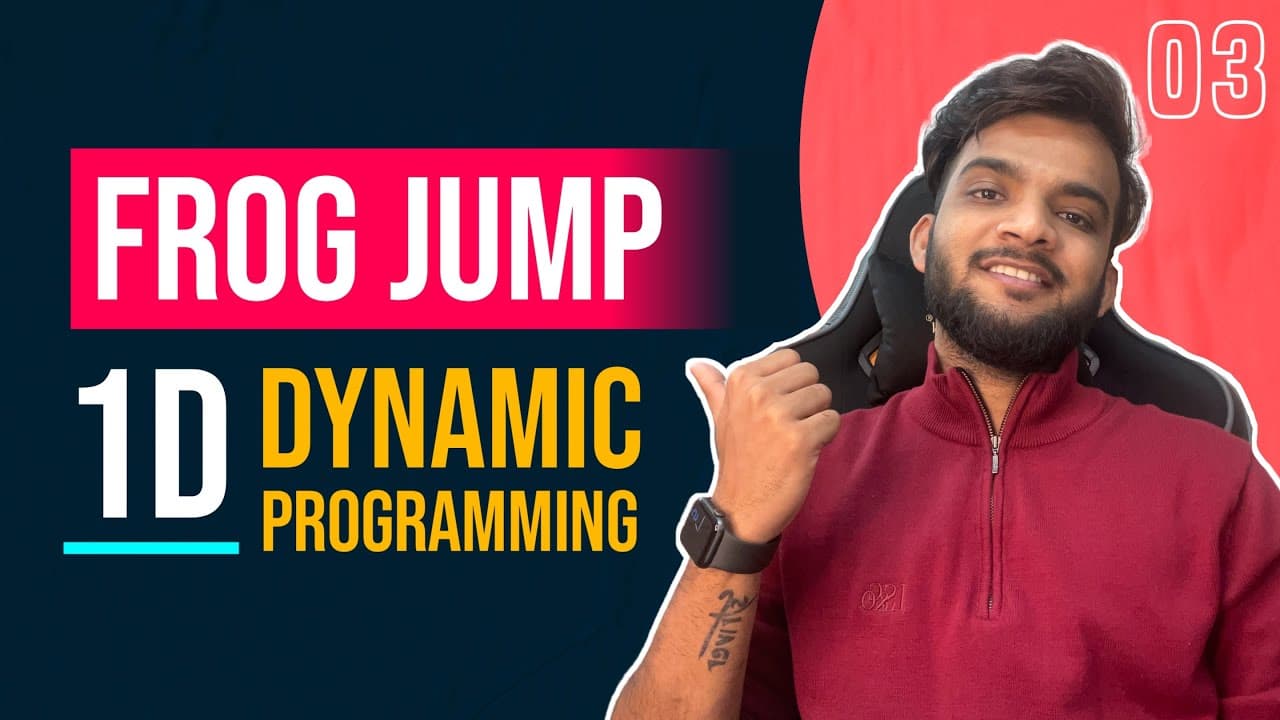
DP 3. Frog Jump | Dynamic Programming | Learn to write 1D DP
TL;DR
This video explains a dynamic programming problem called "Frog Jump" where a frog wants to jump from one stair to another, with the goal of minimizing the total energy used.
Transcript
hey everyone welcome back to the channel i hope you guys are doing extremely well so welcome to the third lecture of the dynamic programming playlist it's a wonderful question frog jump so just to make sure you have watched the previous couple of lectures before attending this one because i have a perfect flow which i will continue so if you're lik... Read More
Key Insights
- 🐸 The frog jumps between stairs in order to reach the final stair, and the goal is to minimize the energy used.
- 💡 The problem can be solved using dynamic programming by breaking it down into subproblems and storing the minimum energy required for each state.
- 💭 The greedy approach, where the frog always chooses the locally optimal jump, does not work in this case as it may lead to a suboptimal solution.
- 🔁 Recursion can be used to try all possible jumps and find the minimum energy required.
- 🔢 The problem can be solved using tabulation, which starts from the smallest subproblem and builds up to the final solution.
- 🧠 Memoization, a top-down approach, can be used to store the results of previously solved subproblems to avoid redundant computations.
- 📉 By using space optimization techniques, such as using variables instead of an array, the memory usage can be reduced.
- 📚 A follow-up question involves modifying the problem to allow for k jumps between stairs, which requires a different approach and cannot be solved using space optimization.
Install to Summarize YouTube Videos and Get Transcripts
Explore YouTube Video Summarizer or Get YouTube Transcript Extractor
Questions & Answers
Q: What is the objective of the "Frog Jump" dynamic programming problem?
The objective is to minimize the total energy used by the frog to jump from the first stair to the last stair on a staircase.
Q: Why is a greedy solution not suitable for this problem?
A greedy solution does not work because it only considers the immediate optimal choice at each step, which can lead to suboptimal overall solutions.
Q: What are the steps involved in converting a recursive solution to a dynamic programming solution?
The steps involve expressing the problem in terms of index, doing all the computations on that index, finding the minimum energy, and then using memoization or tabulation to store and reuse subproblem solutions.
Q: What are the advantages of using dynamic programming over a recursive solution?
Dynamic programming allows for the reuse of subproblem solutions, improving efficiency by eliminating redundant computation. It also allows for better control and analysis of time and space complexity.
Q: Can you explain the difference between memoization and tabulation in dynamic programming?
Memoization involves storing the results of already computed subproblems in a data structure (such as an array or hashmap) and reusing them when needed. Tabulation, on the other hand, involves building up the solution from the base case to the final desired case, iteratively filling in a table or array.
Summary & Key Takeaways
-
This video explains the "Frog Jump" dynamic programming problem.
-
The problem involves a frog trying to jump from one stair to another on a staircase, aiming to minimize the energy used.
-
The video shows how to write a recursive solution for the problem, and then convert it into a dynamic programming solution using memoization.
-
Tabulation and space optimization techniques are also discussed.
Read in Other Languages (beta)
Share This Summary 📚
Summarize YouTube Videos and Get Video Transcripts with 1-Click
Try YouTube Summary with ChatGPT & Claude or YouTube Transcript Generator
Explore More Summaries from take U forward 📚





Summarize YouTube Videos and Get Video Transcripts with 1-Click
Try YouTube Summary with ChatGPT & Claude or YouTube Transcript Generator