Leakage Current in CE - Bipolar Junction Transistor - Basic Electronics
TL;DR
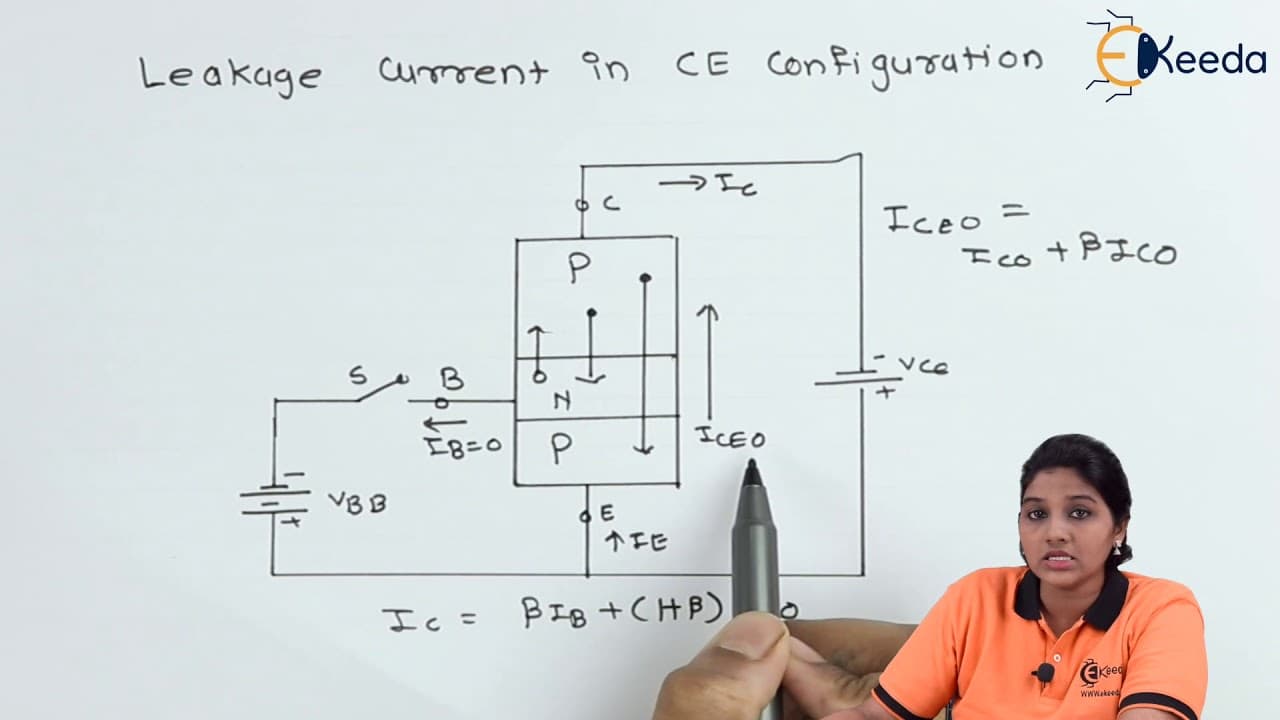
This video explains the concept of leakage current in a common emitter configuration, its generation, and its impact on the transistor's operation.
Transcript
click the Bell icon to get latest videos from equator hello friends in today's video we are going to see leakage current that is reverse saturation current in common emitter configuration how it generated and what its effect on the operation of transistor so let's begin with the topic common emitter configuration is nothing but the configuration in... Read More
Key Insights
- ⚾ A common emitter configuration in a transistor involves the emitter terminal as the common terminal, with the base-emitter junction as the input and the collector-emitter junction as the output.
- 🕳️ Under normal operation, holes move from the emitter to the base, resulting in current flow.
- 🌥️ The collector current is dependent on the value of beta and is significantly larger in a common emitter configuration compared to a common base configuration.
- ⚾ The reverse saturation or leakage current is caused by thermally generated minority carriers, namely electrons, which diffuse across the base-emitter junction.
- ◀️ The magnitude of the reverse saturation current is influenced by temperature, with a doubling effect for every 10 degrees Celsius change.
- ⌛ In a common emitter configuration, the collector current is given by the sum of the normal transistor action current (beta times the base current) and the leakage current (beta divided by beta+1 times the reverse saturation current).
- ❓ The value of beta is typically provided by the manufacturer and remains constant in a common emitter configuration.
Install to Summarize YouTube Videos and Get Transcripts
Explore YouTube Video Summarizer or Get YouTube Transcript Extractor
Questions & Answers
Q: What is the common emitter configuration in a transistor?
Common emitter configuration refers to a transistor configuration where the emitter terminal is considered a common terminal, with the base-emitter junction as the input and the collector-emitter junction as the output.
Q: How is the collector current affected by the value of beta?
The collector current in a common emitter configuration is given by beta times the base current. Therefore, the value of beta directly influences the magnitude of the collector current.
Q: What causes the reverse saturation or leakage current in a common emitter configuration?
The reverse saturation or leakage current is caused by thermally generated minority carriers, specifically electrons, which diffuse across the base-emitter junction.
Q: How does temperature affect the reverse saturation current?
The value of reverse saturation current doubles for every 10 degrees Celsius increase or decrease in temperature. Therefore, temperature directly affects the magnitude of the reverse saturation current.
Summary & Key Takeaways
-
Common emitter configuration is a transistor configuration where the emitter terminal is considered a common terminal, with the base-emitter junction as the input and the collector-emitter junction as the output.
-
Under normal operation, with the base-emitter junction forward biased and the collector-emitter junction reverse biased, holes move from the emitter to the base, leading to the flow of current.
-
When the switch is open, the base-emitter junction is disconnected, resulting in zero base current. However, there is a collector current due to thermally generated minority carriers, known as leakage or reverse saturation current.
Read in Other Languages (beta)
Share This Summary 📚
Summarize YouTube Videos and Get Video Transcripts with 1-Click
Try YouTube Summary with ChatGPT & Claude or YouTube Transcript Generator
Explore More Summaries from Ekeeda 📚






Summarize YouTube Videos and Get Video Transcripts with 1-Click
Try YouTube Summary with ChatGPT & Claude or YouTube Transcript Generator