What a Black Hole Looks Like in a Mirror
TL;DR
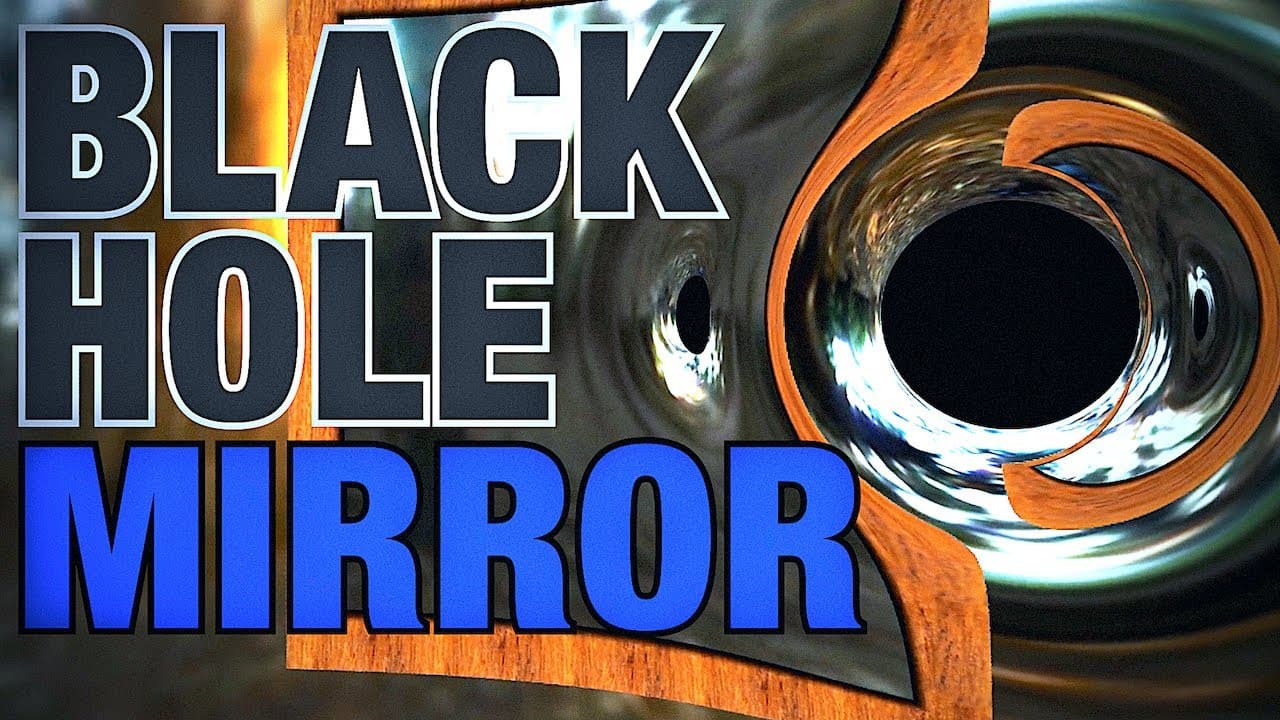
Light behaves strangely around black holes due to the extreme gravitational distortion, resulting in gravitational lensing and heavily distorted images.
Transcript
if I fell into a black hole what would you see as I approach this extreme gravitational distortion every aspect of my image would stretch and distort as I got ever closer I would seem to slow down until I cross the point of no return the event horizon and then a curious fate to be sure because my body's reflected light could not make it back to you... Read More
Key Insights
- 🖤 Black holes are extreme objects with massive gravitational forces and are of great interest to scientists.
- 🙂 Light around black holes bends due to the curvature of space-time, resulting in gravitational lensing and distorted images.
- 🙂 Simulations help scientists understand the complex behavior of light around black holes and visualize the appearance of these objects.
- 🖤 "Interstellar" created a scientifically accurate portrayal of a black hole using equations from theoretical physicist Kip Thorne.
- 🖤 Gravitational lensing offers insights into the nature of black holes and their surrounding environments.
- 🎥 Giant Hollywood budgets can contribute to scientifically accurate visuals in films like "Interstellar."
- 👻 Math and VFX technology allow for the creation of realistic depictions of black holes, aiding scientific understanding.
Install to Summarize YouTube Videos and Get Transcripts
Explore YouTube Video Summarizer or Get YouTube Transcript Extractor
Questions & Answers
Q: How does light behave around black holes?
Light follows the curvature of space-time, resulting in bending and distortion when it comes close to a black hole, creating gravitational lensing.
Q: What is gravitational lensing?
Gravitational lensing is the phenomenon where the paths of light rays are bent as they pass near a massive object like a black hole, leading to distorted images.
Q: How do scientists study what black holes look like?
Scientists use simulations to understand how light behaves around black holes, allowing them to predict and visualize what these extreme objects might look like.
Q: Was the representation of a black hole in the film "Interstellar" accurate?
Yes, the film used equations from theoretical physicist Kip Thorne to create a highly accurate portrayal of a black hole with an accretion disk, leading to a published scientific paper on its depiction.
Summary & Key Takeaways
-
Light bending around black holes causes gravitational lensing, where the paths of light rays are bent, resulting in distorted images.
-
Scientists have made simulations to understand what black holes might look like, revealing the intricate details of distorted light.
-
The film "Interstellar" used equations from theoretical physicist Kip Thorne to create a highly accurate representation of a black hole with an accretion disk.
Read in Other Languages (beta)
Share This Summary 📚
Summarize YouTube Videos and Get Video Transcripts with 1-Click
Try YouTube Summary with ChatGPT & Claude or YouTube Transcript Generator
Explore More Summaries from Kyle Hill 📚

![🔴 Viral "Hanger Reflex" Explained! | [OFFICE HOURS] Podcast 090 thumbnail](/_next/image?url=https%3A%2F%2Fi.ytimg.com%2Fvi%2F-GQPNu0erKc%2Fhqdefault.jpg&w=750&q=75)


Summarize YouTube Videos and Get Video Transcripts with 1-Click
Try YouTube Summary with ChatGPT & Claude or YouTube Transcript Generator