Stanford CS330: Deep Multi-Task & Meta Learning I 2021 I Lecture 18
TL;DR
This lecture explores the frontiers and challenges in multitask and meta learning, focusing on utilizing large language models and making reinforcement learning more data-sponge-like.
Transcript
hi everyone welcome to the last lecture of cs330 um today it's a very exciting lecture we'll be talking about Frontiers and open challenges in multitask and metal learning and we will have um eight um speakers who'll tell us about some of the some of the work that is at the frontier of uh of multitask meta learning and uh and actually other subfiel... Read More
Key Insights
- 🔶 Large language models have the ability to perform zero-shot generalization, making them valuable for a wide range of tasks.
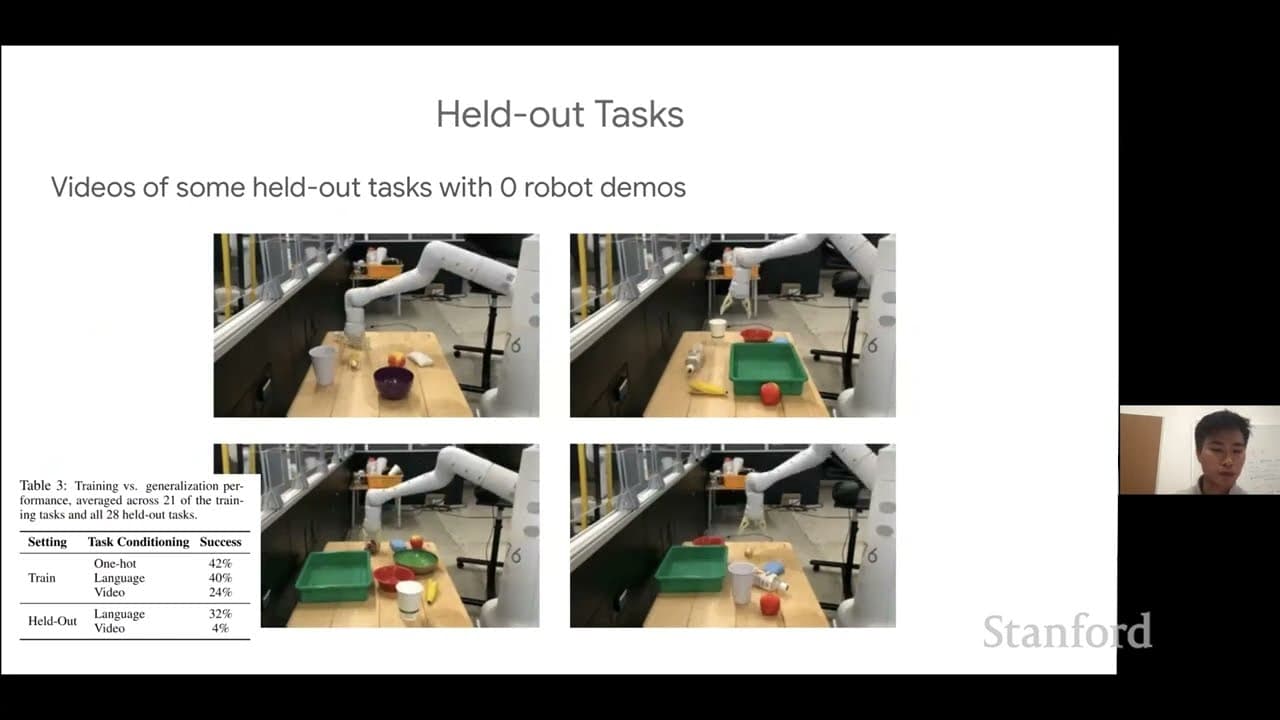
- 🛀 Fine-tuning large language models without negative transfer and applying them to other domains, such as robotics, shows promising results.
- 💄 Making reinforcement learning more data-sponge-like has significant potential for improving sample efficiency and generalization.
- ⚖️ Challenges in scaling up data collection and utilizing diverse data sources can be addressed through autonomous learning algorithms.
Install to Summarize YouTube Videos and Get Transcripts
Explore YouTube Video Summarizer or Get YouTube Transcript Extractor
Questions & Answers
Q: How can large language models perform zero-shot generalization?
Large language models have the ability to perform zero-shot generalization due to their implicit meta-learning capabilities and zero-shot generalization. This ability allows them to generalize to tasks they haven't been trained on at a large scale.
Q: Can the gradient modification process be applied to other forms of meta-learning?
Yes, the gradient modification process can be applied to other forms of meta-learning. Various algorithms, such as Meta Curvature and Warp Grad, already learn transformations of the gradient to enhance expressiveness and adaptability of the models.
Q: How can large language models be applied to domains beyond language, such as robotics?
Large language models can be applied to other domains by fine-tuning them and utilizing their zero-shot generalization capabilities. For example, they can be used in robotics for tasks like math problem solving, code completion, and even as a tool for interactive coding assistance.
Q: How can reinforcement learning be made more data-sponge-like?
Reinforcement learning can be made more data-sponge-like by developing algorithms that allow for the absorption of more data and better generalization. This can involve scaling up data collection, utilizing broader data sources, and developing autonomous learning algorithms that can continue learning without human intervention.
Summary & Key Takeaways
-
The lecture discusses the utilization of large language models for zero-shot generalization and fine-tuning without negative transfer.
-
It explores the application of large language models in other domains, such as robotics, including math problem solving and code completion.
-
The lecture also covers the challenges and strategies for making reinforcement learning more data-sponge-like, including scaling up data collection and utilizing broader data sources.
Read in Other Languages (beta)
Share This Summary 📚
Summarize YouTube Videos and Get Video Transcripts with 1-Click
Try YouTube Summary with ChatGPT & Claude or YouTube Transcript Generator
Explore More Summaries from Stanford Online 📚
Summarize YouTube Videos and Get Video Transcripts with 1-Click
Try YouTube Summary with ChatGPT & Claude or YouTube Transcript Generator