Polar coordinates 3 | Parametric equations and polar coordinates | Precalculus | Khan Academy
TL;DR
Learn how to convert between Cartesian and polar coordinates using algebra and trigonometry.
Transcript
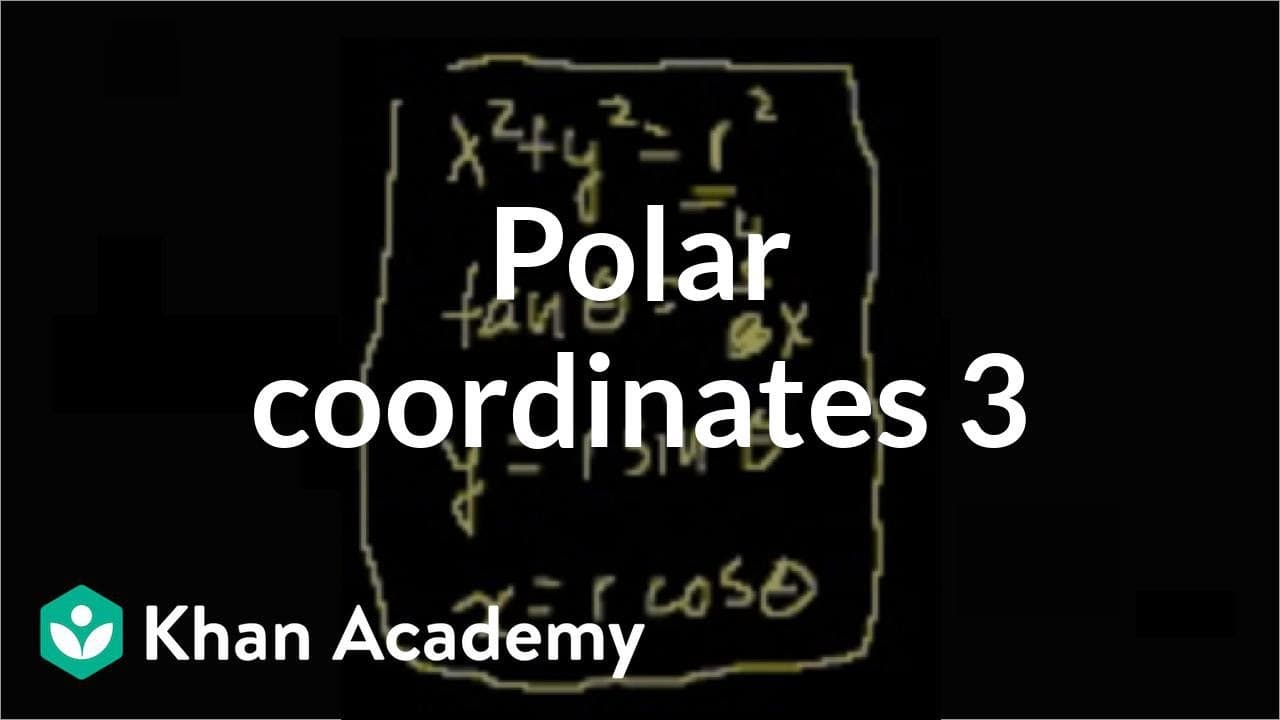
All right, let's keep converting Cartesian functions to polar coordinates. The next one I have here is 3y minus 7x is equal to 10. I cut and pasted our tool kit here, and let's see what we can do. We want to convert this to a function of r and theta. So the simplest thing, we have a y and an x, we just substitute. We know that y is equal to r sine ... Read More
Key Insights
- 🐻❄️ Converting between Cartesian and polar coordinates requires substitution of variables and simplification using trigonometric identities.
- ❣️ Cartesian functions can be converted to polar coordinates by substituting x and y with r cos(theta) and r sin(theta), respectively.
- ❣️ Polar functions can be converted to Cartesian coordinates by dividing both sides of the equation by r and substituting sin(theta) and cos(theta) with y/r and x/r.
- 🔪 The tool kit provides a structured approach to convert coordinates, making the process more organized and easier to comprehend.
- 👻 Converting coordinates allows for easier visualization and understanding of mathematical functions in different coordinate systems.
- ☺️ The resulting equation in Cartesian coordinates will be in implicit form, representing the relationship between x and y.
- ❓ Converting between coordinates involves a combination of algebraic manipulation and trigonometric concepts.
Install to Summarize YouTube Videos and Get Transcripts
Explore YouTube Video Summarizer or Get YouTube Transcript Extractor
Questions & Answers
Q: How do you convert a Cartesian function to polar coordinates?
To convert a Cartesian function to polar coordinates, substitute y with r sin(theta) and x with r cos(theta) in the equation. Simplify as much as possible.
Q: What is the process to convert polar coordinates to Cartesian coordinates?
To convert polar coordinates to Cartesian coordinates, divide both sides of the equation by r and substitute sin(theta) with y/r and cos(theta) with x/r. Simplify the equation further if needed.
Q: What is the significance of the tool kit in converting coordinates?
The tool kit provides a systematic approach to substitute x and y with the appropriate equations in polar coordinates. It simplifies the conversion process for easier understanding and calculation.
Q: Can you convert arbitrary polar equations to Cartesian coordinates?
Yes, you can convert arbitrary polar equations to Cartesian coordinates by utilizing algebraic techniques such as squaring both sides of the equation and substitution. The resulting equation will be in implicit form.
Summary & Key Takeaways
-
The video teaches how to convert Cartesian functions to polar coordinates and vice versa.
-
To convert from Cartesian to polar coordinates, substitute y with r sin(theta) and x with r cos(theta) in the equation, then simplify.
-
To convert from polar to Cartesian coordinates, divide both sides of the equation by r and substitute sin(theta) with y/r and cos(theta) with x/r.
Read in Other Languages (beta)
Share This Summary 📚
Summarize YouTube Videos and Get Video Transcripts with 1-Click
Try YouTube Summary with ChatGPT & Claude or YouTube Transcript Generator
Explore More Summaries from Khan Academy 📚



Summarize YouTube Videos and Get Video Transcripts with 1-Click
Try YouTube Summary with ChatGPT & Claude or YouTube Transcript Generator