First Law Applied to Open System Steady Flow Energy Equation SFEE - First Law of Thermodynamics
TL;DR
This video discusses the first law of thermodynamics applied to open systems and derives the steady flow energy equation for analyzing the expansion process in a steam turbine.
Transcript
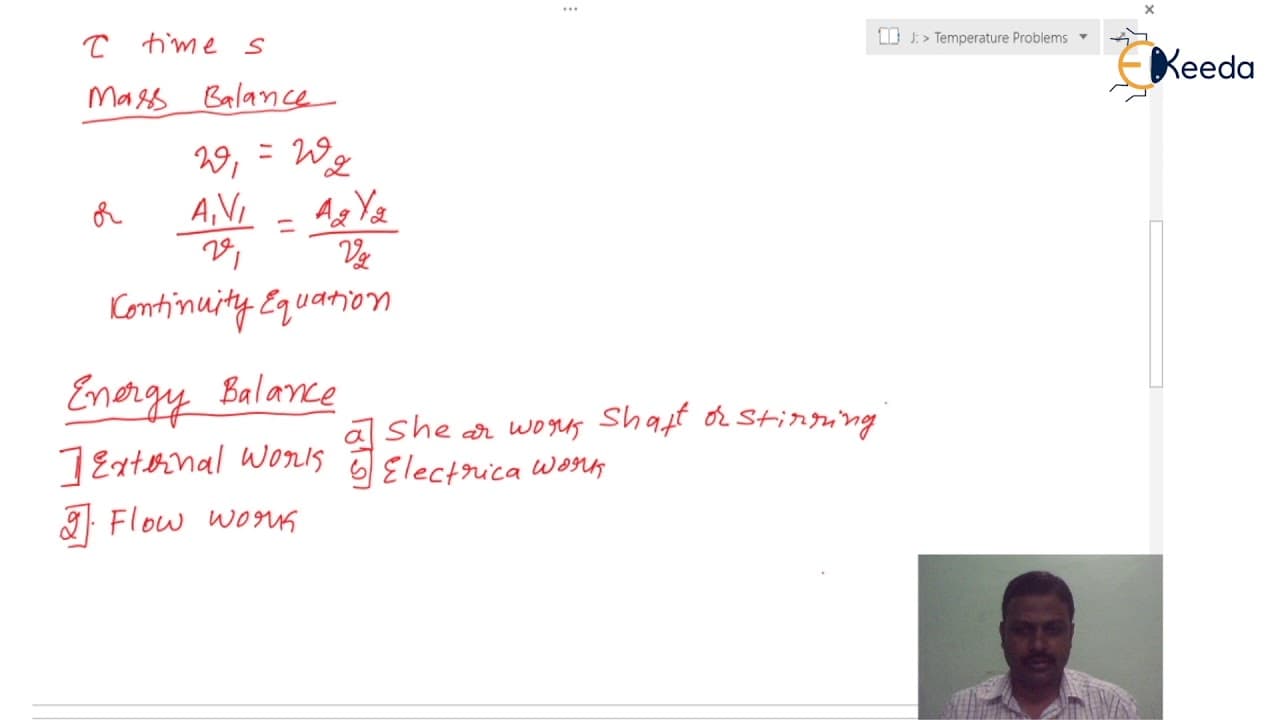
hello friends uh in this video i am going to discuss about first law of thermodynamics applied to open system and derivation of steady flow energy equation for any system and in any process the first law of thermodynamics is given by q equal to delta e plus w where e is all forms of energy that is stored in the system for pure substance that e is e... Read More
Key Insights
- 🥵 The first law of thermodynamics relates heat transfer, energy change, and work done in a system.
- 🤗 Open systems involve the flow of fluids and require the consideration of mass transfer in energy analysis.
- 💦 The steady flow energy equation is used to analyze devices like turbines and provides a relationship between energy and work at the inlet and outlet.
- 💆 The equation can be derived by applying the conservation of mass and energy principles to a control volume with continuous flow.
- 💆 The steady flow energy equation is applicable when there is no accumulation of mass or energy within the system.
- ❓ Specific energies, including kinetic, potential, and internal energy, are considered in the equation.
- 🤗 The equation is useful for understanding the energy balance and efficiency of open system devices.
Install to Summarize YouTube Videos and Get Transcripts
Explore YouTube Video Summarizer or Get YouTube Transcript Extractor
Questions & Answers
Q: What is the first law of thermodynamics?
The first law of thermodynamics states that the heat transfer (q) in a system is equal to the change in energy (ΔE) plus the work done (w) on the system.
Q: What is an open system?
An open system is one that involves the flow of fluids, where mass can enter and leave the system. Most engineering devices, such as turbines, are open systems.
Q: How is the steady flow energy equation derived?
The steady flow energy equation is derived by applying the conservation of mass and energy principles to a control volume with a continuous flow of mass. It relates the energy and work terms at the inlet and outlet of the system.
Q: What is the significance of the steady flow energy equation?
The steady flow energy equation allows engineers to analyze the energy changes in open systems, such as turbines, where there is a continuous flow of fluid. It helps in understanding the efficiency and performance of such devices.
Summary & Key Takeaways
-
The first law of thermodynamics states that the heat transfer (q) is equal to the change in energy (ΔE) plus the work done (w) on the system.
-
An open system is one that involves the flow of fluids, and the energy equation for such a system includes kinetic energy (Ek), potential energy (Ep), and internal energy (U) of the substance.
-
A steam turbine is used as an example to analyze the steady flow process, where a continuous stream of steam enters and exits the control volume, and there is no accumulation of mass or energy within the system.
Read in Other Languages (beta)
Share This Summary 📚
Summarize YouTube Videos and Get Video Transcripts with 1-Click
Try YouTube Summary with ChatGPT & Claude or YouTube Transcript Generator
Explore More Summaries from Ekeeda 📚






Summarize YouTube Videos and Get Video Transcripts with 1-Click
Try YouTube Summary with ChatGPT & Claude or YouTube Transcript Generator