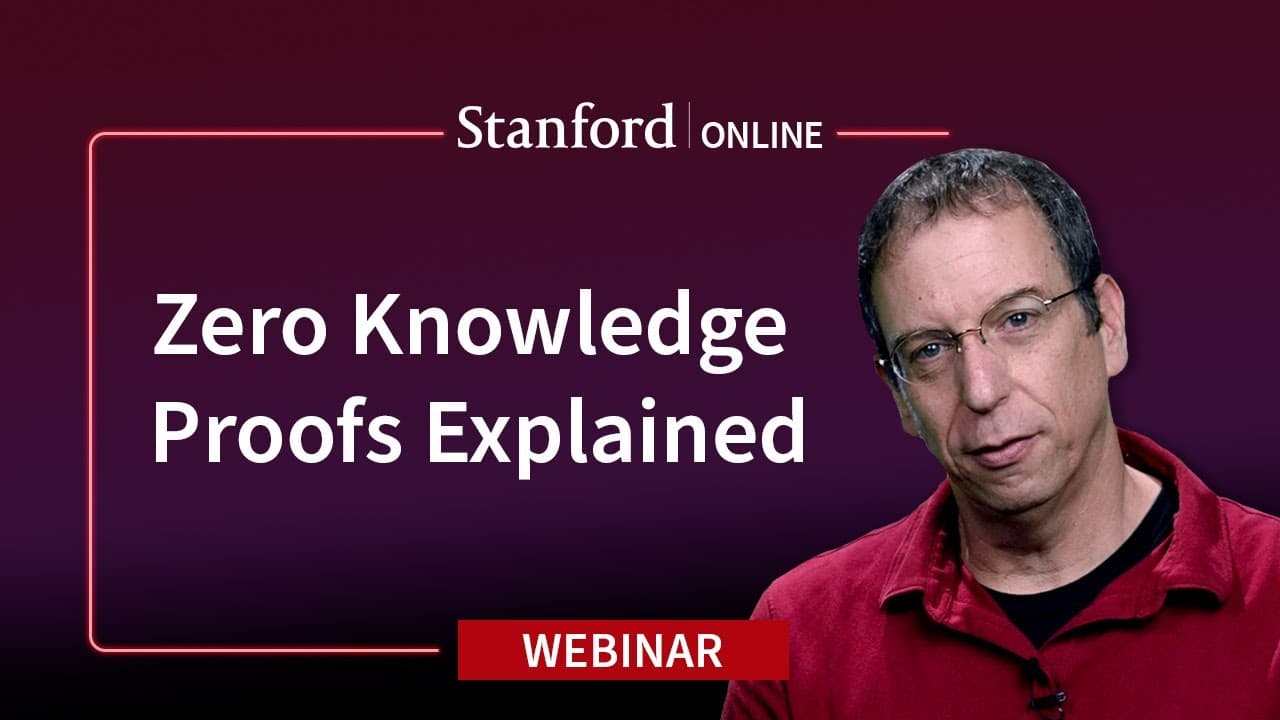
Stanford Webinar - Cybersecurity in Modern Era: Zero Knowledge Proofs Explained
TL;DR
Cryptography expert Dan discusses the need for post-quantum secure signatures and shares a fascinating application of zero knowledge proofs for content authenticity.
Transcript
Dan is a professor of computer science and electrical engineering at Stanford he leads the applied cryptography group and co-directs the computer security lab his re research focuses on applications of cryptography to computer security and his work includes crypto systems with novel properties web security security for mobile devices and crypto ana... Read More
Key Insights
- 😀 Post-quantum signatures are essential to maintain the security of digital transactions in the face of quantum computers, and the transition to these systems is expected to occur by 2035.
- 🤗 Developing short and efficient post-quantum signature schemes remains an open problem, requiring new cryptographic techniques and innovative solutions.
- 🖐️ Zero knowledge proofs play a crucial role in preserving privacy and security in digital interactions, enabling confidential transactions, secure data access, and compliance with regulations.
Install to Summarize YouTube Videos and Get Transcripts
Explore YouTube Video Summarizer or Get YouTube Transcript Extractor
Questions & Answers
Q: What is the current timeline for transitioning to post-quantum signature systems?
The NSA recommends completing the transition by 2035 to ensure security against quantum computers.
Q: Are there any promising approaches for creating short and efficient post-quantum signature schemes?
Researchers are exploring different cryptographic group actions and hash-based signatures. However, finding a solution comparable to current signature schemes is still an open problem.
Q: How can individuals contribute to the development of post-quantum signatures?
It is important to explore new cryptographic techniques and propose solutions to improve the efficiency and security of post-quantum signature schemes. Researchers can also participate in relevant discussions and actively contribute to the field.
Q: How do zero-knowledge proofs enhance security and privacy in digital interactions?
Zero-knowledge proofs allow verifiable claims to be made without revealing sensitive information. They enable privacy-preserving transactions, secure access to encrypted data, and protection of user identities.
Q: Are there other privacy-preserving technologies besides zero-knowledge proofs?
Yes, there are several other privacy-preserving technologies such as secure multi-party computation (MPC), homomorphic encryption (HE), and secure enclaves. These tools enable data privacy and security in various contexts, depending on the specific requirements of each use case.
Summary & Key Takeaways
-
Dan introduces the importance of secure signatures in cryptography and highlights the vulnerabilities of current systems to quantum computers.
-
He discusses the need for post-quantum signature schemes and explains the timeline for transitioning to these secure systems.
-
Dan also delves into the application of zero knowledge proofs for content authenticity, specifically in verifying the origin and integrity of images.
Read in Other Languages (beta)
Share This Summary 📚
Summarize YouTube Videos and Get Video Transcripts with 1-Click
Try YouTube Summary with ChatGPT & Claude or YouTube Transcript Generator
Explore More Summaries from Stanford Online 📚

Summarize YouTube Videos and Get Video Transcripts with 1-Click
Try YouTube Summary with ChatGPT & Claude or YouTube Transcript Generator