Sum of polynomial roots (proof) | Math for fun and glory | Khan Academy
TL;DR
There is a fast way to find the sum of the roots of any polynomial, regardless of its degree.
Transcript
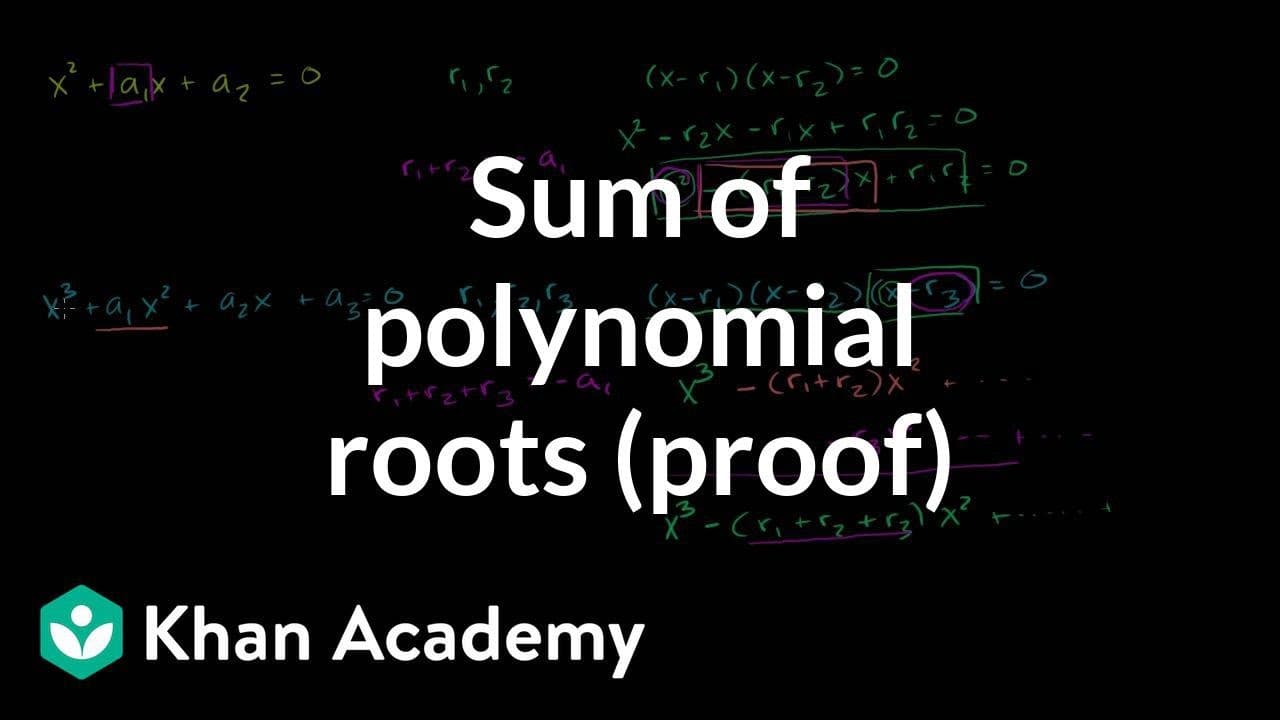
What I want to do in this video, is figure out if there's any fast way to figure out the sum of the roots of any polynomial. And actually, there actually is. And so that's why I'm doing this video. So let's start with a second degree polynomial. So let's say it's x squared plus a1x, plus a2 is equal to 0. So this is just a standard set quadratic eq... Read More
Key Insights
- 😘 The sum of the roots of a polynomial can be found by looking at the negative coefficient on the term one degree lower than the polynomial's degree.
- 🥹 The pattern holds true for polynomials with both real and complex roots.
- ✋ If a polynomial has a coefficient other than 1 in front of the highest degree term, it can be divided by that coefficient to simplify the calculation.
Install to Summarize YouTube Videos and Get Transcripts
Explore YouTube Video Summarizer or Get YouTube Transcript Extractor
Questions & Answers
Q: How can you find the sum of the roots of a second degree polynomial?
The sum of the roots of a second degree polynomial is equal to the negative coefficient on the first degree term.
Q: Does the pattern apply to polynomials with complex roots?
Yes, the pattern holds true for both real and complex roots. The imaginary parts of complex roots cancel out when calculating the sum.
Q: What if a polynomial has a coefficient other than 1 in front of the highest degree term?
In such cases, you can divide all the coefficients by the same number to make the coefficient of the highest degree term equal to 1, and then apply the pattern to find the sum of the roots.
Q: Can this method be applied to any polynomial degree?
Yes, the pattern can be applied to polynomials of any degree, allowing for a fast and efficient calculation of the sum of the roots.
Summary & Key Takeaways
-
The sum of the roots of a second degree polynomial is equal to the negative coefficient on the first degree term.
-
The same applies to third degree polynomials - the sum of the roots is equal to the negative coefficient on the second degree term.
-
This pattern holds true for polynomials of any degree, allowing for a fast and efficient way to calculate the sum of the roots.
Read in Other Languages (beta)
Share This Summary 📚
Summarize YouTube Videos and Get Video Transcripts with 1-Click
Try YouTube Summary with ChatGPT & Claude or YouTube Transcript Generator
Explore More Summaries from Khan Academy 📚



Summarize YouTube Videos and Get Video Transcripts with 1-Click
Try YouTube Summary with ChatGPT & Claude or YouTube Transcript Generator