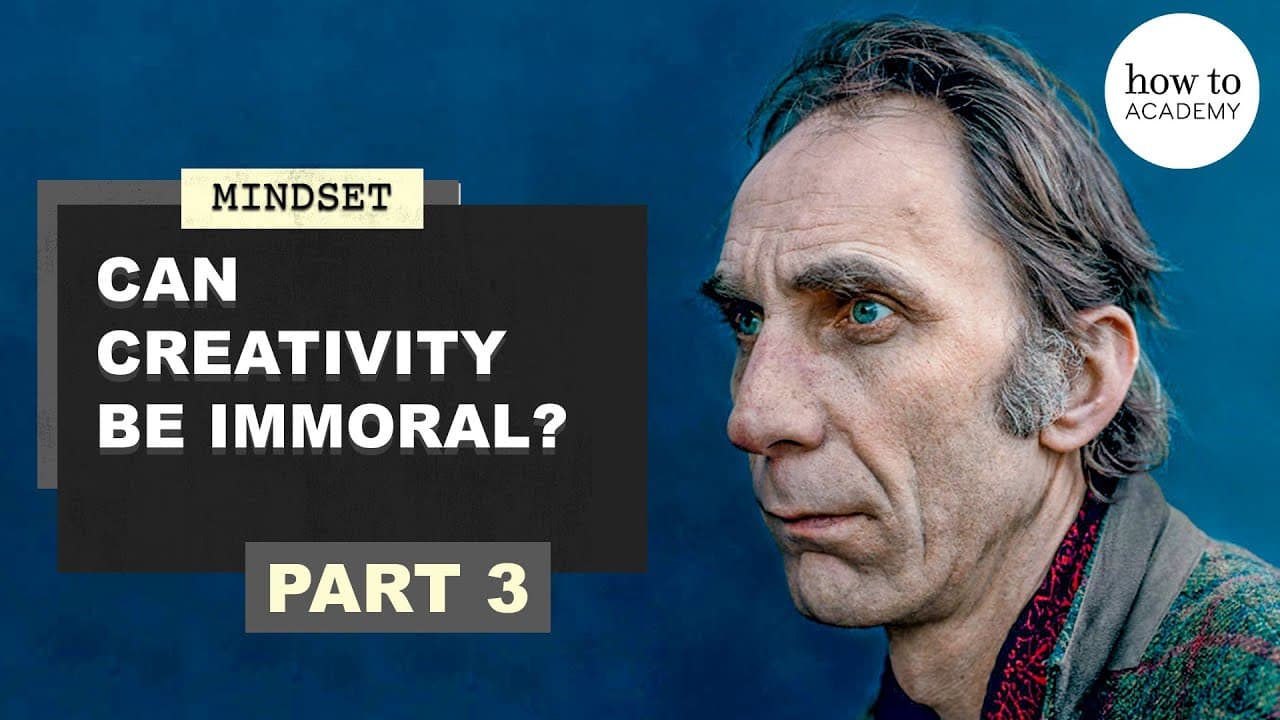
Will Self: "Starve Yourself of Other People's Creativity"
TL;DR
Engaging in the creative process requires discipline, isolation from other influences, and the development of a personal creative technology.
Transcript
you know enjoy if you're a writer telling yourself the story you're writing dividing yourself into two and quite self-consciously thinking of half of yourself as the writer and the other half of yourself as the reader that's very important for when you go back over stuff but it's equally important to keep yourself engaged with the work and keep the... Read More
Key Insights
- 💦 Engaging with one's own creative work as both a writer and reader is crucial for growth and development.
- 👻 Isolating oneself from other creative influences and sources allows for a deeper focus on one's own creative ideas and eliminates the distraction of comparison.
- ⏳ The flow state, experienced in various artistic pursuits, allows for the freedom to manipulate and alter creative output in real-time.
- ❤️🩹 Creativity is amoral in itself and can be directed towards both positive and negative ends.
- 🥺 Developing one's own technology of creativity, including discipline and hard work, leads to a sense of satisfaction and autonomy.
- 🧑🏫 Creative discipline can be taught to some extent, but it is important for individuals to develop their own creative autonomy.
- 🤳 Negative self-talk and self-doubt are common in the creative process, and it is necessary to turn down their volume and live with their presence.
Install to Summarize YouTube Videos and Get Transcripts
Explore YouTube Video Summarizer or Get YouTube Transcript Extractor
Questions & Answers
Q: How does the speaker reconcile the need for discipline and hard work with the idea of creativity as a liberating force?
The speaker believes that discipline and hard work are integral to the creative process, leading to a sense of freedom and satisfaction when one looks back on what they have created. The goal of creativity is not just the production of work, but an ongoing activity that perpetuates itself.
Q: Can creativity be taught to others?
While the speaker acknowledges that creativity can be taught to some extent, they focus more on teaching the technology of creation and nurturing creative autonomy. Following their rules and developing one's own creative discipline can lead to a sense of liberty and satisfaction in the creative process.
Q: How does the speaker address negative self-talk and self-doubt in the creative process?
The speaker advises turning down the volume on negative self-talk and learning to live with the critical voices that often arise during the creative process. They emphasize that these voices are habitual and can be silenced through continued creative practice.
Q: Did the speaker find the lockdown period helpful for creativity?
The speaker states that while the lockdown provided opportunities for isolation and plein air composition, sustained concentration necessary for full-flow creativity has been difficult to achieve due to the rapidly changing circumstances of the pandemic. However, they remain hopeful that increased isolation may lead to a closer attention to the immediate environment, sparking new forms of creativity for many.
Summary & Key Takeaways
-
The speaker emphasizes the importance of engaging with one's own creative work as both a writer and a reader.
-
The speaker advocates for isolating oneself from other creative influences and sources while actively creating.
-
The speaker discusses the concept of a flow state in creativity and its potential applications to various artistic pursuits.
Read in Other Languages (beta)
Share This Summary 📚
Summarize YouTube Videos and Get Video Transcripts with 1-Click
Try YouTube Summary with ChatGPT & Claude or YouTube Transcript Generator
Explore More Summaries from How To Academy Mindset 📚

Summarize YouTube Videos and Get Video Transcripts with 1-Click
Try YouTube Summary with ChatGPT & Claude or YouTube Transcript Generator