Stokes example part 2: Parameterizing the surface | Multivariable Calculus | Khan Academy
TL;DR
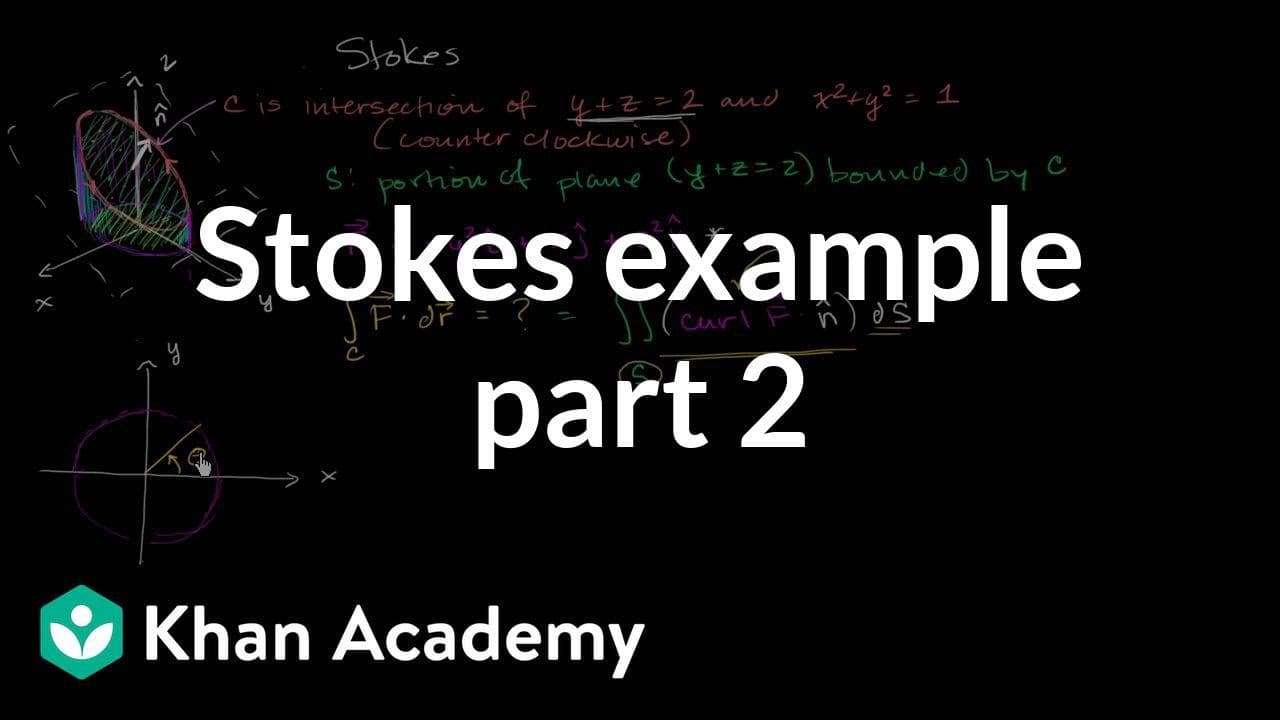
This video discusses how to parametrize a surface using polar coordinates and demonstrates how to express x, y, and z coordinates in terms of parameters r and theta.
Transcript
Now that we've set up our surface integral, we can attempt to parametrise the surface. And one way to think about is we want our x and y values to take on all of the values inside of the unit circle, what I'm shading in right over here. And that our z values can be a function of the y values. We can express this equation right here, z is equal to 2... Read More
Key Insights
- 😥 Parametrizing a surface allows for a systematic approach to representing its points using parameters.
- 🐻❄️ Polar coordinates, with the radius and angle parameters, are useful for parametrizing a surface within a unit circle.
- 😑 The x and y coordinates can be expressed in terms of the radius and angle parameters.
- 🤪 The z coordinate can be determined by expressing it as a function of y, completing the parametrization.
- 🔺 Varying the radius and angle parameters allows for reaching all points inside the unit circle.
- 😥 The role of theta is to sweep out points along the surface, covering a full circle.
- 💱 Changing the radius parameter sweeps out circles of different sizes, filling up the entire surface.
Install to Summarize YouTube Videos and Get Transcripts
Explore YouTube Video Summarizer or Get YouTube Transcript Extractor
Questions & Answers
Q: How can a surface be parametrized using polar coordinates?
The surface can be parametrized by defining x = r * cos(theta), y = r * sin(theta), and z = 2 - r * sin(theta), where r varies between 0 and 1, and theta ranges from 0 to 2pi.
Q: What is the significance of the unit circle in parametrization?
The unit circle is utilized to obtain all possible x and y coordinates within the surface. By varying the radius and angle parameters, all points inside the unit circle can be reached.
Q: Can you explain the role of theta in the parametrization process?
Theta represents the angle with the x-axis and is used to sweep out different points along the surface. It ranges from 0 to 2pi, covering a full circle.
Q: How does changing the radius parameter affect the parametrization?
Changing the radius parameter sweeps out circles of varying sizes. By varying the radius between 0 and 1, all circles within the unit circle are formed, effectively covering the entire surface.
Summary & Key Takeaways
-
The video explores the concept of parametrizing a surface and introduces the idea of using polar coordinates.
-
By defining x and y in terms of r and theta, it becomes possible to represent all the points inside a unit circle.
-
The z component can be expressed as a function of y, allowing for the complete parametrization of the surface.
Read in Other Languages (beta)
Share This Summary 📚
Summarize YouTube Videos and Get Video Transcripts with 1-Click
Try YouTube Summary with ChatGPT & Claude or YouTube Transcript Generator
Explore More Summaries from Khan Academy 📚



Summarize YouTube Videos and Get Video Transcripts with 1-Click
Try YouTube Summary with ChatGPT & Claude or YouTube Transcript Generator