Proof: Corresponding angle equivalence implies parallel lines | Geometry | Khan Academy
TL;DR
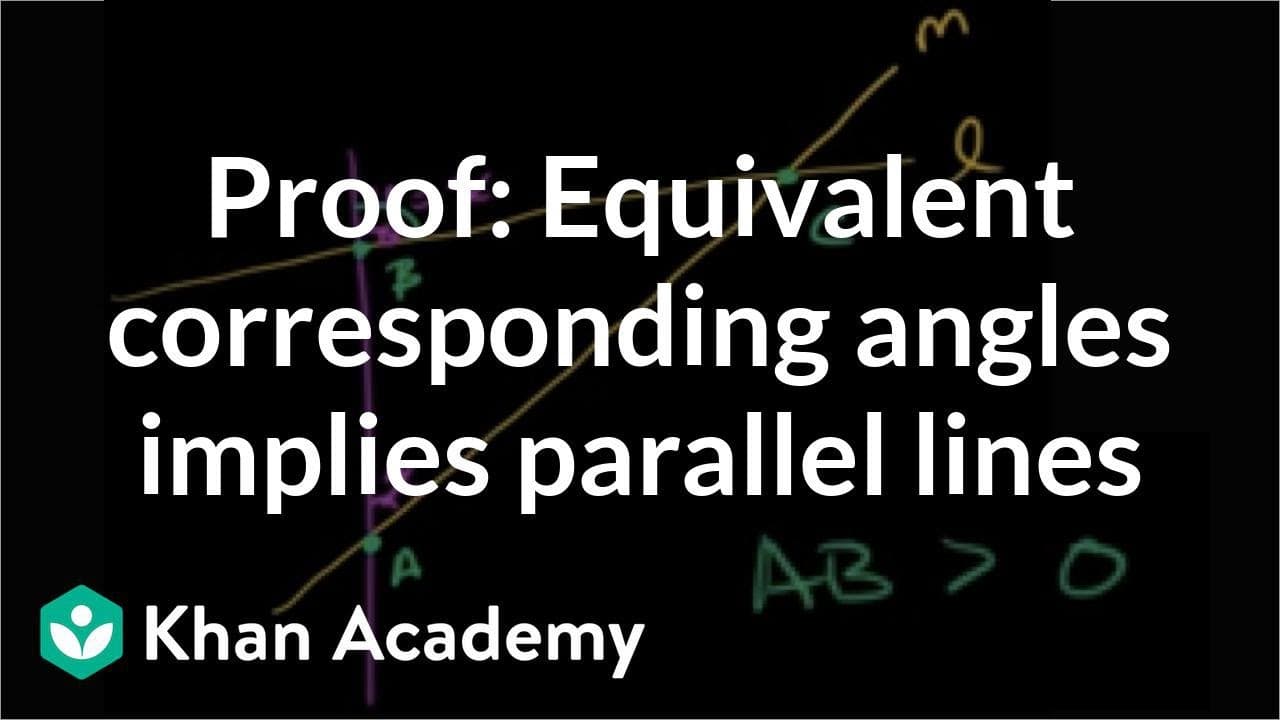
This video proves that if two lines have equal corresponding angles, then they are parallel.
Transcript
We know that if we have two lines that are parallel-- so let me draw those two parallel lines, l and m. So that's line l and line m. We know that if they are parallel, then if we were to draw a transversal that intersects both of them, that the corresponding angles are equal. So this is x, and this is y So we know that if l is parallel to m, then x... Read More
Key Insights
- 🫥 Parallel lines have equal corresponding angles.
- 🫥 Assuming equal corresponding angles and non-parallel lines leads to a contradiction.
- 🫥 The contradiction arises from a degenerate triangle or the lines being the same.
- 🫥 The video uses a proof by contradiction to demonstrate the relationship between equal corresponding angles and parallel lines.
- 👍 The analysis of the resulting triangle helps prove the initial statement.
Install to Summarize YouTube Videos and Get Transcripts
Explore YouTube Video Summarizer or Get YouTube Transcript Extractor
Questions & Answers
Q: What is the relationship between parallel lines and corresponding angles?
Parallel lines have equal corresponding angles, meaning if two lines are parallel, their corresponding angles are equal and vice versa.
Q: How does the video prove that if two lines have equal corresponding angles, they are parallel?
The video uses a proof by contradiction, assuming that the lines are not parallel and analyzing the resulting triangle. This leads to a contradiction, proving that the lines must be parallel.
Q: What contradiction arises when assuming equal corresponding angles but non-parallel lines?
Assuming equal corresponding angles but non-parallel lines creates a triangle with a degenerate angle of 0 degrees, which contradicts the assumption that the lines are not parallel.
Q: How does the video demonstrate that the lines cannot be different but not parallel?
The analysis of the resulting triangle shows that if the lines are not parallel, they must form either a degenerate triangle or the same line, which contradicts the assumption.
Summary & Key Takeaways
-
The video explains that if two lines are parallel, their corresponding angles are equal.
-
The goal is to prove the opposite: if two lines have equal corresponding angles, then they are parallel.
-
By assuming that the lines are not parallel and analyzing the resulting triangle, a contradiction is reached, proving the initial statement.
Read in Other Languages (beta)
Share This Summary 📚
Summarize YouTube Videos and Get Video Transcripts with 1-Click
Try YouTube Summary with ChatGPT & Claude or YouTube Transcript Generator
Explore More Summaries from Khan Academy 📚



Summarize YouTube Videos and Get Video Transcripts with 1-Click
Try YouTube Summary with ChatGPT & Claude or YouTube Transcript Generator