Design of Muff Coupling Formulae Numerical Part 2 - Introduction to Mechanical Engineering Design
TL;DR
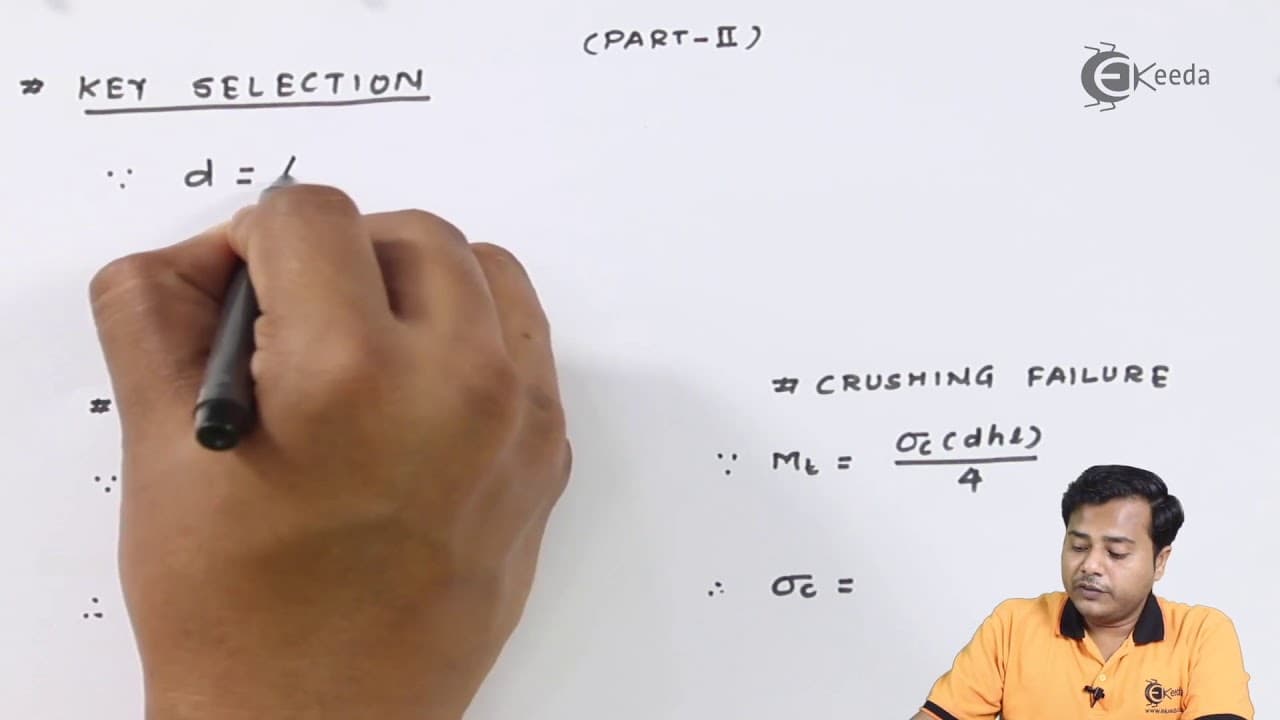
This video discusses the safe dimensions for a muff coupling and the key selection process, ensuring the design is safe in shear and compressive failure.
Transcript
click the bell icon to get latest videos from ekeeda hello friends welcome back to the subject of machine design one we are right now solving a numerical on muff coupling in the last session we have figured out the dimensions of the shaft as well as the dimensions with the standard proportion of the muf in this session we are going to prove that th... Read More
Key Insights
- ❓ The length of the muff and its failure are closely related, with torsional or compressive forces causing failure.
- 🐻❄️ The calculation of shear stress and polar moment of inertia determines the safety of the muff in shear.
- 🤩 Key selection is an essential part of muff coupling design, with the dimensions determined based on the shaft diameter and length.
- 🤩 The key can fail in shear if the shear stress exceeds the allowable shear stress.
- 🤩 Compressive failure of the key can occur if the compressive stress exceeds the allowable compressive stress.
- 🤩 By comparing the induced stresses with the allowable stresses, the safety of the key in shear and compression can be determined.
- 🤩 The final dimensions of the key are determined based on the calculations and safety criteria.
Install to Summarize YouTube Videos and Get Transcripts
Explore YouTube Video Summarizer or Get YouTube Transcript Extractor
Questions & Answers
Q: What are the parameters considered to ensure the safety of the muff coupling in shear?
The safety of the muff coupling in shear is determined by comparing the calculated shear stress (tau) with the allowable shear stress. If the calculated shear stress is smaller than the allowable shear stress, the muff is deemed safe in shear.
Q: How is the length of the key determined in the key selection process?
The length of the key is assumed to be exactly half the length of the shaft. In this case, the length of the key is determined to be 80 millimeters based on a shaft length of 160 millimeters.
Q: What are the criteria for key failure?
The key can fail either through shear failure or compressive failure. Shear failure occurs when the shear stress exceeds the allowable shear stress. Compressive failure occurs when the compressive stress exceeds the allowable compressive stress.
Q: How is the safety of the key in shear and compression determined?
The induced shear stress (tau) and compressive stress (sigma_c) are compared to the allowable shear stress (tau allowable) and allowable compressive stress (sigma_c allowable), respectively. If the induced stresses are smaller than the allowable stresses, the key is considered safe in shear and compression.
Summary & Key Takeaways
-
The video starts by explaining the relationship between the length of the muff and its failure due to torsional or compressive forces.
-
The torsional equations are used to calculate the shear stress and the polar moment of inertia for the muff.
-
The calculated shear stress is compared to the allowable shear stress to determine the safety of the muff in shear.
-
The video then moves on to the key selection process, where the dimensions of the key are determined based on the diameter and length of the shaft.
-
The formulas for shear and compressive failure are used to calculate the induced stresses in the key, which are then compared to the allowable stresses to determine the safety of the key in shear and compression.
-
Based on the calculations, the final dimensions for the key are determined.
Read in Other Languages (beta)
Share This Summary 📚
Summarize YouTube Videos and Get Video Transcripts with 1-Click
Try YouTube Summary with ChatGPT & Claude or YouTube Transcript Generator
Explore More Summaries from Ekeeda 📚


Summarize YouTube Videos and Get Video Transcripts with 1-Click
Try YouTube Summary with ChatGPT & Claude or YouTube Transcript Generator