Position-time graphs | One-dimensional motion | AP Physics 1 | Khan Academy
TL;DR
Learn about different ways to represent position change over time, including tables, animations, and position-time graphs.
Transcript
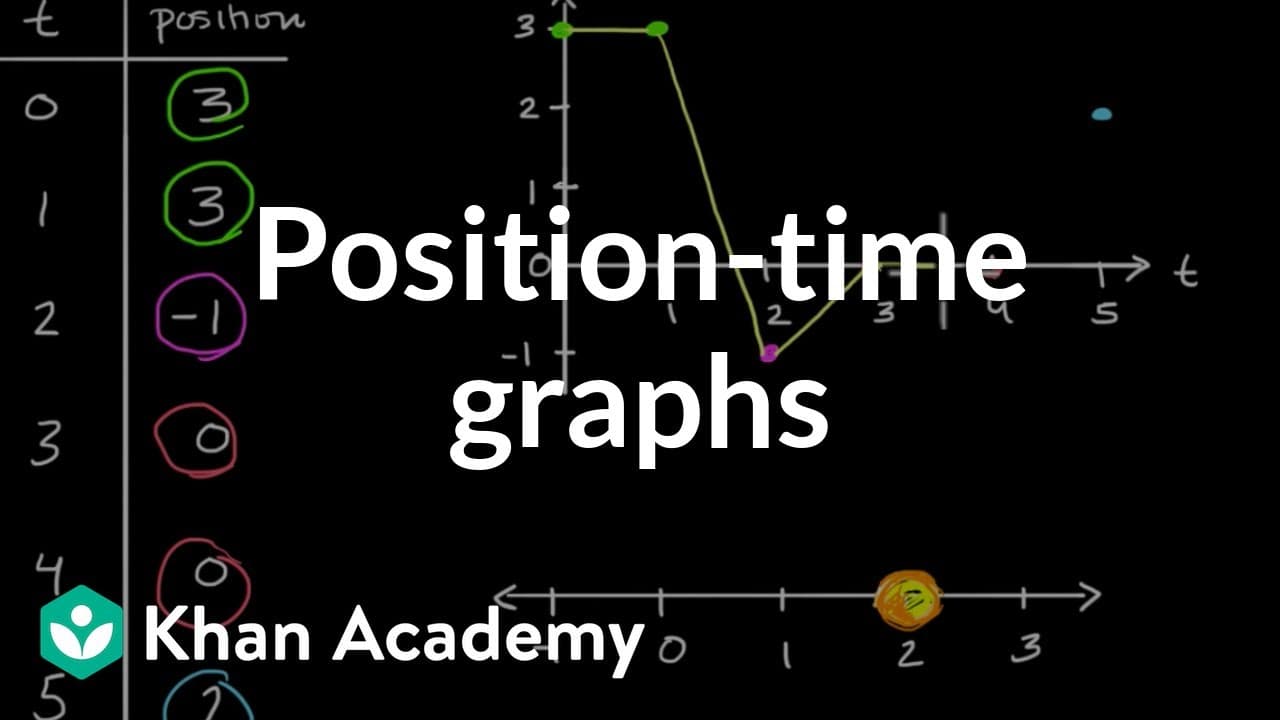
- [Instructor] What we're going to do in this video is think about different ways to represent how position can change over time. So one of the more basic ways is through a table. For example right over here in the left column I have time, maybe it's in seconds, and in the right column I have position and this could be in some units, let's say it's... Read More
Key Insights
- 🧘 Different methods, such as tables, animations, and position-time graphs, can be used to represent position change over time.
- 🖤 Tables provide numerical data but lack visualization and information about in-between changes.
- ❓ Animations offer visual representation but require continuous observation.
- 🧘 Position-time graphs provide a clear visual understanding of position change over time without the need for continuous observation.
- 🧘 Position-time graphs help identify patterns, rates, and specific values of position at different time intervals.
- 🧘 To interpret a position-time graph, the vertical axis represents position, while the horizontal axis represents time.
- 🧘 The slope of a position-time graph indicates the object's velocity or speed of position change over time.
Install to Summarize YouTube Videos and Get Transcripts
Explore YouTube Video Summarizer or Get YouTube Transcript Extractor
Questions & Answers
Q: What are some ways to represent position change over time?
Position change over time can be represented through tables, animations, and position-time graphs. Tables provide numerical data, animations help visualize the motion, while position-time graphs offer a visual representation of position change over time.
Q: Why is a table representation of position change over time limited?
Tables only provide information at specific time intervals and do not show what happens between those intervals. They don't reveal whether the position remained constant, changed momentarily, or returned to its original position.
Q: How does an animation help understand position change over time?
An animation visually represents the position change over time, showing how the object moves. However, it still requires continuous observation, and it may not provide a clear understanding of the numerical values or precise changes in position.
Q: What is a position-time graph, and how does it help understand position change?
A position-time graph represents an object's position on the vertical axis and time on the horizontal axis. It shows the relationship between position and time, allowing for a quick understanding of how the position changes over time without the need for continuous observation.
Summary & Key Takeaways
-
Position change over time can be represented through a table, but it doesn't provide a clear visualization or information about what happens between time intervals.
-
An animation can help visualize position change over time, but it still requires continuous observation.
-
A position-time graph is a more useful way to understand how an object's position changes over time, providing a visual representation without the need for continuous observation.
Read in Other Languages (beta)
Share This Summary 📚
Summarize YouTube Videos and Get Video Transcripts with 1-Click
Try YouTube Summary with ChatGPT & Claude or YouTube Transcript Generator
Explore More Summaries from Khan Academy 📚



Summarize YouTube Videos and Get Video Transcripts with 1-Click
Try YouTube Summary with ChatGPT & Claude or YouTube Transcript Generator