Establishing DNA as transformation principle
TL;DR
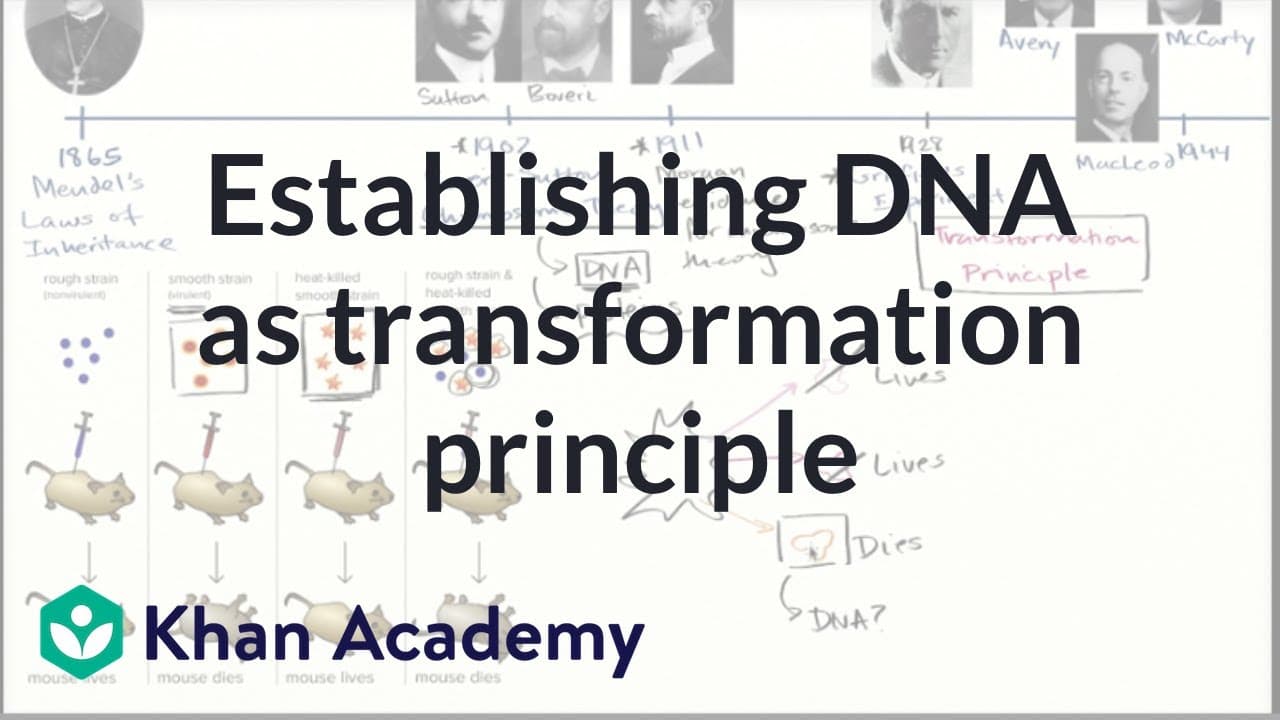
In the early 1900s, Mendel's laws of inheritance were rediscovered and Boveri, Sutton, and Morgan independently proposed the chromosome theory. It wasn't until Griffith's experiment in 1928 and the subsequent work by Avery, McCarty, and McLeod in 1944 that DNA was identified as the molecule responsible for inheritance.
Transcript
- [Voiceover] So to review how we got at least to this video, in 1865, Mendel first shares his laws of inheritance. He observes that there are these heritable factors, these discrete heritable factors that would be passed down from parent to offspring according to certain rules. And he came up with the laws of inheritance, law of segregation, law o... Read More
Key Insights
- 👮 Mendel's laws of inheritance were not initially recognized and accepted, but were rediscovered in the early 1900s.
- 🧑🏭 Boveri and Sutton proposed the chromosome theory, linking chromosomes to heritable factors.
- 🪽 Thomas Hunt Morgan's experiments with fruit flies provided evidence for the importance of chromosomes in inheritance.
- ✊ Griffith's experiment demonstrated the transferability and transformative power of genetic material.
- ❓ Avery, McCarty, and McLeod identified DNA as the molecule responsible for inheritance.
- 💨 The discovery of DNA as the basis of inheritance revolutionized the field of genetics and paved the way for further studies in genetic engineering.
- 🥺 Understanding the role of chromosomes and DNA in inheritance has led to significant advancements in medicine and agriculture.
Install to Summarize YouTube Videos and Get Transcripts
Explore YouTube Video Summarizer or Get YouTube Transcript Extractor
Questions & Answers
Q: Why were Mendel's laws of inheritance not taken seriously when he first shared them in 1865?
Mendel's laws were not taken seriously at the time due to lack of understanding and acceptance of his ideas. It wasn't until much later that the laws were rediscovered and recognized as groundbreaking contributions to genetics.
Q: What did Boveri and Sutton propose in 1902?
Boveri and Sutton proposed the chromosome theory, which suggested that chromosomes were the physical basis for heritable factors described by Mendel. They observed how chromosomes behaved during cell division and saw similarities between chromosome behavior and inheritance patterns.
Q: How did Thomas Hunt Morgan contribute to the understanding of inheritance?
Morgan used fruit flies to study inheritance patterns and observed how certain traits were passed on from one generation to another. His experiments with fruit flies led him to conclude that these traits were being passed on through the X sex chromosome.
Q: What was significant about Griffith's experiment in 1928?
Griffith's experiment showed that genetic material could be transferred between bacteria and transform their traits. This implied that there was a substance responsible for encoding genetic information.
Summary & Key Takeaways
-
In 1865, Mendel shared his laws of inheritance, but they were not taken seriously until they were rediscovered in the early 1900s.
-
Boveri and Sutton proposed the chromosome theory in 1902, suggesting that chromosomes were the physical location for heritable factors.
-
Thomas Hunt Morgan's experiments with fruit flies in 1911 provided evidence that chromosomes were indeed responsible for inheritance.
-
Griffith's experiment in 1928 showed that DNA could be transferred between bacteria and transform their traits.
-
Avery, McCarty, and McLeod isolated DNA as the transformation principle in 1944.
Read in Other Languages (beta)
Share This Summary 📚
Summarize YouTube Videos and Get Video Transcripts with 1-Click
Try YouTube Summary with ChatGPT & Claude or YouTube Transcript Generator
Explore More Summaries from Khan Academy 📚



Summarize YouTube Videos and Get Video Transcripts with 1-Click
Try YouTube Summary with ChatGPT & Claude or YouTube Transcript Generator