11.3: Chrome Extensions: Content Scripts - Programming with Text
TL;DR
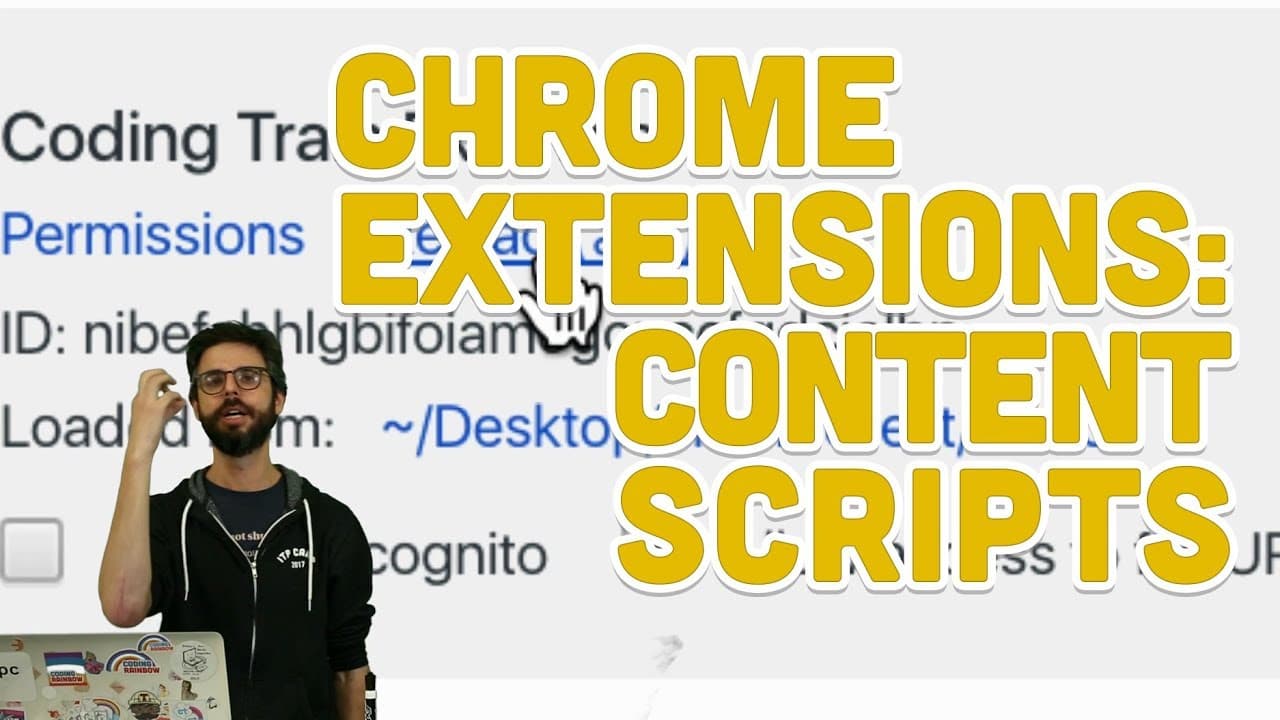
This video provides a step-by-step guide on creating a basic Chrome extension and introduces the concept of content scripts and manifest files.
Transcript
all right so how I wanted to besides having you watch me erase this is I want to talk about Chrome extensions and I guess the anatomy of a Chrome extension I'm going to start with the most basic kind of Chrome extension you can possibly do so first of all again let's think about this diagram this is the Chrome browser maybe there is there's a toolb... Read More
Key Insights
- 💁 The anatomy of a Chrome extension includes a manifest file, which contains configuration properties and information about the extension.
- 🏃 Content scripts are JavaScript files associated with a Chrome extension that run on web pages to alter their content and behavior.
- 👨🦱 Matches in the manifest file specify the URLs on which the content script should execute.
- 🫠 Chrome extensions require permissions to read and change data on visited websites.
- 👻 The Chrome extensions page allows you to enable, disable, and manage extensions.
- 👂 The background script of a Chrome extension runs as soon as Chrome launches and can listen for events and user actions.
- 👨🦱 Chrome extensions can have multiple content scripts, each with its own JavaScript file and associated URLs.
Install to Summarize YouTube Videos and Get Transcripts
Explore YouTube Video Summarizer or Get YouTube Transcript Extractor
Questions & Answers
Q: What is a manifest file and why is it important for a Chrome extension?
A manifest file is a JSON file that contains configuration details and information about the Chrome extension. It is important because it specifies the extension's properties and settings, such as its name, version, and permissions.
Q: What is a content script and how does it work?
A content script is a JavaScript file that is executed by the Chrome extension on a web page after it has finished loading. It can modify and manipulate the web page's content and behavior. Content scripts are associated with specific URLs or can be set to run on all pages.
Q: Can a Chrome extension have multiple content scripts?
Yes, a Chrome extension can have multiple content scripts associated with it. Each content script can have its own JavaScript file and can be set to run on different web pages or URLs.
Q: How do you install and enable a Chrome extension?
To install a Chrome extension, you need to enable developer mode in the Chrome extensions settings. Then, you can use the "Load unpacked extension" option to select the folder containing the extension's manifest file and JavaScript files. Once loaded, you can enable the extension and it will run on web pages accordingly.
Summary & Key Takeaways
-
The video explains that the first requirement for a Chrome extension is a manifest file, which contains configuration properties and information about the extension.
-
The video demonstrates how to create a manifest.json file and add content scripts to the extension, which allows JavaScript code to manipulate and alter web page content.
-
The video discusses the use of matches in the manifest file to specify the URLs on which the extension should run.
-
The video shows how to install and enable the Chrome extension, as well as how to reload the extension when making changes.
Read in Other Languages (beta)
Share This Summary 📚
Summarize YouTube Videos and Get Video Transcripts with 1-Click
Try YouTube Summary with ChatGPT & Claude or YouTube Transcript Generator
Explore More Summaries from The Coding Train 📚

Summarize YouTube Videos and Get Video Transcripts with 1-Click
Try YouTube Summary with ChatGPT & Claude or YouTube Transcript Generator