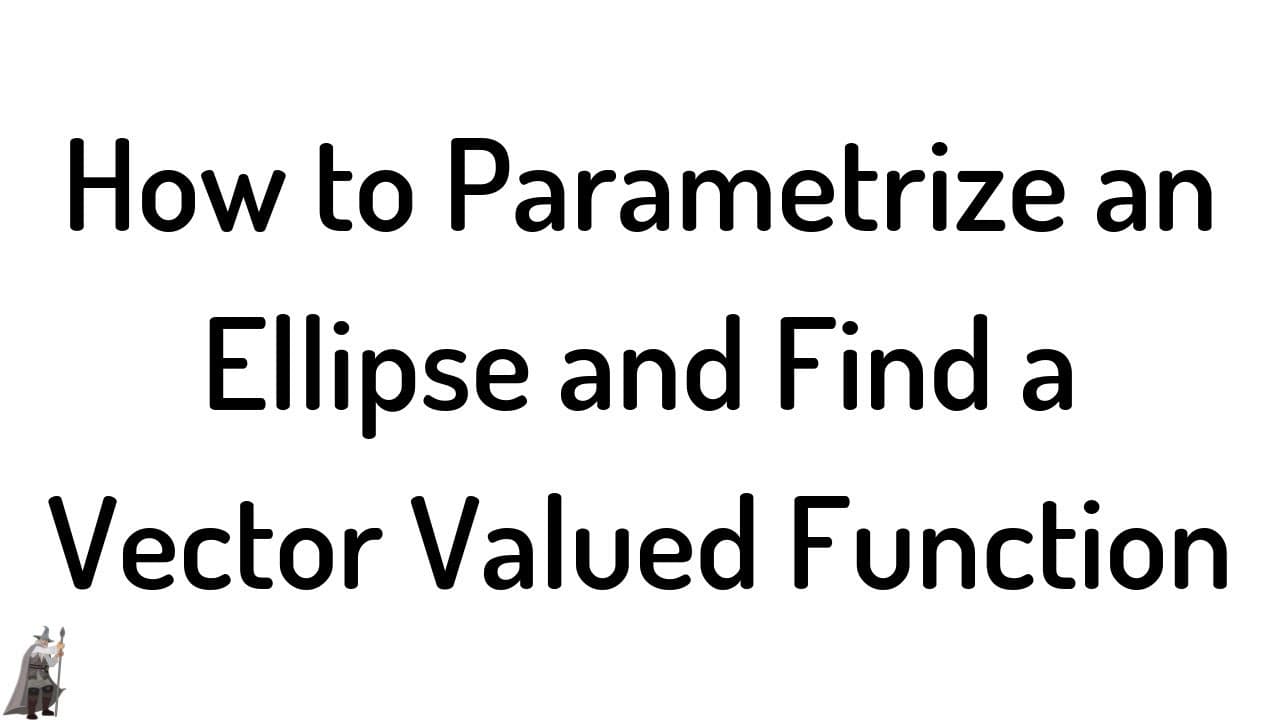
How to Parametrize an Ellipse and Find a Vector Valued Function
TL;DR
This video explains how to find the parametric equations for ellipses and represent them as vector-valued functions.
Transcript
hey everyone in this video we're going to take the graph of an ellipse and we're gonna find the parametric equations for it and then we're gonna represent it as a vector valued function so let's do it so let's start off with a simple example say we have x squared over 9 plus y squared over 4 and it's equal to 1 so we're gonna find the parametric eq... Read More
Key Insights
- 😑 Parametric equations for ellipses involve substituting trigonometric expressions for x and y to satisfy the equation.
- 🚄 There are infinitely many pairs of parametric equations for an ellipse, with different values of T resulting in different speed of tracing the ellipse.
- ❓ The parametric equations can be converted into a vector-valued function using the formula R(T) = X(T)i + Y(T)j.
Install to Summarize YouTube Videos and Get Transcripts
Explore YouTube Video Summarizer or Get YouTube Transcript Extractor
Questions & Answers
Q: How can the parametric equations for an ellipse be found?
To find the parametric equations for an ellipse, we can substitute trigonometric expressions for x and y that satisfy the equation. In this case, x is replaced with 3cos(T) and y with 2sin(T).
Q: What does it mean to have infinitely many pairs of parametric equations?
In the case of parametric equations for an ellipse, there are infinitely many pairs of equations. By replacing T with 2T, the ellipse will be traced out twice as fast. However, the equation x = 3cos(T) and y = 2sin(T) is sufficient as one solution.
Q: How can the parametric equations be converted into a vector-valued function?
To convert the parametric equations into a vector-valued function, we use the formula R(T) = X(T)i + Y(T)j. In this case, the vector-valued function is (3cos(T)i + 2sin(T)j).
Q: Is there an alternative method for finding the parametric equations of an ellipse?
Yes, there is a formula available to find the parametric equations of an ellipse. However, the approach demonstrated in the video encourages understanding and creative problem-solving by using substitution and trigonometric identities.
Summary & Key Takeaways
-
The video demonstrates how to find the parametric equations for a simple ellipse equation (x^2/9 + y^2/4 = 1) and write them as a vector-valued function.
-
The process involves replacing x and y with trigonometric expressions (3cos(T) and 2sin(T) respectively) to satisfy the equation.
-
The concept of infinitely many pairs of parametric equations is introduced, where replacing T with 2T makes the ellipse trace out twice as fast.
-
A more complex ellipse equation (X-1^2/4 + y+2^2/25 = 1) is also solved using the same technique.
Read in Other Languages (beta)
Share This Summary 📚
Summarize YouTube Videos and Get Video Transcripts with 1-Click
Try YouTube Summary with ChatGPT & Claude or YouTube Transcript Generator
Explore More Summaries from The Math Sorcerer 📚
Summarize YouTube Videos and Get Video Transcripts with 1-Click
Try YouTube Summary with ChatGPT & Claude or YouTube Transcript Generator