Comparators Introduction, Classification - Design of Gauge - Metrology and Quality Engineering
TL;DR
Comparators are measuring instruments used to measure diameters and lengths on gauges and components using slip gauges as standards.
Transcript
hello students today we will discuss the topic comparators so first of all we will go to the introduction of comparators so generally all the measuring instruments are called as comparators it may be either a simple scale or a complex instrument which is incorporating its own standard scale so for an engineering metrologist a comparator is an instr... Read More
Key Insights
- ❓ Comparators are measuring instruments used in engineering metrology to measure diameters and lengths on gauges and components.
- 💦 They work by indicating differences in size between a standard and the work being measured using a pointer or scale.
- 🔍 Comparators have three basic features: a sensing device, a magnifying or amplifying system, and a display system.
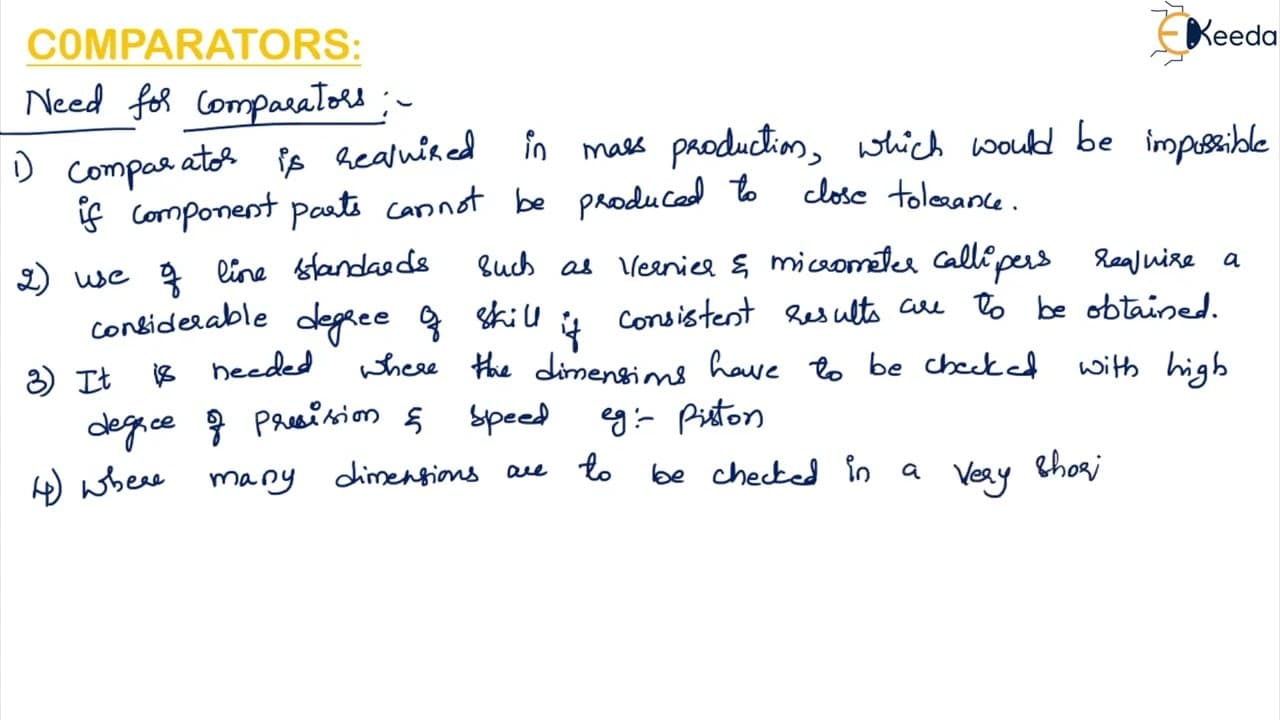
- 😚 They are needed in mass production to ensure components are produced to close dimensional tolerances.
- 🫥 Comparators are easier to use and provide consistent results compared to line standards such as vernier and micrometer calipers.
- 🚄 They are required where dimensions must be checked with high precision and speed, such as in the case of pistons.
- 🍰 Comparators are also useful for checking multiple dimensions in a short time.
- 😘 The basic requirements of comparators include robust design and construction, quick indication of results, compensation for temperature effects, linear scale characteristics, versatility in measurement, low and constant measuring pressure, and clear and oscillation-free indicators.
- 🦾 Comparators can be classified as mechanical, optical, electrical/electronic, pneumatic, or fluid displacement comparators based on the design used for amplification and recording of variations.
Install to Summarize YouTube Videos and Get Transcripts
Explore YouTube Video Summarizer or Get YouTube Transcript Extractor
Questions & Answers
Q: What is a comparator and how is it used in engineering metrology?
A comparator is a measuring instrument used to measure diameters and lengths on gauges and components. It is used by indicating the differences in size between a standard and the work being measured using a pointer or scale.
Q: What are the three basic features of comparators?
The three basic features of comparators are a sensing device, a magnifying or amplifying system, and a display system. The sensing device senses the input signal, the magnifying system increases the signal to a suitable magnitude, and the display system utilizes the amplified signal to provide a readable output.
Q: Why are comparators needed in mass production?
Comparators are needed in mass production because it would be impossible to produce component parts to close dimensional tolerances without them. They ensure consistent and precise measurements, allowing for efficient mass production.
Q: How do comparators differ based on the type of magnifying system used?
Comparators can be classified as mechanical, optical, pneumatic, hydraulic, or electronic based on the type of magnifying system they use. Each type of comparator utilizes a different method to amplify the input signal for accurate measurements.
Summary & Key Takeaways
-
Comparators are measuring instruments used in engineering metrology to measure diameters and lengths on gauges and components.
-
They work by indicating differences in size between a standard and the work being measured using a pointer or scale.
-
Comparators have three basic features: a sensing device, a magnifying or amplifying system, and a display system.
Read in Other Languages (beta)
Share This Summary 📚
Summarize YouTube Videos and Get Video Transcripts with 1-Click
Try YouTube Summary with ChatGPT & Claude or YouTube Transcript Generator
Explore More Summaries from Ekeeda 📚



Summarize YouTube Videos and Get Video Transcripts with 1-Click
Try YouTube Summary with ChatGPT & Claude or YouTube Transcript Generator