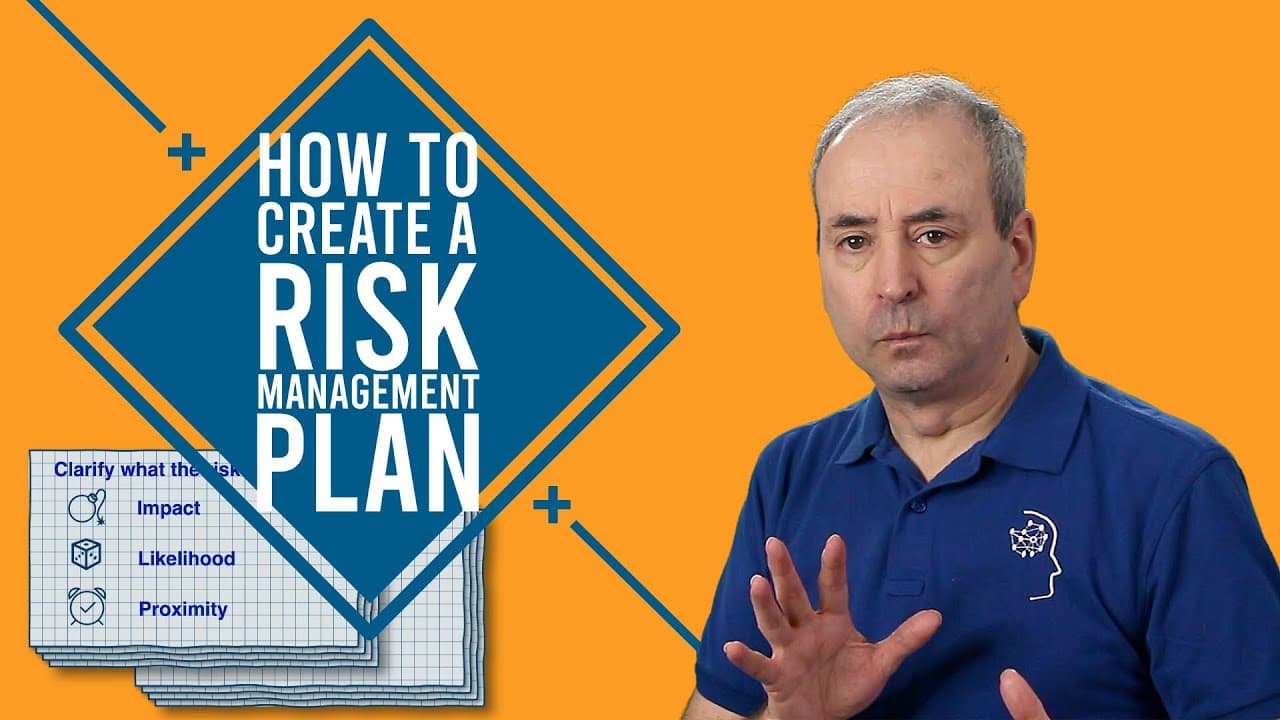
How to Create a Risk Management Plan
TL;DR
Understand and assess the risk, identify the causes and potential sub-risks, determine strategic responses, develop detailed tactics, create an action plan, evaluate residual risk, and document contingency plans.
Transcript
the risk management process is straightforward we identify our risks we understand them and then we put together a plan before taking action but how do we put together a risk management plan the first step in developing a risk management plan is to clarify what the risk is we need to characterize it describe it and evaluate it in terms of its impac... Read More
Key Insights
- ⚾ Characterize and evaluate risks based on impact, likelihood, and proximity.
- 🥺 Understanding root causes and the sequence of events leading to a risk helps design effective interventions.
- ✳️ Breaking risks into sub-risks enables better management and mitigation.
- 🌱 Strategic responses can include eliminating, reducing, transferring, building contingency plans, or accepting risks.
- 📜 Developing detailed tactics involves evaluating options and documenting the approach.
- 😥 Action plans should include actions, timing, responsibilities, resources, budget, and review points.
- 🌱 Assess residual risks and develop contingency plans for any remaining threats.
Install to Summarize YouTube Videos and Get Transcripts
Explore YouTube Video Summarizer or Get YouTube Transcript Extractor
Questions & Answers
Q: How can we clarify and evaluate risks in a risk management plan?
In a risk management plan, we clarify risks by characterizing and describing them, while evaluating them based on their impact, likelihood, and proximity. This helps us understand the severity and urgency of each risk.
Q: Why is it beneficial to split a risk into smaller sub-risks?
Breaking down a risk into smaller sub-risks allows for more focused management and mitigation. Describing risks in a loose manner, like "financial cost overruns," makes it difficult to address the specific causes. Managing individual sub-risks is more manageable and effective in preventing the overall risk.
Q: What are the strategic responses for mitigating risks?
Strategic responses for risk mitigation can include eliminating the risk, reducing its likelihood or impact, transferring the risk, building contingency plans, or accepting the risk and taking no action. Combining multiple strategies may be necessary for handling significant risks.
Q: How can we develop detailed tactics for risk mitigation?
Developing detailed tactics involves evaluating various options for each strategic response and documenting the best approach. This includes determining the actions to be taken, creating a timeline, assigning responsibilities, allocating resources, setting a budget, and establishing review points to monitor progress.
Summary & Key Takeaways
-
The risk management process involves identifying, characterizing, and evaluating risks in terms of their impact, likelihood, and proximity.
-
Understanding the causes and sequence of events that lead to a risk can help design effective interventions.
-
Breaking down risks into smaller sub-risks makes them more manageable, and determining strategic responses helps mitigate risks effectively.
Read in Other Languages (beta)
Share This Summary 📚
Summarize YouTube Videos and Get Video Transcripts with 1-Click
Try YouTube Summary with ChatGPT & Claude or YouTube Transcript Generator
Explore More Summaries from Online PM Courses - Mike Clayton 📚


Summarize YouTube Videos and Get Video Transcripts with 1-Click
Try YouTube Summary with ChatGPT & Claude or YouTube Transcript Generator