Self-folding robots
Transcript
Read and summarize the transcript of this video on Glasp Reader (beta).
Install to Summarize YouTube Videos and Get Transcripts
Explore YouTube Video Summarizer or Get YouTube Transcript Extractor
Summary
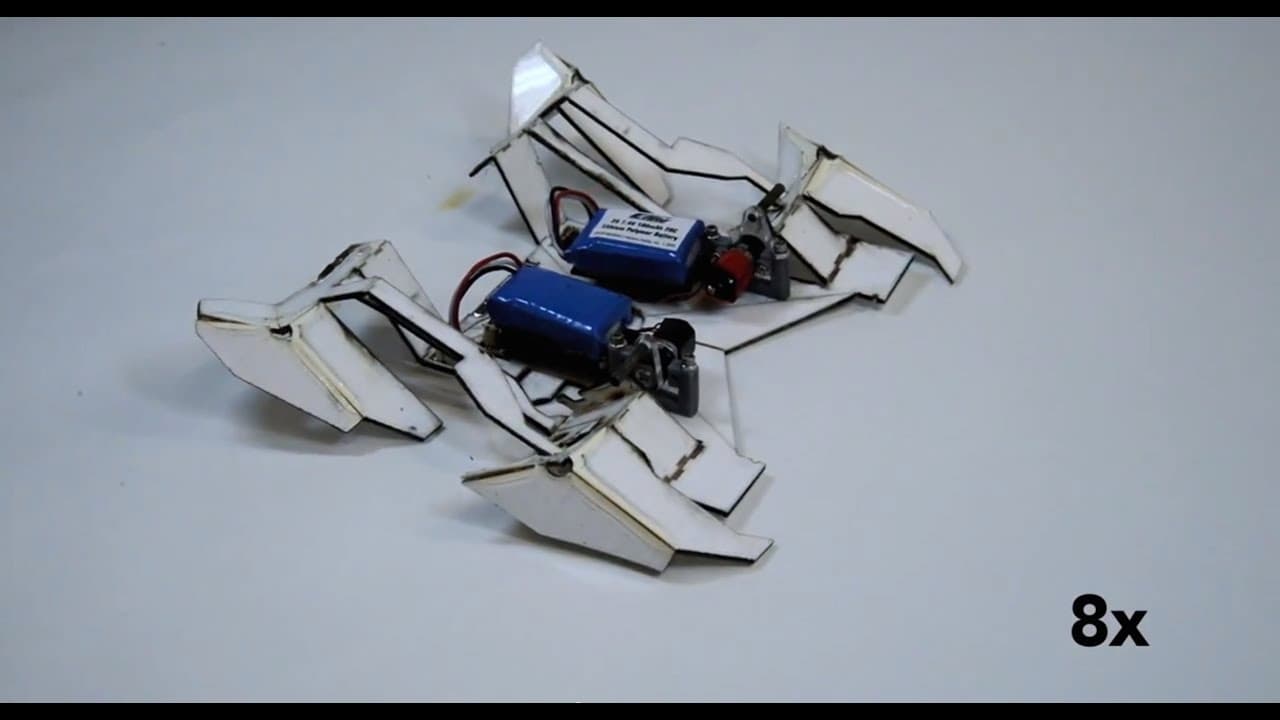
This video discusses the use of origami-inspired folding in manufacturing robots. The goal is to make robots accessible, cheap, and quick to produce. The speaker explores the use of folding in natural systems and how it can be applied to create complex structures. They explain the process of using flexible printed circuit boards and laser machining to create fold patterns. The demonstration shows a self-folding machine that can assemble itself and perform a task.
Questions & Answers
Q: What is the primary challenge addressed in this video?
The primary challenge is manufacturing robots in an accessible, cheap, and quick way.
Q: How does the speaker draw inspiration from origami and natural systems?
The speaker mentions that assembly by folding is not only inspired by origami but also by natural systems such as the unfolding of leaves and insect wings, as well as protein folding.
Q: How does the speaker achieve the folding process using composite materials?
The speaker explains that a flat composite is made using flexible printed circuit boards, which can be made out of paper and polystyrene. The polystyrene is put through a laser machining system to create a fold pattern. The composite is then folded up into a functional machine.
Q: How are the hinges programmed to control the folding process?
The composite is mechanically pre-programmed with features at each hinge, which determine how far to fold along each line.
Q: What support has the work received?
The work is largely supported by the National Science Foundation.
Q: What is the bigger vision behind this work?
The speaker mentions that the bigger vision is to have complex machines that can assemble themselves and perform useful tasks without the need for experts to assemble them.
Q: What is the significance of the demonstrated self-folding machine?
The self-folding machine is significant because it shows that folding can be used to not only assemble a machine but also make it functional. In the case of the demonstration, the machine is able to walk away.
Q: How can this self-folding technology be applied to different problems?
The speaker suggests that self-folding can be applied to various problems, such as deploying machines in harsh or exotic environments like space or battlefields, as well as creating deployable structures for hard-to-reach places.
Q: What is the analogy made to Kinkos in the context of self-folding machines?
The speaker suggests that self-folding machines could do for machines what Kinkos did for home printing. It could make the assembly of machines more accessible and convenient.
Q: What is the key takeaway from the work demonstrated?
The key takeaway is that the work shows that relatively straightforward requirements can be translated into a flat design and a set of assembly recipes. By pressing a button, the structure can then assemble itself and perform a task, such as walking.
Takeaways
The video highlights the use of origami-inspired folding to address the challenge of manufacturing robots in an accessible and efficient way. By using flexible printed circuit boards and laser machining, complex structures can be created through folding. The self-folding demonstration showcases the potential for machines to assemble themselves and perform useful tasks. This technology has applications in various environments and has the potential to make the assembly of machines more convenient and accessible.
Read in Other Languages (beta)
Share This Summary 📚
Summarize YouTube Videos and Get Video Transcripts with 1-Click
Try YouTube Summary with ChatGPT & Claude or YouTube Transcript Generator
Explore More Summaries from Harvard University 📚





Summarize YouTube Videos and Get Video Transcripts with 1-Click
Try YouTube Summary with ChatGPT & Claude or YouTube Transcript Generator