This Jello Simulation Uses Only ~88 Lines of Code
TL;DR
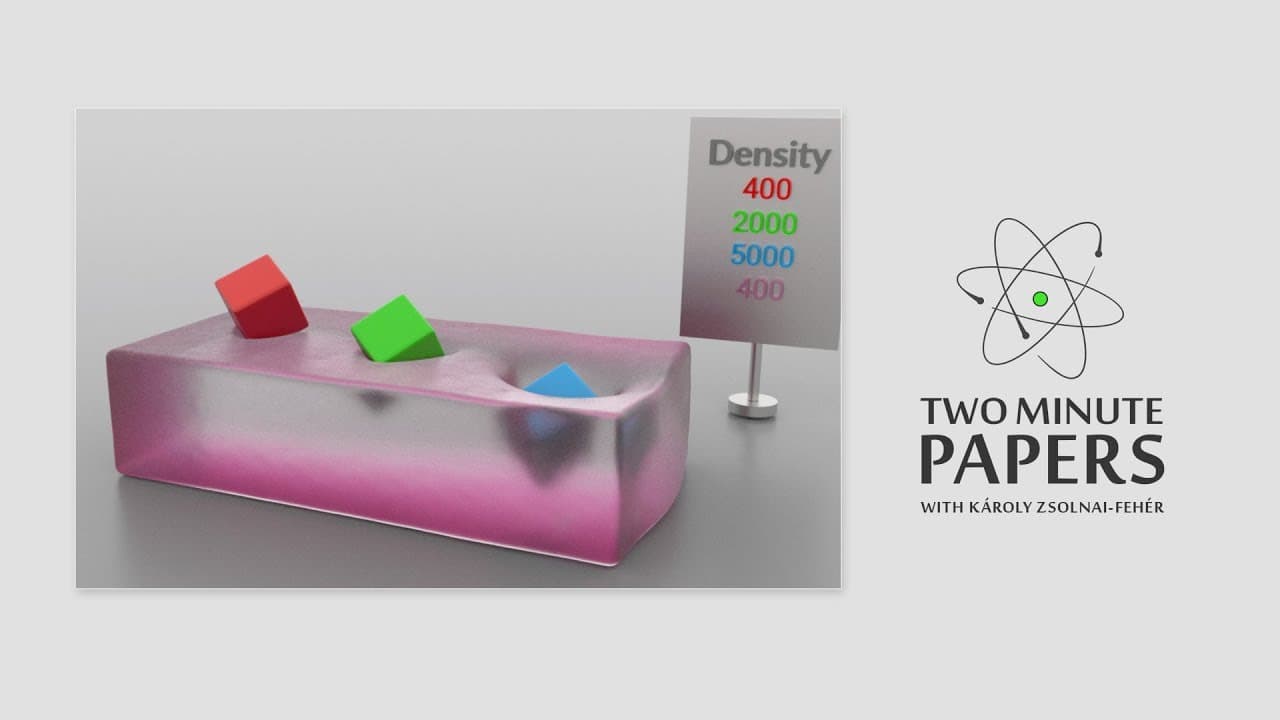
The material point method combines grids and particles to simulate various dynamic phenomena, and this paper presents improvements that make the simulations faster and enable new types of simulations.
Transcript
Dear Fellow Scholars, this is Two Minute Papers with Károly Zsolnai-Fehér. Today we’re going to talk about the material point method. This method uses both grids and particles to simulate the movement of snow, dripping honey, interactions of granular solids and a lot of other really cool phenomena on our computers. This can be used, for instance, i... Read More
Key Insights
- 😥 The material point method combines grids and particles to simulate various dynamic phenomena, providing accurate and realistic results.
- ⌛ This paper introduces advancements that make simulations faster, allowing for real-time or near-real-time applications.
- 🤗 The ability to simulate complex thin boundaries opens up new possibilities for virtual dismemberment or cutting of objects.
- 💨 Two-way coupling enables accurate simulation of interactions between different materials, further enhancing realism.
- 😥 The material point method, while computationally intensive, offers a straightforward implementation process using the Taichi framework.
- 🤖 The simulations produced using this method closely resemble real-life behaviors, as demonstrated in examples with robots and granular mediums.
- 😥 The material point method has significant potential applications in industries such as animation, movie production, and scientific research.
Install to Summarize YouTube Videos and Get Transcripts
Explore YouTube Video Summarizer or Get YouTube Transcript Extractor
Questions & Answers
Q: What is the material point method and how does it work?
The material point method is a simulation technique that combines grids and particles to model dynamic phenomena. It represents objects as a collection of material points and uses a grid to calculate forces and movements.
Q: What are the applications of the material point method?
The material point method can be used in the movie industry to simulate floods or other large-scale dynamic scenes. It is also valuable for studying the behavior of granular materials and simulating complex physical interactions.
Q: What are the key improvements presented in this paper?
This paper introduces two significant improvements to the material point method. Firstly, it allows for the simulation of complex thin boundaries, enabling the cutting of virtual objects. Secondly, it introduces two-way coupling, meaning that the movement of one material affects the behavior of another material.
Q: How is the implementation of this method simplified?
Implementing the material point method is made easier through the use of the Taichi framework. The paper highlights that the essential algorithm can be implemented in just 88 lines of code, making it accessible to researchers and developers.
Summary & Key Takeaways
-
The material point method is used to simulate the movement of snow, dripping honey, and interactions of granular solids.
-
This paper introduces improvements to the technique, allowing simulations to run twice as fast and simulate new phenomena not previously supported.
-
The enhancements include accurate simulation of complex thin boundaries and two-way coupling between different materials.
Read in Other Languages (beta)
Share This Summary 📚
Summarize YouTube Videos and Get Video Transcripts with 1-Click
Try YouTube Summary with ChatGPT & Claude or YouTube Transcript Generator
Explore More Summaries from Two Minute Papers 📚




Summarize YouTube Videos and Get Video Transcripts with 1-Click
Try YouTube Summary with ChatGPT & Claude or YouTube Transcript Generator