Direct variation models | Rational expressions | Algebra II | Khan Academy
TL;DR
The video explains how to solve word problems using direct variation models and graphs.
Transcript
Let's do some word problems that are essentially dealing with slope of a line. You might see these being referred to as direct variation models, because we're going to model what's being described in this problem. We're going to graph it out and then hopefully we're going to be able actually answer their question. Let's see what they're asking. The... Read More
Key Insights
- 📁 Word problems can be solved using direct variation models, which describe the relationship between two variables.
- 🫥 Graphing the direct variation models helps visualize the relationship and provides a visual representation of the line.
- 🫥 The slope of the line in a direct variation model represents the rate of change or constant of variation.
- 📁 Direct variation models can be used to calculate specific quantities or answer questions about the variables involved.
- ❣️ The x-axis in a direct variation model represents the independent variable, while the y-axis represents the dependent variable.
- 🫥 Interpretation of the line graph involves understanding the units of the variables and their relationship.
- 😫 Setting up direct variation models involves identifying the variables, using appropriate equations, and solving for unknowns.
Install to Summarize YouTube Videos and Get Transcripts
Explore YouTube Video Summarizer or Get YouTube Transcript Extractor
Questions & Answers
Q: What is a direct variation model?
A direct variation model is an equation that describes the relationship between two variables, where one variable is a constant multiple of the other. It can be represented in the form y = mx, where m is the constant of variation and x is the independent variable.
Q: How is a line graph related to a direct variation model?
A line graph represents the relationship between two variables in a direct variation model. The slope of the line represents the constant of variation, and the x and y coordinates correspond to the independent and dependent variables, respectively.
Q: How do you solve word problems using direct variation models?
To solve word problems, you need to identify the variables involved and set up a direct variation model that relates them. From the model, you can use equations or graphs to calculate or determine specific quantities.
Q: What does the slope of a line in a direct variation model represent?
The slope of a line in a direct variation model represents the rate of change or the constant of variation. It indicates how the dependent variable changes for each unit increase in the independent variable.
Summary & Key Takeaways
-
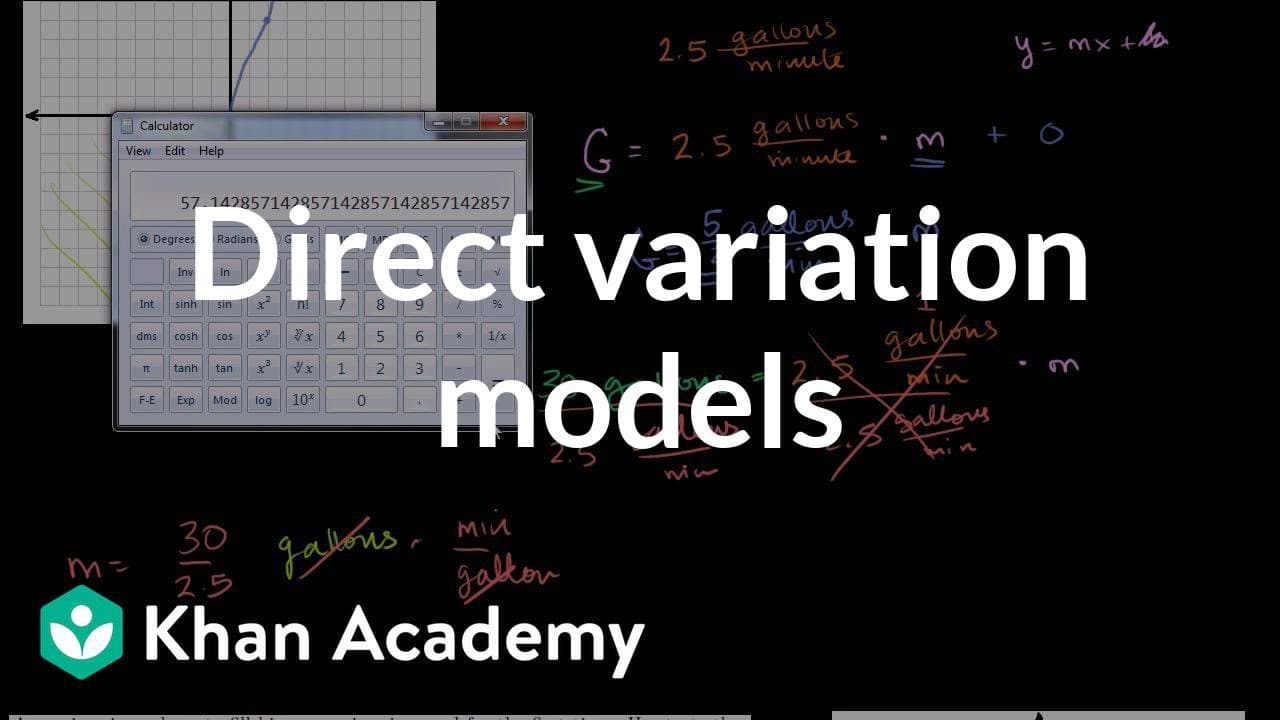
The video discusses how to set up direct variation models to solve word problems involving slopes of lines.
-
It demonstrates how to graph the models and interpret them to answer questions about quantities.
-
Two examples are provided: calculating the time to fill a bathtub using a low-flow showerhead and determining the time it takes for a swimming pool to be completely filled.
Read in Other Languages (beta)
Share This Summary 📚
Summarize YouTube Videos and Get Video Transcripts with 1-Click
Try YouTube Summary with ChatGPT & Claude or YouTube Transcript Generator
Explore More Summaries from Khan Academy 📚



Summarize YouTube Videos and Get Video Transcripts with 1-Click
Try YouTube Summary with ChatGPT & Claude or YouTube Transcript Generator