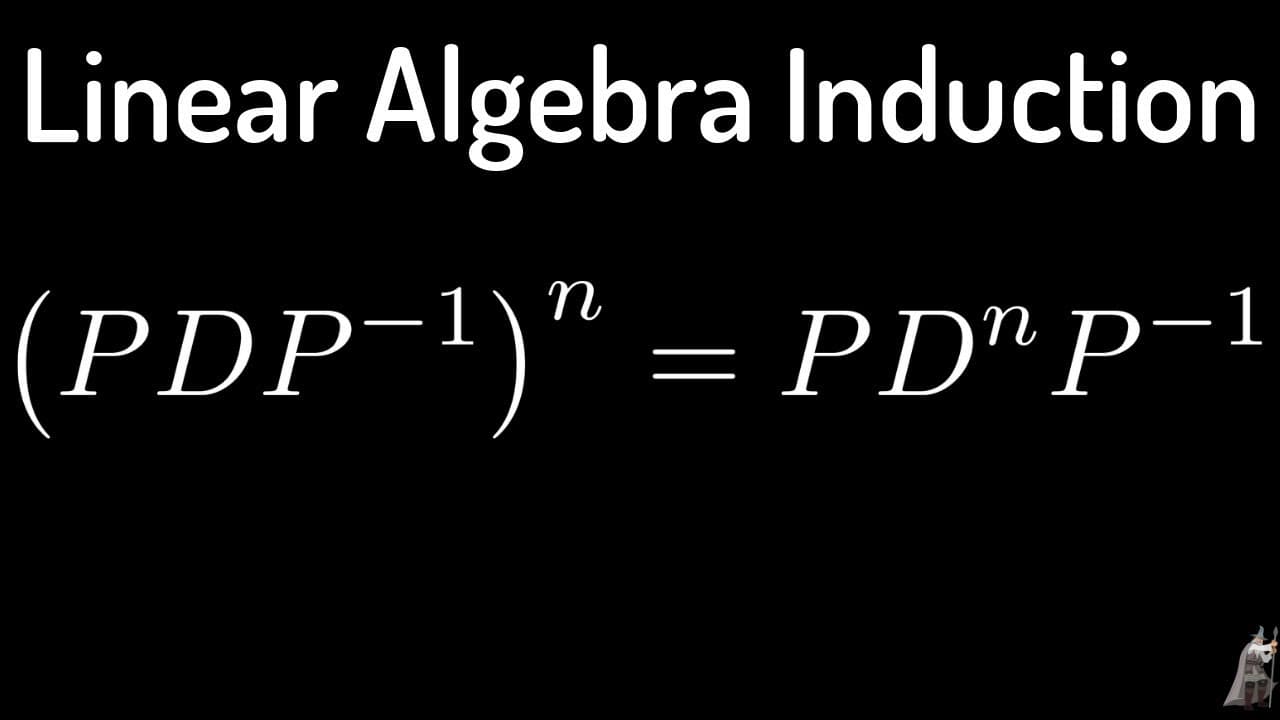
Matrix Powers Induction Proof (PDP^(-1))^n = PD^nP^(-1)
TL;DR
The proof demonstrates that for square matrices P and D, and invertible P, PDP inverse to the N power is equal to P D to the N P inverse.
Transcript
prove P DP inverse to the N power is equal to p d to the n p inverse for every positive integer n so here P and D are square matrices and P is invertible so proof let's go ahead and try this by induction so our statement in all of this will be this one right here and this will be our s subn so first we'll start with the base case and since we're sh... Read More
Key Insights
- ❓ The proof relies on the principle of mathematical induction to establish the equality for all positive integer values of N.
- 😫 The base case is used to set the initial condition for the proof.
- ✋ The induction hypothesis helps extend the proof to the next highest value of N.
- ✖️ The proof utilizes the properties of matrix multiplication and exponents.
- 🥹 The equality holds true due to the invertibility of matrix P.
- 😑 The identity matrix is involved in simplifying the expression.
- 🔝 The proof demonstrates a specific case of matrices P and D, with P being invertible.
Install to Summarize YouTube Videos and Get Transcripts
Explore YouTube Video Summarizer or Get YouTube Transcript Extractor
Questions & Answers
Q: What is the base case of the proof?
The base case of the proof is when N is equal to one. It is shown that PDP inverse to the first power is equal to PDP inverse.
Q: How is the induction hypothesis used in the proof?
The induction hypothesis assumes that the statement is true for some positive integer K. It allows us to consider the case for N equal to K + 1 and build upon the previously established equality.
Q: How is the left-hand side of the equation simplified in the proof?
The left-hand side, PDP inverse to the K + 1 power, is simplified by using the properties of exponents. It is expressed as PDP inverse to the K times PDP inverse to the first power.
Q: What identity property is employed in the proof?
The identity property of matrix multiplication is used in the proof when P inverse multiplied by P results in the identity matrix, which has no effect on the multiplication.
Summary & Key Takeaways
-
The content presents a proof that shows the equality between PDP inverse to the N power and P D to the N P inverse.
-
The base case is established by showing that the statement holds true when N is equal to one.
-
The induction hypothesis is introduced, assuming the truth of the statement for some positive integer K.
-
The induction step demonstrates that the statement remains true for N equal to K + 1, concluding the proof.
Read in Other Languages (beta)
Share This Summary 📚
Summarize YouTube Videos and Get Video Transcripts with 1-Click
Try YouTube Summary with ChatGPT & Claude or YouTube Transcript Generator
Explore More Summaries from The Math Sorcerer 📚


Summarize YouTube Videos and Get Video Transcripts with 1-Click
Try YouTube Summary with ChatGPT & Claude or YouTube Transcript Generator