POS Numerical Based On K map Type 4 | Logic Gates and Combinational Circuits in EXTC Engineering
TL;DR
Learn how to minimize POS expressions using K-Maps with step-by-step numerical examples.
Transcript
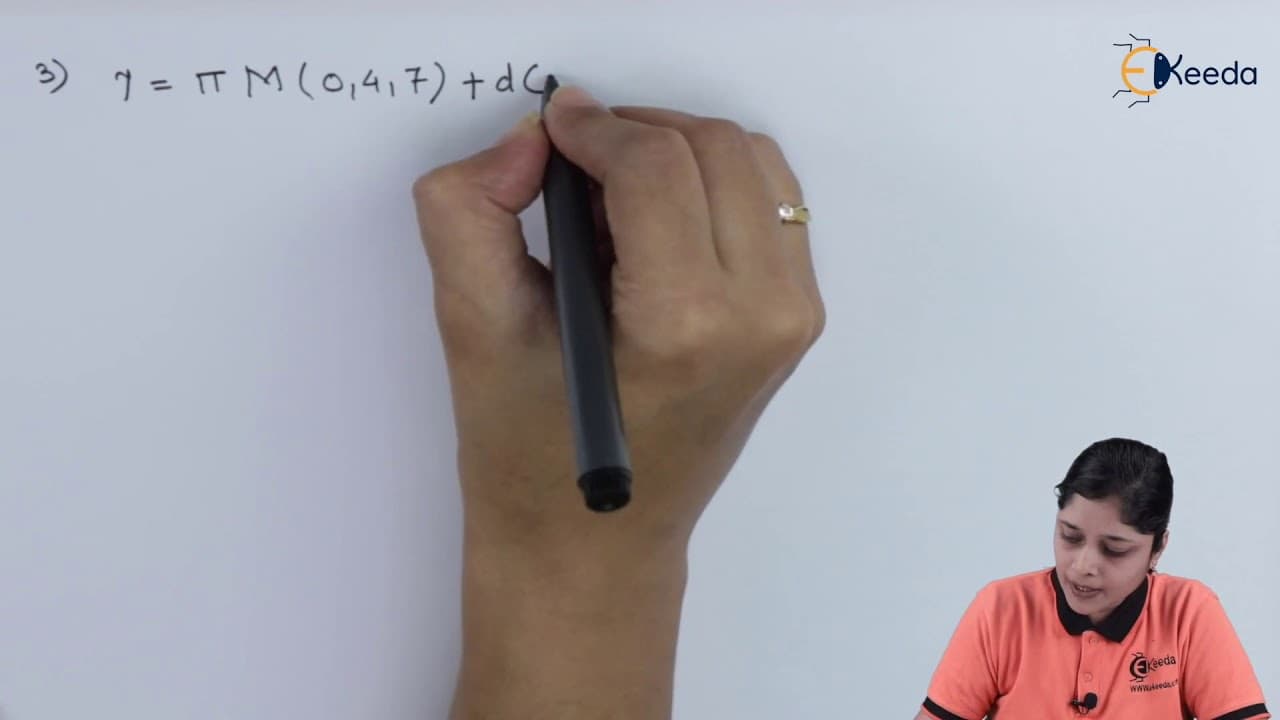
click the bell icon to get latest videos from ekeeda hello friends now we are going to see the numericals based on pos expressions considering the don't care conditions let's start with the first example so your first example is y is equals to product of max terms 1 3 5 6 13 plus d inside the bracket 9 comma 14 and your aim is to what draw k map an... Read More
Key Insights
- 😑 K-Maps provide an effective method for minimizing POS expressions.
- 😨 Don't care conditions allow for additional simplification in the grouping process.
- 😑 Grouping zeros helps reduce the number of terms in the final expression.
- 😨 The minimized equation is derived from the grouped terms while considering don't care conditions.
- 😑 A 4-variable K-Map is suitable for expressions with up to 15 max terms, while a 3-variable K-Map is used for expressions with up to 7 max terms.
- 👥 The grouping procedure involves searching for groups of zeros of powers of 2 (8, 4, 2), excluding groups already covered by higher power groups.
- 👥 The minimized equation should be written with logic operators (AND, OR, NOT) and the variables involved in the grouped terms.
Install to Summarize YouTube Videos and Get Transcripts
Explore YouTube Video Summarizer or Get YouTube Transcript Extractor
Questions & Answers
Q: What is the purpose of using K-Maps in minimizing POS expressions?
K-Maps provide a visual representation of the expression, allowing us to simplify it by grouping zeros and covering all ones, while considering don't care conditions.
Q: How are don't care conditions represented in a K-Map?
Don't care conditions are denoted by a cross sign in the corresponding cells of the K-Map.
Q: How do we group zeros in a K-Map?
Zeros are grouped by forming rectangles around sets of zeros, where each rectangle should contain a power of 2 number of zeros (1, 2, 4, 8, etc.).
Q: Do don't care conditions affect the grouping process?
Don't care conditions can be used to form groups of zeros even if the number of zeros is not a power of 2, enhancing the grouping process.
Q: What are the steps involved in minimizing a POS expression using a K-Map?
The steps include drawing the K-Map, marking max terms and don't care conditions, grouping zeros, and obtaining the minimized equation using the grouped terms.
Summary & Key Takeaways
-
The video demonstrates how to minimize POS expressions using K-Maps with the consideration of don't care conditions.
-
The first example involves drawing a 4-variable K-Map, marking max terms and don't care conditions, and grouping zeros to obtain the minimized equation.
-
The second example follows a similar process with a 4-variable K-Map, showcasing the grouping procedure with max terms and don't care conditions.
-
The third and fourth examples show the minimization process using 3-variable and 4-variable K-Maps, respectively, while considering max terms and don't care conditions.
Read in Other Languages (beta)
Share This Summary 📚
Summarize YouTube Videos and Get Video Transcripts with 1-Click
Try YouTube Summary with ChatGPT & Claude or YouTube Transcript Generator
Explore More Summaries from Ekeeda 📚




Summarize YouTube Videos and Get Video Transcripts with 1-Click
Try YouTube Summary with ChatGPT & Claude or YouTube Transcript Generator